Traditional cleaning often means draining a tank, sending workers inside, and shutting down production for days or weeks. Confined space entry under OSHA 29 CFR 1910.146 brings permits, atmospheric testing, and rescue planning. Get any part of that wrong, and the consequences are severe.
This guide breaks down the equipment types available, the criteria that should drive your selection, and how robotic no-entry systems are changing what's possible for facility owners.
Key Takeaways
- Equipment options include vacuum trucks, centrifuges, high-pressure jetting, and zero-entry robotic crawlers
- Match the method to sludge type, tank access, viscosity, and tolerance for downtime or human entry
- Traditional entry-based methods trigger OSHA 1910.146 permit requirements and confined space hazards
- Robotic systems like Bristola's eliminate both downtime and human entry during cleaning cycles
Types of Tank Cleaning and Sludge Removal Equipment
Tank cleaning gear falls into a few practical groups: extraction, fluidizing, separation/dewatering, and zero-human-entry robotics. Matching the tool to sludge type, tank access, and whether the vessel can stay online drives cost, safety, and downtime.
Vacuum Trucks and Industrial Sludge Vacuums
Vacuum trucks use negative pressure to pull loosened sludge into a mounted tank, keeping thick material out of the vacuum pump itself. Industrial units like the GapVax HV-57 handle roughly 17 cubic yards of usable debris with cyclone and baghouse filtration for spill cleanup and waste processing.
Safety features to look for:
- Overflow shutdown sensors
- Belt guards on rotating components
- Cyclone/baghouse filtration for airborne particulates

High-Pressure Jetting and Manway Cannons
These systems liquefy hardened sludge without requiring full tank entry. KOS Automated Solutions manway cannons deliver up to 740 psi and 280 gpm, with 180-degree movement and an effective range of 150 feet through a 12-inch flange.
Centrifuges: Two-Phase and Three-Phase
Once sludge is extracted, centrifuges separate it into usable components:
- Two-phase decanters separate solids from liquid, common for municipal and industrial wastewater sludge
- Three-phase decanters handle solid-liquid-liquid separation, splitting oil, water, and solids
Remote-Operated Crawlers and Submersible Pumps
Remote crude-oil tank crawlers can operate in tanks up to 360 feet in diameter, fluidizing deep sludge and directing it toward a hydraulic pump, all while entering through a 24-inch manway rather than requiring full-body entry.
Robotic Zero-Human-Entry Systems
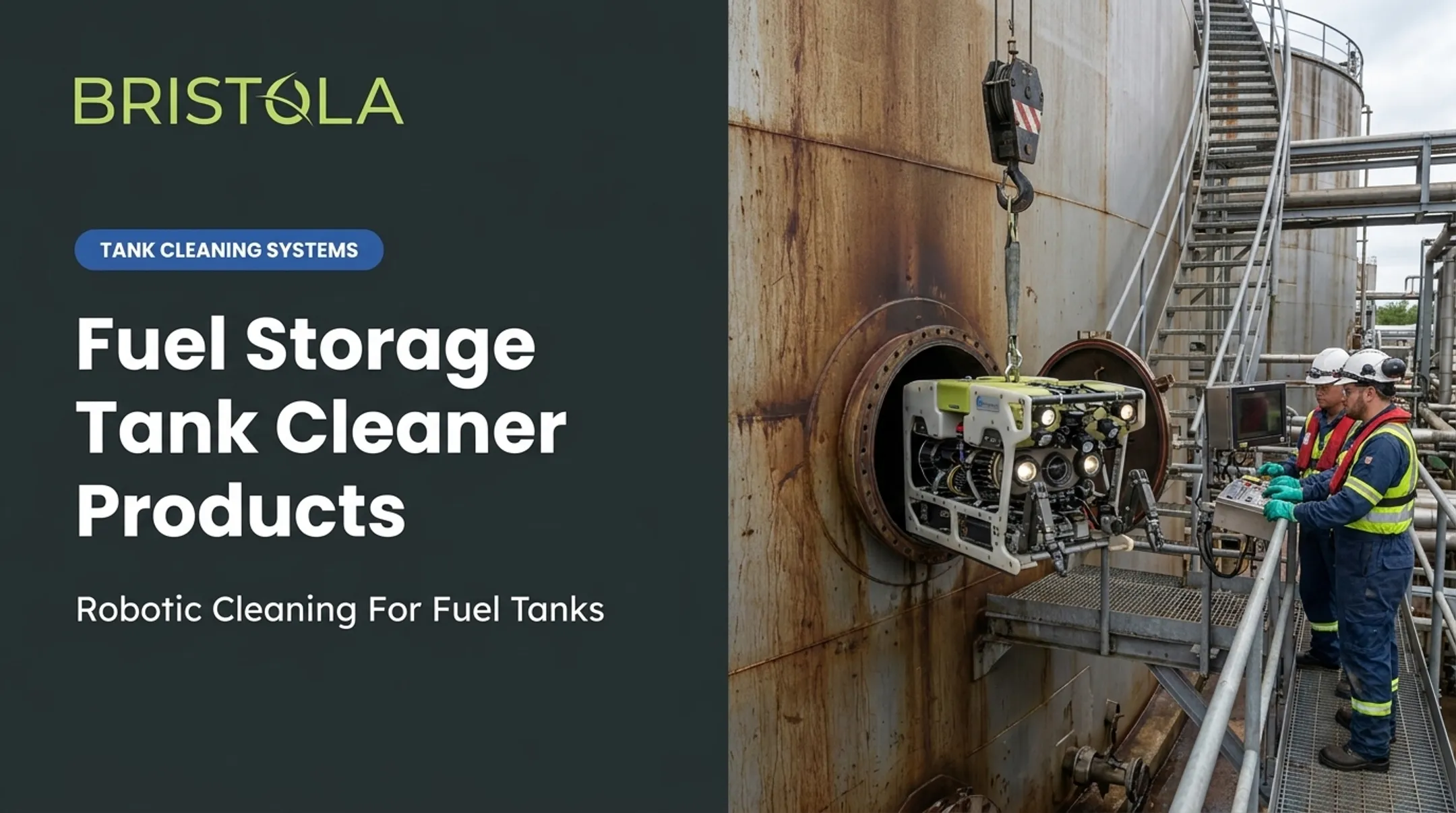
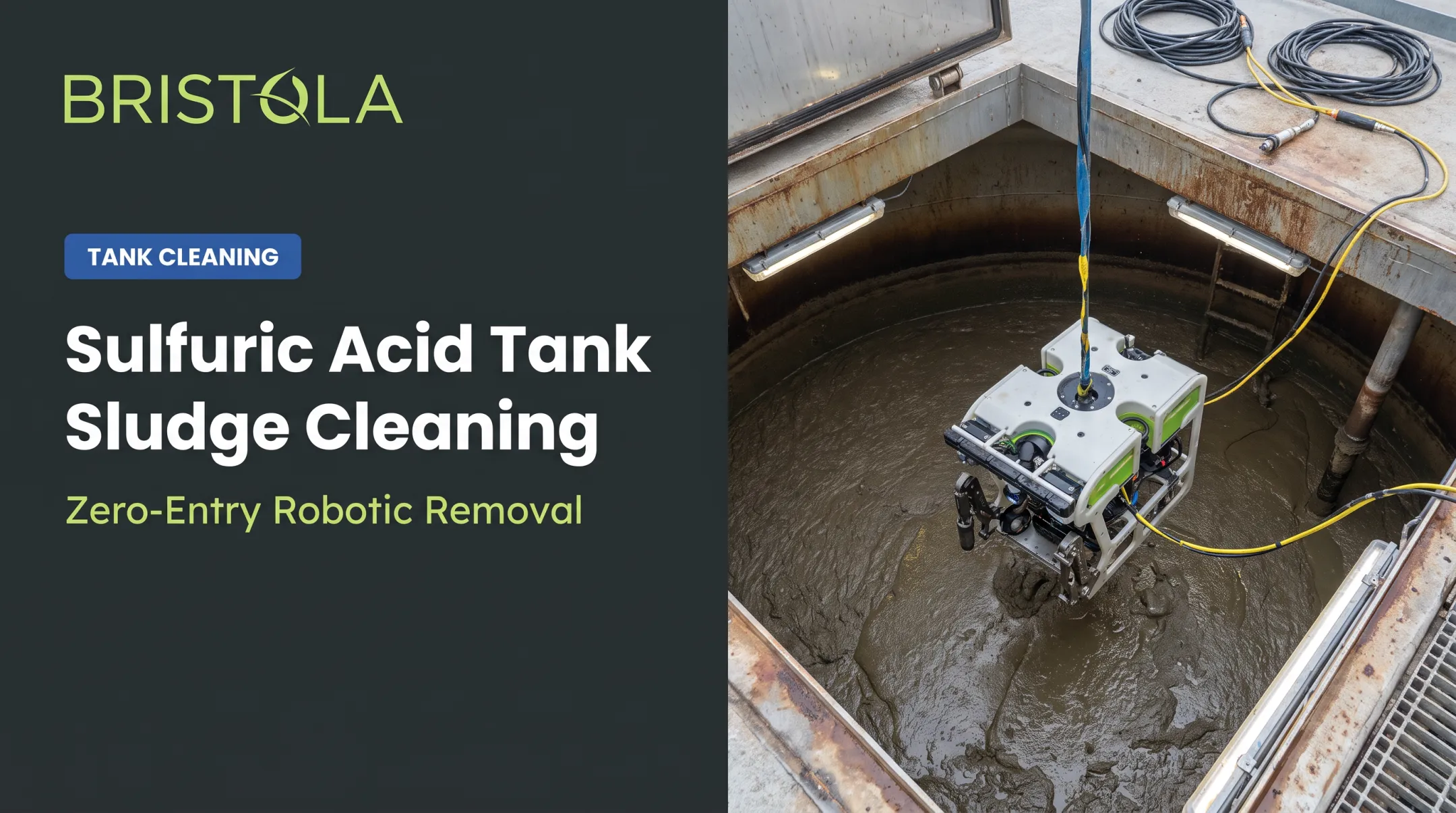
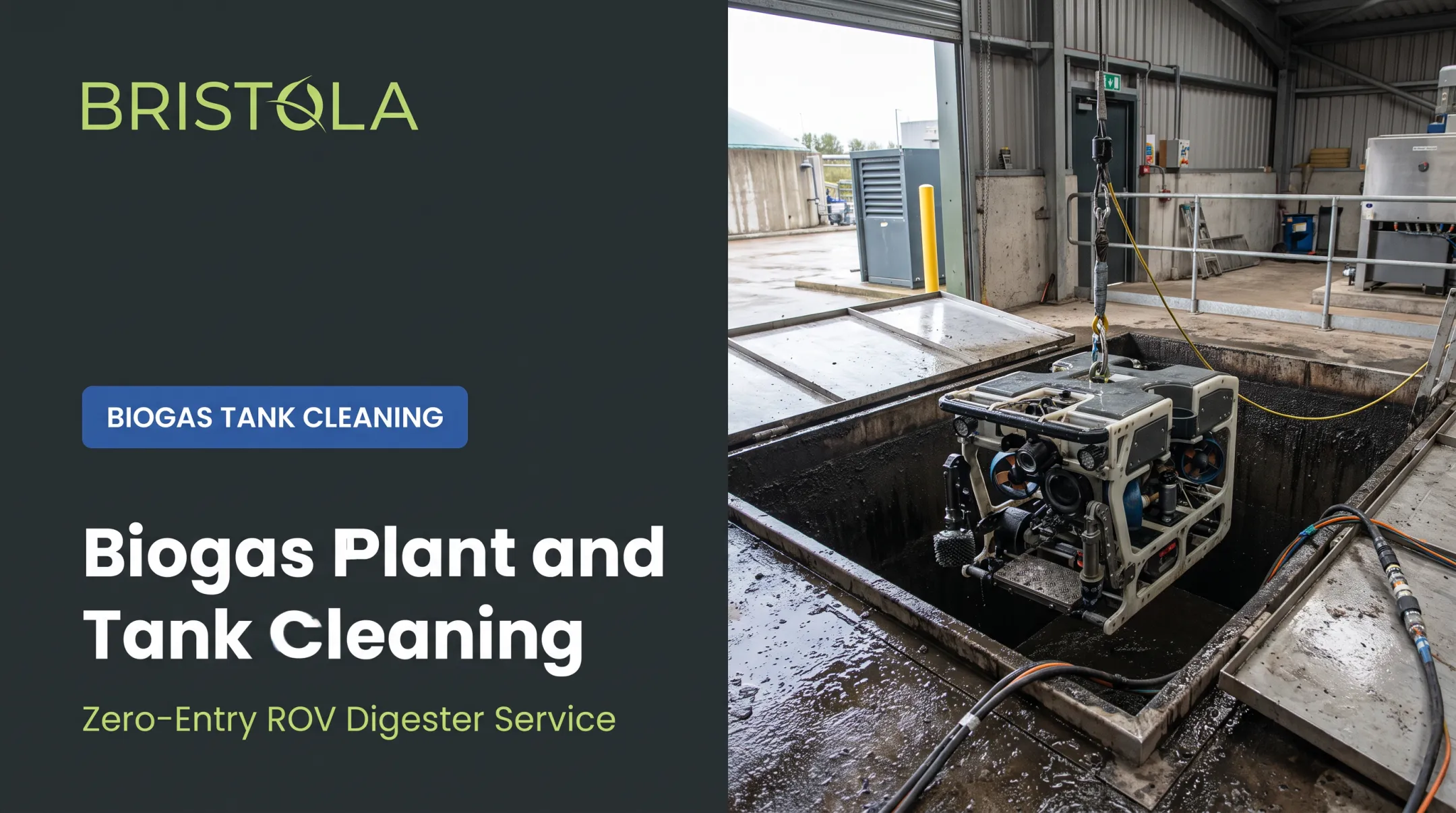
Zero-human-entry robotics remove the need to drain the tank or send people inside. Bristola's Submersible Robotic Cleaning System uses a patented equalization chamber entry port (an airlock-style portal) installed through the tank roof or an existing manhole of 24 inches or greater.
The robot deploys via winch, navigates using sonar (essential in tanks where visibility is zero), and cleans while the tank stays full and in active production. No draining. No confined space entry. No production halt.
The system also captures and reports facility condition and performance data throughout the cleaning cycle, giving operators visibility they wouldn't otherwise have.

Filter Presses and Dewatering Systems
Belt filter presses squeeze water from sludge between porous belts, typically achieving 15-25% dry solids for municipal sludge. Recessed-plate filter presses use higher pressure (100-225 psi) to press slurry into dewatered cake, with capacities ranging from 0.5 to 600 cubic feet depending on the unit.
Key Features and Selection Criteria
Choosing equipment starts with matching it to your material and access constraints.
Match equipment to sludge type:
- Organic/biological sludge responds well to high-pressure agitation
- Hydrocarbon sludge often needs chemical emulsification first
- Inorganic sediment may require mechanical crawlers or abrasion-resistant pumps
Evaluate tank access configuration. Manway size, covered lagoon design, and sealed digester specs all determine whether equipment can physically reach the tank floor. A crawler rated for a 24-inch manway won't help if your access point is smaller. Verify entry method and manway compatibility before you commit.
Consider automation and remote monitoring. Systems that cut human entry often produce performance data you can use for maintenance planning and audit trails.
Factor in downtime costs. GapVax lists industrial equipment price bands from $200,000 to $700,000+ depending on capacity and features, but capital cost is only part of the equation. If the method requires draining and shutdown, lost production often outweighs the equipment cost. Prefer options that clean while the tank stays in service—zero-entry robotic systems remove that tradeoff without a full drain-down.
Prioritize corrosion-resistant, explosion-proof design for flammable or hazardous sludge. Under OSHA 1910.307, electrical equipment in hazardous locations must be intrinsically safe and specifically approved for that classification, not assumed safe by default.
Traditional Cleaning vs. Robotic No-Entry Systems
| Method | Requires Entry | Downtime | Best Use Case |
|---|---|---|---|
| Manual confined space entry | Yes | Full shutdown, days-weeks | Small tanks, no access barrier |
| Chemical emulsification + pump-out | Partial/none | Moderate | Hydrocarbon sludge, viscous material |
| Robotic no-entry systems | No | Minimal to none | Active tanks, digesters, hazardous contents |

The OSHA Compliance Burden
Any equipment requiring human entry triggers permit-required confined space rules. Employers must run a written program that covers:
- Hazard evaluation and atmospheric testing order (oxygen, then combustibles, then toxins)
- Ventilation and rescue procedures
- Permits that document entrants, attendants, and acceptable conditions
Canceled permits stay on file for at least one year.
That documentation exists because the stakes are real. Between 2011 and 2018, the Bureau of Labor Statistics recorded 1,030 worker deaths involving confined spaces. Tanks with hardened sludge, trapped gases, or oxygen displacement are exactly the environments this data describes.
What No-Entry Systems Change
Bristola's robotic system eliminates human entry entirely, using the equalization chamber to deploy the ROV while the tank remains sealed, full, and operational. It can be retrofitted onto existing tanks or built into new facilities from day one.
An early industry example from Oil & Gas Journal documented a refinery removing sludge without taking the tank offline, completing the job in roughly one-third the time of conventional cleaning.
On cost, one Bristola project example shows a $150,000 initial tank modification plus a $150,000 annual subscription, versus $300,000 for first-time traditional cleaning. Annualized, that works out to roughly $170,000 versus $250,000, or about $80,000 in yearly savings per tank.

Results vary by facility, but the pattern holds: continuous no-entry maintenance tends to beat repeated five-year drain-and-clean cycles once downtime is factored in.
Maintenance and Safety Best Practices
Regardless of equipment type, a few habits separate facilities that stay ahead of sludge from those constantly playing catch-up.
Inspect routinely:
- Check hoses and nozzles for wear or blockage
- Examine seals and gaskets for degradation
- Monitor filters and collection containers against capacity limits
Test atmosphere before human entry: Oxygen first, then combustible gases, then toxic contaminants — in that exact order, using calibrated direct-reading instruments. Hydrogen sulfide alone carries a NIOSH ceiling of 10 ppm and becomes immediately dangerous to life at 100 ppm.
Favor scheduled cleaning over reactive cleaning: Sludge that sits too long hardens, and hardened layers take longer and cost more to remove. Preventive cycles, whether jetting, vacuum extraction, or continuous robotic maintenance, keep material manageable instead of letting it compound.
Frequently Asked Questions
What type of pump is best for handling sludge?
Submersible slurry pumps handle abrasive, muddy sludge when run directly in the liquid. Diaphragm pumps self-prime and manage high solids or variable viscosity—choose based on abrasiveness and solids content.
What is the most effective way to remove sludge from a tank without emptying it?
Robotic submersible systems, like Bristola's zero-entry ROV, are built specifically to clean while tanks stay full and in production, avoiding drainage entirely.
How often should industrial tanks be cleaned to prevent sludge buildup?
Frequency depends on tank use and solids loading. API 653 governs petroleum storage tank inspection but doesn't mandate a fixed cleaning interval — base your schedule on operational performance indicators instead.
Is manual tank sludge removal dangerous?
Yes. It qualifies as confined space work under OSHA regulations, with real risks from hydrogen sulfide exposure and oxygen deficiency below 19.5%.
What determines the cost of tank cleaning equipment?
Tank size, sludge type, automation level, and compliance or certification requirements are the primary cost drivers, alongside whether installation is a retrofit or a new build.
Can sludge removal equipment handle both oil-based and organic sludge?
Not with the same approach. Hydrocarbon sludge typically needs chemical emulsification, while organic sludge responds better to high-pressure agitation. Match the equipment to the material.