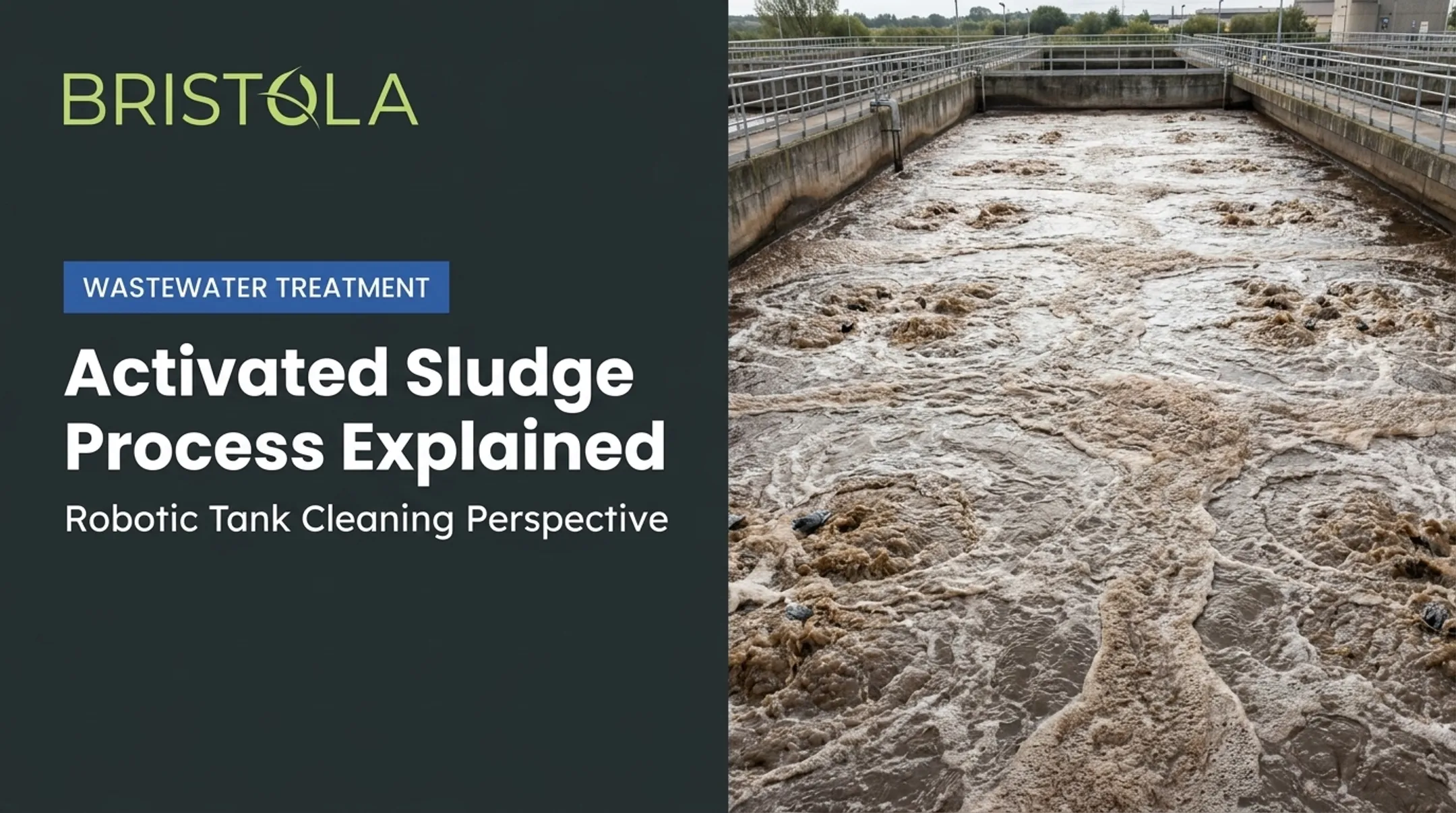
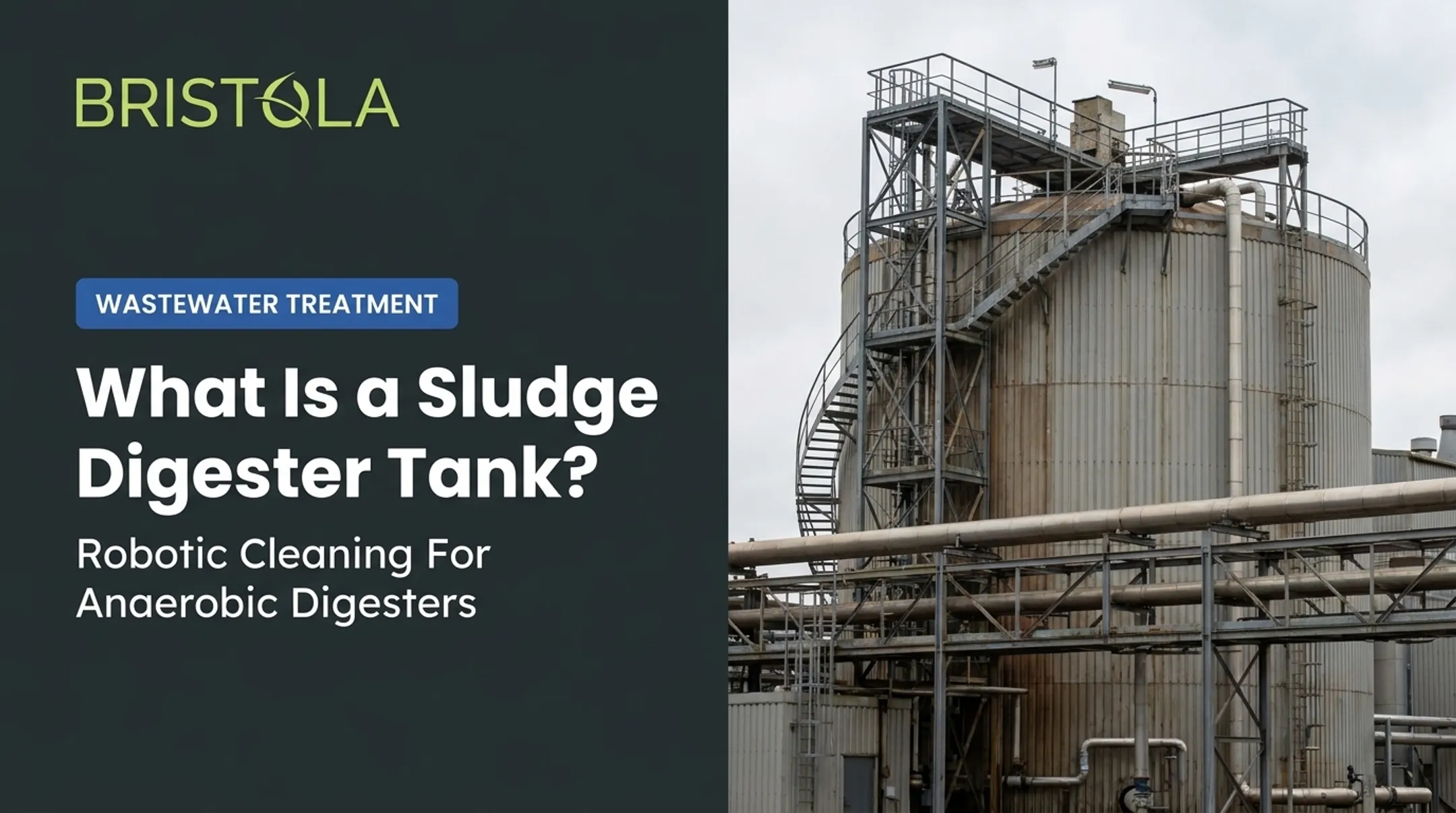
This article covers how settling tanks work, the main types you'll encounter, common problems that hurt performance, and what modern maintenance approaches look like.
Key Takeaways
- Settling tanks use gravity separation to remove solids before secondary treatment
- Short-circuiting, sludge bulking, and scum buildup are the top performance killers
- Settling velocity depends on hydraulic loading, temperature, and particle size
- Zero-human-entry robotic cleaning removes downtime and confined-space safety risks
What Is a Sludge Settling Tank?
A sludge settling tank is a gravity-based basin that separates solids from liquid in the wastewater stream. It works by slowing the flow far below sewer velocity, giving heavier particles time to sink and lighter material time to rise.
These tanks typically sit right after screening and grit removal, and before secondary or advanced treatment begins. The same equipment goes by several names, depending on its place in the treatment train:
- Clarifier
- Sedimentation tank
- Primary or secondary settling tank
A clarifier is a full system, not an empty basin. Core parts include:
- Inlet structures
- Sludge-collecting mechanisms
- Skimmers and weirs
- Sludge draw-off setup
The core performance metric operators watch is surface hydraulic loading — flow divided by basin surface area.

How Sludge Settling Tanks Work
Flow Entry and Distribution
Wastewater enters through baffled inlets designed to spread flow evenly across the tank. Poor inlet design causes short-circuiting, where water travels directly from inlet to outlet without adequate settling time.
Common short-circuiting culprits include:
- High inlet velocity
- Uneven outlet weir rates
- Inlet and outlet placed too close together
- Wind effects on open tanks
- Temperature-driven density currents
Sedimentation and Settling Velocity
Once flow calms inside the tank, gravity takes over. Heavier solids sink to the bottom while oils and scum float to the surface. How fast particles settle depends on their size, density, and shape, the basic relationship behind Stokes' Law.
Settling velocity isn't a fixed number you can plug into every tank. It changes with:
- Suspension density and viscosity
- Water temperature (warmer water settles solids faster, up to a point)
- Whether particles are discrete, flocculent, or in a hindered-settling zone
Detention Time and Solids Removal
Detention time (how long wastewater stays in the tank) directly determines how much solids removal you get. Too little retention and solids simply pass through with the clarified effluent.
Mechanical scrapers move settled sludge toward hoppers for removal, while surface skimmers handle floating scum. Clarified water exits the tank and moves on to secondary treatment or discharge.

Types of Sludge Settling Tanks
Settling tank design shapes how solids separate, how sludge is collected, and how much footprint the process needs. Common configurations include:
| Type | How it works | Best for |
|---|---|---|
| Rectangular | Horizontal flow, end-to-end travel, mechanical scrapers | Sites needing simpler construction and multiple parallel bays |
| Circular | Radial flow, central sludge hopper | Facilities with variable flow conditions |
| Primary clarifier | Removes raw solids before biological treatment | Every treatment train, ahead of secondary stages |
| Secondary clarifier | Separates biological floc after treatment | Sizing tied directly to the biological process it serves |
| Inclined plate/lamella | Angled plates increase settling surface in less footprint | Space-constrained sites |
| Imhoff tank | Combines sedimentation and sludge digestion in one unit | Small or decentralized systems |
A 2015 peer-reviewed study found inclined plate settlers did not necessarily outperform conventional tanks on suspended-solids removal. Unequal flow through the plate slots was a real design risk. A smaller footprint only helps when hydraulic distribution is sound.

Factors That Influence Settling Tank Efficiency
Several variables interact to determine how well a tank actually performs:
- Flow rate and hydraulic loading: slower flow improves settling; overloading shortens detention time and lets solids escape
- Temperature and viscosity: warmer wastewater settles faster because it is less viscous; activated sludge can slow as temperatures drop
- Particle characteristics: size, density, and shape all change settling speed
- Tank design and geometry: proper depth and shape reduce turbulence and eliminate dead zones where solids collect
None of these factors work in isolation. A tank with great geometry can still underperform if it's hydraulically overloaded, and vice versa.
Common Challenges in Sludge Settling Tanks
Sludge Accumulation and Bulking
Bulking sludge shows up as a homogeneous blanket extending through the clarifier, sometimes spilling over the effluent weirs. It's usually tied to operational issues, not just shock loading.
Common fixes include:
- Adjusting wasting rates
- Balancing return-sludge flow
- Tuning aeration levels
Scum, Odor, and Gas Buildup
Floating sludge and scum often trace back to denitrification gases, trapped oils, or aging biomass. Left unmanaged, accumulated solids decompose anaerobically, generating odor and hydrogen sulfide.
Infrequent solids withdrawal is one of the biggest drivers of septic conditions in a settling tank. Those same solids also make routine cleaning harder and riskier over time.
The Cleaning Problem
Those conditions are why traditional maintenance gets expensive fast. Conventional cleaning usually means:
- Draining the tank completely
- Arranging temporary storage for the material generated
- Sending workers into a confined space to clean manually
That confined-space entry isn't a minor formality. OSHA classifies tanks like this as permit-required confined spaces when they involve engulfment risk, limited entry/exit, or other serious hazards — requiring atmospheric testing, attendants, and rescue planning before anyone goes in.
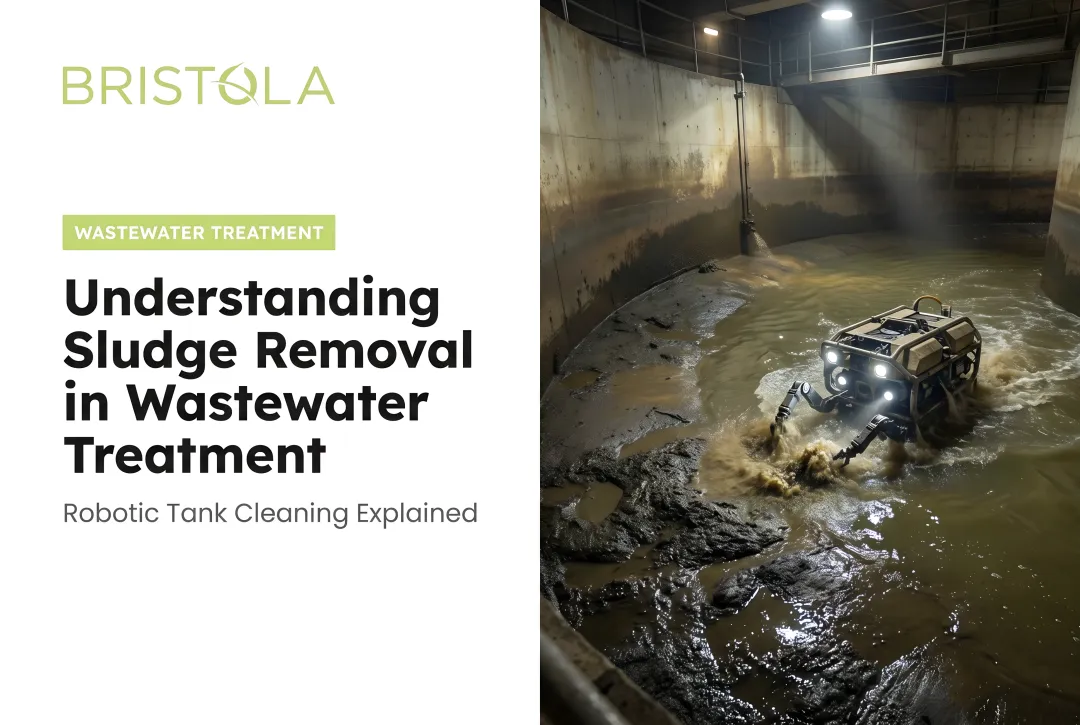
Bristola's Submersible Robotic Cleaning System is built for this scenario. Instead of draining the tank and sending crews inside, a remote-controlled ROV enters through a patented equalization-chamber portal that fits manholes 24 inches or larger in the existing roof or cover.
A winch lowers the ROV to the tank floor, where it removes accumulated sludge and transfers it through a flexible hose to a designated processing point. Sonar navigation supports real-time monitoring throughout.
Because the tank stays full and operational, facilities avoid the shutdown, temporary storage, and confined-space exposure that come with conventional cleanouts.

Best Practices to Improve Sludge Settling
Fix hydraulics before chemistry. Check baffle placement, weir condition, and flow distribution across parallel units first. Most settling problems trace back to uneven flow, not insufficient tank capacity.
Use flocculants selectively. Coagulants and polymers can improve particle aggregation and settling speed, but overdosing can restabilize solids and make them harder to settle. Jar testing before full-scale dosing is worth the time.
Base desludging on sludge blanket levels, not a calendar. Routine monitoring beats fixed schedules. Bristola's robotic system evaluates, stores, and reports facility condition data during cleaning, so managers can time maintenance instead of guessing.
Consider retrofitting for higher throughput. Advanced settlers or automated cleaning systems can boost capacity without expanding your tank footprint. Bristola's entry system installs onto existing manholes for this kind of retrofit, with no new construction or shutdown required for setup.
Frequently Asked Questions
What is the purpose of a settling tank?
A settling tank separates solids from wastewater using gravity, reducing the organic and solids load before the water moves into further treatment stages. It's one of the first major treatment steps after screening and grit removal.
How can I improve sludge settling?
Optimize flow distribution with baffles, use flocculants where appropriate, and maintain sufficient retention time. Desludge based on actual sludge blanket levels rather than a fixed calendar.
What is the ideal settling velocity for a sedimentation tank?
There's no single universal number. Settling velocity depends on particle size, density, and shape, and is estimated using Stokes' Law principles. The real value varies by wastewater characteristics and should be tested on-site.
How often should a sludge settling tank be cleaned?
Cleaning frequency depends on how fast sludge accumulates, often ranging from monthly to quarterly. Continuous monitoring and in-service cleaning technology can reduce reliance on fixed shutdown schedules.
Can settling tanks be cleaned without stopping operations?
Yes. Zero-human-entry robotic systems, such as Bristola's Submersible Robotic Cleaning System, clean tanks while they stay full and in production. Traditional methods require draining the tank and sending workers inside.