Unlike aerobic systems, anaerobic treatment doesn't need constant air pumped through the tank. That alone changes the energy math. It also produces methane-rich gas that facilities can burn for heat or electricity instead of buying it.
This article covers how anaerobic treatment actually works, the main system types in use today, the real benefits and trade-offs, and what it takes to keep a digester performing at full capacity year after year.
Key Takeaways
- Anaerobic treatment breaks down organics without oxygen, producing biogas and cutting sludge volume
- Best suited for high-strength wastewater (COD above 4,000 mg/L), common in food, beverage, and industrial processing
- Main system types: UASB, EGSB, CSTR, anaerobic lagoons, and covered digesters
- Sludge and sediment buildup gradually reduce biogas output, making regular tank maintenance essential
- Most anaerobic systems still need aerobic post-treatment to meet nitrogen and phosphorus discharge limits
What Is Anaerobic Wastewater Treatment and How Does It Work?
Anaerobic treatment relies on microorganisms working in a sealed, oxygen-free tank to convert organic matter into methane and carbon dioxide. The process happens in four connected stages:
- Hydrolysis — complex organic polymers break down into simpler soluble compounds
- Acidogenesis — those compounds convert into volatile fatty acids
- Acetogenesis — fatty acids convert further into acetate, hydrogen, and CO2
- Methanogenesis — methanogens convert the acetate and hydrogen into methane

A disruption at any one stage shows up downstream, usually as acid buildup and stressed methanogens. That's why operators monitor the process as one linked system rather than four separate steps.
Operating Conditions That Keep the Biology Stable
Stable biology depends on a tight operating window. Key targets include:
- Temperature: mesophilic (30–38°C) or thermophilic (50–57°C)
- pH: held between 6.8 and 7.5 for stable microbial activity
- Supporting factors: alkalinity and retention time, which interact with temperature and pH
Hitting one number in isolation is not enough—the variables move together.
When those conditions hold, removal performance still varies with feed strength and system design. In one documented full-scale UASB plant, the reactor alone achieved 91.3% BOD removal, and the complete treatment train reached 93% COD and 98% BOD removal after post-treatment.
Anaerobic systems strip organic load well, but they do almost nothing for nitrogen and phosphorus. Facilities facing nutrient limits in their discharge permit still need a polishing step downstream, no matter how strong the anaerobic stage performs.
Common Types of Anaerobic Wastewater Treatment Systems
Four reactor designs cover most industrial and municipal anaerobic treatment needs. The right choice depends on organic loading, available footprint, and how much process control you need.
Upflow Anaerobic Sludge Blanket (UASB) Reactors
Wastewater enters at the bottom and flows upward through a dense blanket of granular sludge, where microorganisms digest organics as the water passes through. UASB reactors are a go-to choice for food and beverage processing, and pulp and paper mills, handling loading rates of roughly 5-15 kg COD/m³/day.
Expanded Granular Sludge Bed (EGSB) Systems
EGSB reactors push wastewater through the sludge bed at a higher upflow velocity, intensifying contact between microbes and organic matter. This allows loading rates of 10-20 kg COD/m³/day in standard designs, with some full-scale systems reaching 25-35 kg COD/m³/day. EGSB systems handle higher hydraulic loads than UASB, so they suit facilities that need more throughput in a smaller footprint.
Continuous Stirred Tank Reactors (CSTRs)
CSTRs mix and heat wastewater continuously, which is why they remain a common choice for municipal sludge digestion. Steady mixing also helps them handle variable waste streams. Unlike UASB and EGSB systems, they do not depend on sludge granulation, so composition swings pose less operational risk.
Anaerobic Lagoons and Covered Digesters
Common in agricultural and industrial settings with available land, anaerobic lagoons typically run 8–20 feet (2.4–6.0 m) deep, with retention times from 1 to 50 days depending on loading. Covering the lagoon captures methane for beneficial use rather than letting it escape. Covered digesters generally need a minimum 17-day retention time for complete-mix designs, per NRCS guidance.

Key Benefits of Anaerobic Wastewater Treatment
Energy savings top the list. Aerobic treatment needs continuous aeration to keep oxygen levels up, which is one of the biggest electricity draws in a treatment plant. Eliminating that requirement can cut related energy use by up to 75%, though pumping, heating, and post-treatment still consume power.
Biogas becomes a usable energy resource. Composition typically runs 60-70% methane, translating to roughly 6-7 kWh per cubic meter of biogas. Facilities can use this onsite for heat or electricity, offsetting utility costs directly.
Other advantages include:
- Lower sludge volume — digestion converts volatile solids into biogas rather than leaving them as waste to haul away
- Smaller footprint — high-rate reactors like UASB and EGSB handle heavy loads in compact tanks
- Built for high-strength waste — anaerobic treatment often works where aerobic treatment becomes impractical, at COD levels above 4,000 mg/L
- Methane capture reduces emissions — gas-tight systems keep methane out of the atmosphere instead of releasing it as fugitive emissions
The climate benefit only holds if covers, seals, and flares are properly maintained. A poorly sealed digester can undercut its own environmental case.
Challenges, Maintenance Needs, and Keeping Systems Running Efficiently
Anaerobic digesters are sensitive equipment. Temperature swings, pH shifts, and inconsistent feedstock can throw off the microbial balance. When that happens, tank performance drops fast.
The Buildup Problem
Over time, sludge, sediment, and solids settle at the bottom of the tank. This gradually eats into working volume, reduces biogas output, and can eventually clog inlet and outlet piping. In covered lagoons, a thick bottom layer of sediment and sludge builds up the same way.
Left unchecked for years, that buildup shows up in hard numbers. At a 1.2-million-gallon EnviTec digester in New York that Bristola later cleaned, conditions had deteriorated to:
- Volatile-solids reduction below 25%
- Daily biogas production down 20%
- No cleaning for more than four years
- Inability to hold mesophilic temperature through colder months

Why Traditional Cleaning Is So Disruptive
Conventional tank cleaning means:
- Draining the digester completely
- Sending workers into a confined space with lethal gas risks
- Shutting down production for days or weeks
- Losing biogas output the entire time
That mix of downtime and confined-space risk is what pushed Bristola founder Jared Burma to develop a zero-entry alternative after a near-death experience inside a tank.
A Zero-Human-Entry Alternative
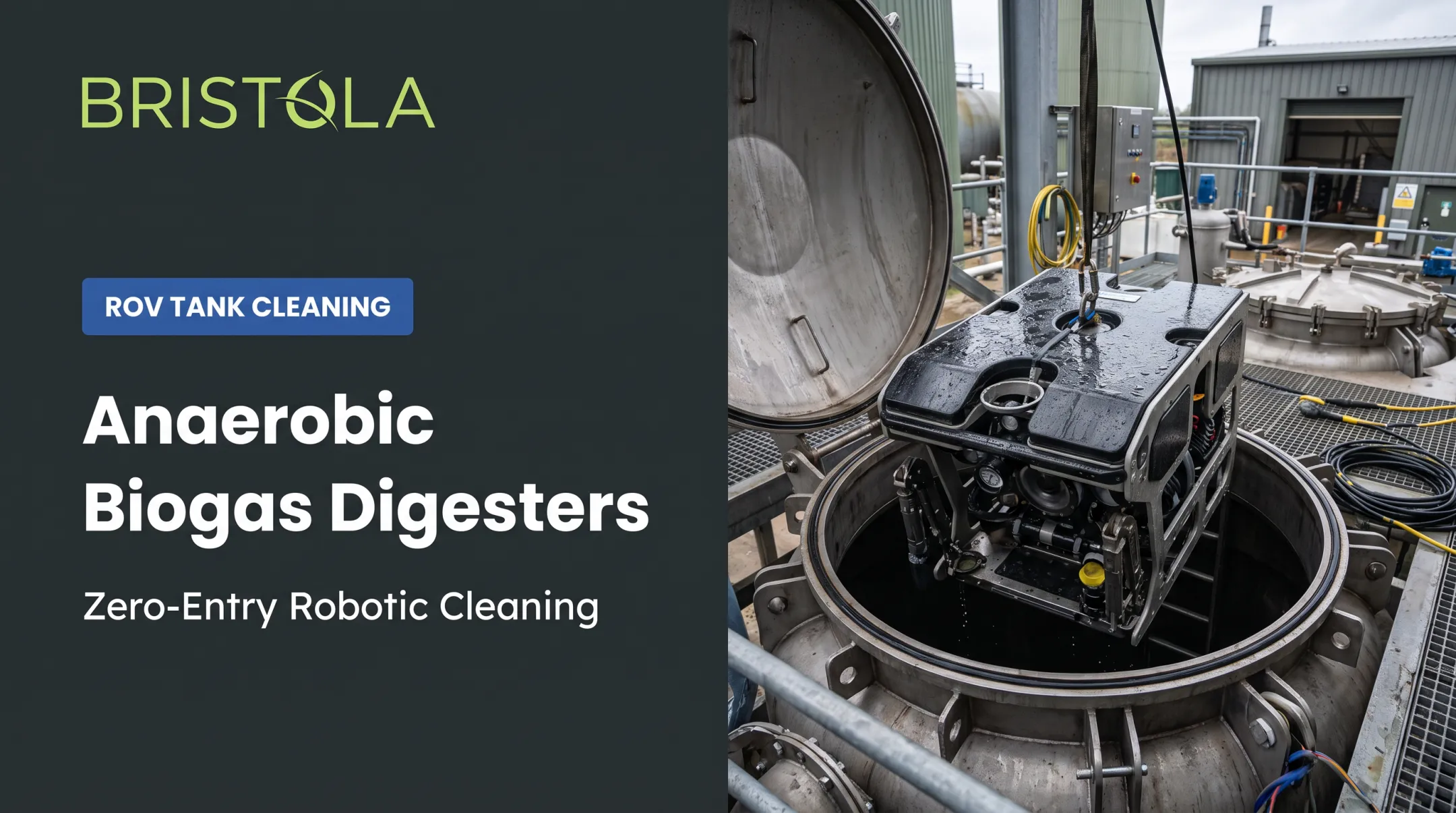
Bristola's robotic cleaning system uses a patented equalization-chamber entry portal installed at an existing manhole (24 inches or larger). A submersible ROV enters the sealed, operating tank without draining it or sending anyone inside, then removes sludge and sediment through a flexible hose while the facility keeps running.

The same approach works on anaerobic digesters, covered lagoons, and wastewater treatment tanks. Covered lagoons usually need draining and partial cover removal for the first install; every cleaning after that runs without stopping operations. Facilities stay online, workers stay out of confined spaces, and working volume comes back without a multi-week shutdown.
Anaerobic vs. Aerobic Treatment: Which Is Right for Your Facility?
| Factor | Anaerobic | Aerobic |
|---|---|---|
| Best-suited COD range | Above 4,000 mg/L (high-strength) | Below 1,000 mg/L (low-strength) |
| Energy use | Low (no aeration required) | Higher (continuous aeration needed) |
| Footprint | Compact for high-rate reactors | Larger for equivalent load |
| Sludge output | Lower, with biogas as a byproduct | Higher volume, no energy recovery |
| Nutrient removal | Limited to none | Better suited for nitrogen/phosphorus polishing |
Most facilities don't have to pick one or the other. Many run anaerobic treatment as a first stage to knock down the heavy organic load and recover energy. An aerobic step then follows to hit strict discharge limits on nitrogen, phosphorus, or final effluent quality.
The Accra plant mentioned earlier is a good example: strong anaerobic removal upfront, then aerobic polishing to close the gap.
Frequently Asked Questions
Are anaerobic septic systems good?
Anaerobic septic systems work well for breaking down household organic waste, but they depend on proper design, consistent maintenance, and periodic tank cleaning. Without that upkeep, sludge builds up and the system can fail.
What types of wastewater are not suitable for anaerobic treatment?
High sulfate content, heavy metals, and very dilute wastewater all create problems for anaerobic systems. Sulfate reducers compete with methanogens for organic matter, while metals and very low organic concentrations can inhibit microbial activity entirely.
How long does it take to start up an anaerobic treatment system?
With buffered seed sludge from a nearby plant, startup can take two weeks or less. Without adequate seeding, studies show that municipal UASB reactors can take 80 to 120 days to fully stabilize.
Can anaerobic systems meet strict discharge standards on their own?
Usually not. Anaerobic treatment removes organic load effectively but does little for nitrogen or phosphorus. Facilities with strict nutrient limits typically need aerobic or other post-treatment to fully comply.
How often should an anaerobic digester or tank be cleaned?
Buildup rates vary by feedstock type and loading, so there's no universal schedule. Regular inspection paired with proactive, non-disruptive cleaning, like Bristola's zero-human-entry system, helps catch sediment accumulation before it hurts biogas output.