Introduction
Potable water storage tanks are easy to overlook — until something goes wrong. Without regular cleaning, stored water becomes a breeding ground for bacteria, sediment, and biofilm that can compromise water quality long before anyone notices a problem.
Waterborne diseases affect an estimated 7.2 million people per year in the US, costing more than $3 billion annually. Poorly maintained storage and distribution infrastructure drives many of these cases. A neglected tank creates regulatory exposure, accelerates infrastructure damage, and — in serious cases — becomes a direct public health threat.
The good news: most of those risks are preventable with a consistent cleaning routine. This guide walks through the warning signs, a five-step cleaning process, method comparisons, and a practical maintenance schedule.
Key Takeaways
- Clean potable water tanks at least once a year — more often in warm climates or high-use systems
- The core process: drain → scrub → disinfect → rinse → test
- Use NSF 60-approved, unscented sodium hypochlorite (5.25%–8.25%) for disinfection
- Never enter a large storage tank without OSHA-compliant confined space protocols in place
- Large water systems must follow AWWA C652 standards for disinfection and clearance testing
Why Cleaning Your Potable Water Storage Tank Matters
Neglected tanks don't announce themselves. Biofilm forms on walls, sediment settles at the floor, algae colonizes surfaces exposed to light. Stored water keeps flowing to taps the entire time — with none of it visible from the outside.
The Health Stakes Are Real
CDC surveillance data from 2015–2020 recorded 214 US drinking-water outbreaks resulting in 2,140 cases, 563 hospitalizations, and 88 deaths. Legionella was the most frequent cause and drove the majority of severe outcomes. The pathogen thrives in stagnant, warm water with sediment and reduced chlorine residuals — exactly the conditions that develop inside a tank that hasn't been cleaned.

Legionella isn't the only concern. E. coli and total coliform bacteria signal fecal contamination that triggers mandatory corrective action under EPA's Revised Total Coliform Rule — a separate regulatory pressure on top of the health risk itself.
Regulatory and Infrastructure Consequences
Large water storage facilities are subject to AWWA C652 for disinfection procedures and EPA drinking water regulations. Failing to maintain tanks can trigger:
- Regulatory violations and mandatory public notification
- Boil-water advisories, which cost utilities roughly $1,020 per day on average according to peer-reviewed research
- Accelerated tank wear from corrosive biofilm and sediment attacking coatings, liners, and fittings
The Illinois EPA notes that tanks not periodically cleaned can lead to costly repairs or premature failure. Scheduled cleaning is far cheaper than emergency remediation — and far less damaging to the people who depend on the water supply.
Signs Your Potable Water Tank Needs Cleaning
Some warning signs are obvious. Others only show up in test results.
Visual Indicators
- Discolored water (yellow, brown, or cloudy)
- Green or brown algae growth on interior surfaces
- Floating particles or settled sediment visible at the tank floor
- Slime or biofilm coating on interior walls
Water Quality Red Flags
- Change in taste, odor, or color at the tap
- A positive test result for total coliform or E. coli
- Chlorine residual dropping faster than expected (EPA requires ≥0.2 mg/L disinfectant residual entering distribution; readings below that threshold warrant immediate investigation)
Event-Based Triggers (Clean Immediately)
These situations require cleaning no matter when the tank was last serviced:
- A new or recently repaired supply line connected to the tank
- Tank left drained and unused for several months
- Flooding or storm events near the tank site
- Any suspected contamination from external sources
How to Clean a Potable Water Storage Tank: Step by Step
The process below applies to tanks up to approximately 3,000 gallons. Larger tanks may require professional procedures and must comply with AWWA C652 — see the following section for details on those scenarios.
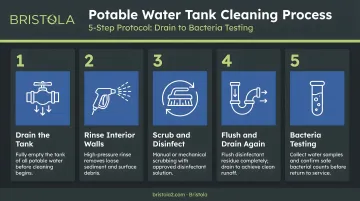
Step 1: Drain the Tank
Use the drain port at the base of the tank — not the outlet valve — to fully empty it. Complete drainage is essential before any cleaning begins.
The water remaining at the tank floor typically carries the highest concentration of sediment and contaminants. If gravity drainage isn't sufficient, use a wet vacuum or sump pump to remove residual water entirely.
Step 2: Scrub the Interior
Using a non-metallic bristle brush with an extendable handle (or a pressure washer for larger residential tanks), scrub all interior surfaces — walls, floor, corners, and around any fittings. A mild detergent or soapy water solution works well for general cleaning.
For stubborn algae or biofilm, household bleach or a baking soda paste applied directly to affected areas helps loosen buildup before rinsing.
Critical safety note: No person should enter a large storage tank during cleaning. Confined space entry requires trained personnel, atmospheric testing, ventilation, communication systems, and a written permit under OSHA 29 CFR 1910.146. This is a mandatory legal requirement — not a guideline — and violations can be fatal.
Step 3: Disinfect
Use NSF 60-approved, unscented liquid bleach containing 5.25%–8.25% sodium hypochlorite. For household-strength bleach, EPA emergency disinfection guidance recommends a 30-minute minimum contact time for drinking water treatment.
For small tanks and cisterns, CDC recommends 3 cups of bleach per 100 gallons of water as a practical disinfection ratio. Distribute the solution through the tank and allow it to sit:
- Accessible, well-mixed tanks: minimum 30 minutes
- Tanks where mixing isn't possible: overnight contact time
Step 4: Rinse Thoroughly
After the required contact time, drain the tank completely and rinse two to three times with clean water. The goal is removing all residual bleach before the tank returns to service.
If distribution lines connect to the tank, run taps downstream until the bleach odor is no longer detectable. This confirms the full connected system has been flushed.
Step 5: Test Before Returning to Service
Before refilling for use, test for:
- Total coliform and E. coli — use certified lab analysis or validated field test strips
- Chlorine residual — confirm it falls within safe drinking water levels
If bacteria are still detected, repeat the full disinfection and rinse cycle before returning the tank to service. For tanks larger than 3,000 gallons or those connected to municipal systems, the process changes significantly — see the next section for professional and regulated cleaning requirements.
Cleaning Methods: Routine vs. Disinfection vs. Professional
Different situations call for different approaches. Here's how to match the method to the problem.
Routine DIY Cleaning (Small to Mid-Size Tanks)
For residential or small commercial tanks, annual cleaning using the five-step process above is typically sufficient. This covers mechanical scrubbing, basic chlorine disinfection, and water quality verification — and can be completed without specialized equipment.
Shock Chlorination (Corrective Disinfection)
When bacterial contamination is confirmed through testing, a higher-concentration chlorine treatment is required. AWWA C652 defines three recognized methods:
| Method | Free Chlorine Target | Contact Time |
|---|---|---|
| Method 1 | ≥10 mg/L | 6–24 hours |
| Method 2 | ~200 mg/L (spray/paint) | ≥30 minutes |
| Method 3 | ~50 mg/L partial volume, then fill | ≥6 hours + 24-hour hold |
Shock-treated water at these concentrations cannot be consumed. It must be drained and flushed completely, with bacteriological sampling confirming coliform absence before the tank returns to service.
Professional Cleaning for Large or Confined Tanks
For large municipal, commercial, or industrial water storage tanks, human entry to perform cleaning creates confined space hazards — including oxygen deficiency and toxic vapor exposure. Professional cleaning services address this through specialized equipment, certified personnel, and AWWA C652-compliant procedures.
Bristola's robotic cleaning system removes human entry from the equation entirely. Its patented equalization chamber entry system functions as an airlock, allowing a remote-controlled submersible ROV to access tanks through manholes 24 inches or larger — without draining the tank or stopping operations.
Extracted sediment and sludge travel through a flexible hose to a processing point of the facility's choice. The tank stays in service throughout the entire cleaning cycle.
How Often Should You Clean a Potable Water Tank?
The industry standard is at least once per year — but that's a floor, not a universal answer. Actual frequency should reflect the specific conditions your tank operates in.
Frequency by Risk Factor
| Condition | Recommended Frequency |
|---|---|
| Standard indoor or shaded tank | Once per year |
| Direct sunlight or warm/tropical climate | 2–3 times per year |
| Translucent or light-colored tank exposed to light | More frequent; inspect quarterly |
| High-use or continuously replenished system | Annual minimum + quarterly inspections |
| Fed by private well or surface water | Every 6 months or per well disinfection schedule |
When to Clean Outside Your Regular Schedule
Any of these events warrant immediate cleaning, regardless of when you last cleaned the tank:
- Positive bacteria test result
- Flooding or contamination near the tank site
- New or repaired supply line connection
- Extended period of non-use or stagnation
- Suspected external contamination
Regulatory Requirements for Large Systems
Municipal and commercial water systems subject to regulatory oversight should consult AWWA C652 and applicable state drinking water regulations to confirm cleaning frequency, documentation standards, and sampling requirements. Requirements differ significantly by jurisdiction and system type, so verifying your specific obligations before scheduling service is worth the time.
Frequently Asked Questions
How often should potable water tanks be cleaned?
Most potable water tanks should be cleaned at least once a year. Tanks in sunny, warm, or high-use environments — or those fed by surface water — need more frequent attention, typically every 6 months. Contamination events require immediate cleaning regardless of schedule.
What is the process of water tank cleaning?
The five core steps are: drain completely, scrub all interior surfaces, disinfect with an approved bleach solution, rinse two to three times with clean water, and test for bacteria and chlorine levels before returning the tank to service.
How do professionals clean water tanks?
Professionals use pressure washing equipment, specialized disinfectants, and follow AWWA C652 procedures. For large tanks, robotic and ROV-based systems allow complete cleaning without human entry — eliminating confined space risk while keeping the tank in service throughout the process.
How long can water sit in a tank before it goes bad?
Properly treated water in a sealed, clean tank can remain safe for months under normal conditions. The CDC recommends rotating stored water every six months as a general benchmark. In untreated or contaminated tanks — especially in warm or sunlit environments — bacterial growth can begin significantly sooner.
How do you maintain a water storage tank?
Key maintenance practices include: scheduling annual cleaning and disinfection, inspecting regularly for sediment or algae growth, keeping lids sealed and secured, testing water quality periodically, and following manufacturer and regulatory guidelines for your specific tank type.
What is the NFPA 22 standard for water tanks?
NFPA 22 is the Standard for Water Tanks for Private Fire Protection, covering the design, installation, and maintenance of tanks used in fire suppression systems. It governs inspection frequency, structural integrity, and cleanliness requirements — but applies to fire protection tanks, not potable drinking water storage. Potable tanks fall under AWWA C652 and EPA drinking water regulations.