This article breaks down what tank bottoms actually mean, physically and financially. We'll cover why Cushing sits at the center of the storm, and why the sludge buildup problem never really goes away, crisis or no crisis.
Key Takeaways
- Tank bottoms are unusable sludge, water, and sediment that cut real working volume at the base of every storage tank
- Cushing's inventory levels set the price benchmark for WTI crude and can shake global markets
- Sludge buildup is continuous—capacity loss compounds until tanks are cleaned
- Regular sludge removal protects capacity, pump pressure, and product quality year-round
What Does "Oil Tank Bottom" Mean?
Tank bottoms are the minimum volume of product that must stay in a tank and its connected piping for pumps to keep working. The EIA explains that below this line, pump suction becomes ineffective. Once inventory drops past that point, the oil cannot be moved.
This creates three distinct capacity tiers:
- Shell capacity – total design volume of the tank
- Working storage capacity – maximum safe fill volume minus tank bottoms
- Contingency space – buffer space above operating inventory, normally kept empty
What's Actually in That Sludge
Tank bottom sludge isn't just leftover crude. Research on storage-tank deposits identifies asphaltenes, resins, wax, mechanical impurities, and water as the core components, with wax and asphaltenes often settling together into thick deposits. Composition depends on the crude source. Studies report:

- Water content: 30–90%
- Oil content: 5–60%
As inventory nears the bottom line, operations get constrained fast:
- Pumps lose suction
- Blending different crude grades becomes difficult
- Pipeline pressure can drop entirely
Tank bottoms are not a crisis-only issue. They are built into every crude oil, refined product, and industrial liquid storage tank. The EIA states that the amount of storage that must remain available to keep systems running is unknown nationally, so no single percentage applies across the U.S. system.
Why Cushing, Oklahoma Is Ground Zero for Tank Bottom Concerns
Cushing's Role as America's Oil Hub
Cushing isn't just a big storage yard. It's the physical delivery point for NYMEX WTI futures contracts and sets the pricing benchmark for the US crude market. CME Group describes the delivery network as nearly two dozen pipelines feeding roughly 15 storage terminals, linking Midwest refineries and Gulf Coast export terminals at a single pricing point.
That concentration is exactly why small inventory swings at Cushing ripple outward fast.
Operational Minimum and Market Impact
Traders have long treated roughly 20 million barrels as Cushing's practical operational floor. Below that threshold, oil becomes difficult to physically remove, according to Reuters reporting from 2023. That floor is roughly 10-20% of Cushing's total capacity of over 98 million barrels.
When inventories in 2026 approached that line:
- Cushing spent three consecutive weeks (June 19 - July 10) below 20 million barrels
- The Brent-WTI spot differential turned negative for the first time since January 2022
- Futures curves showed classic backwardation, where near-term prices trade above future months
This isn't new behavior. In September 2023, a similar draw saw Cushing fall from over 43 million barrels in June to just under 23 million by mid-September, the lowest level since July 2022.
WTI backwardation then widened to $2.26 per barrel from just $0.10 in the following months as the market braced for further depletion. At those levels, tank bottoms matter: unpumpable sludge and sediment shrink usable inventory, complicate quality, and make every remaining barrel harder to move.

What Happens When Tanks Hit Bottom: Ripple Effects
Contractual and Physical Strain
When operators genuinely cannot deliver contracted volumes due to physical constraints, force majeure clauses can come into play. But this isn't automatic.
Sample terminal agreements filed with the SEC define force majeure narrowly, covering acts of God, government orders, and equipment accidents — low inventory alone isn't typically listed as a qualifying event. Any declaration depends heavily on the specific contract language and whether the operator can prove genuine inability to perform.
Landlocked Refineries Feel It First
Midwest refineries don't have easy access to seaborne crude. They lean heavily on pipeline supply from Cushing and Canadian imports. EIA data shows Cushing's working capacity represents more than half of all PADD 2 (Midwest) working storage capacity. A squeeze at the hub hits regional refiners directly, with fewer alternative supply routes than coastal refineries enjoy.
The Mirror Image of 2020
Compare this to April 2020, when WTI futures traded negative for the first time ever, hitting -$40.32 per barrel. That crisis was oversupply: refinery runs had collapsed 24% due to COVID-19 demand destruction, and Cushing tanks were 76% full with nowhere left to put the oil.
The 2026 scenario is the opposite problem entirely:
| Factor | 2020 Crisis | 2026 Crisis |
|---|---|---|
| Root cause | Demand collapse, oversupply | Supply draw, undersupply |
| Cushing fill level | 76% full | Approaching bottoms |
| Price effect | Negative futures | Backwardation, spread inversion |
Too little movable oil creates just as much market chaos as too much unmovable oil.

Tank Bottoms Are a Year-Round Operational Challenge, Not Just a Crisis
Strip away the headlines, and every storage operator — refinery, terminal, or industrial facility — deals with gradual sludge buildup constantly. Gravity and temperature changes cause heavy hydrocarbons, wax, and sediment to settle continuously. It never stops on its own.
The Traditional Cleaning Problem
Conventional tank cleaning means:
- Draining the tank completely
- Sending workers inside for manual, confined-space entry
- Managing OSHA protocols for toxic gas, oxygen deficiency, and related entry hazards
- Taking the facility offline for days, sometimes longer
- Arranging temporary storage for displaced product
OSHA's guidance on tank cleaning identifies fire, explosion, toxic exposure, and fall hazards as inherent risks of manual entry work. For routine maintenance, those risks and the downtime that comes with them add up fast.
A Different Approach
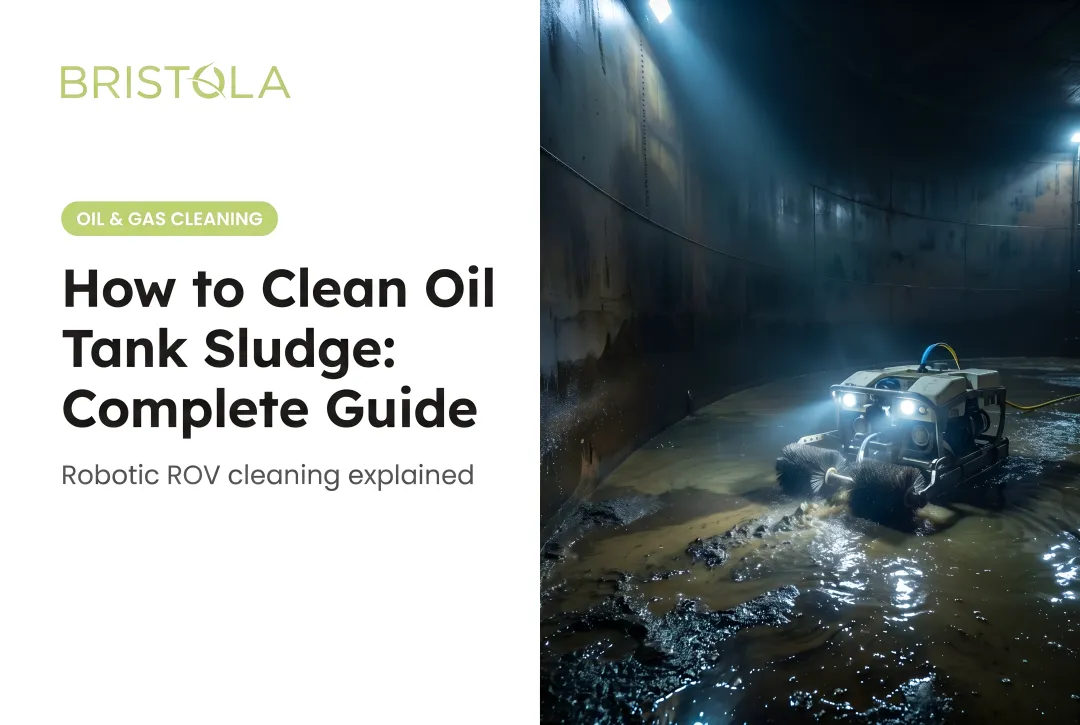
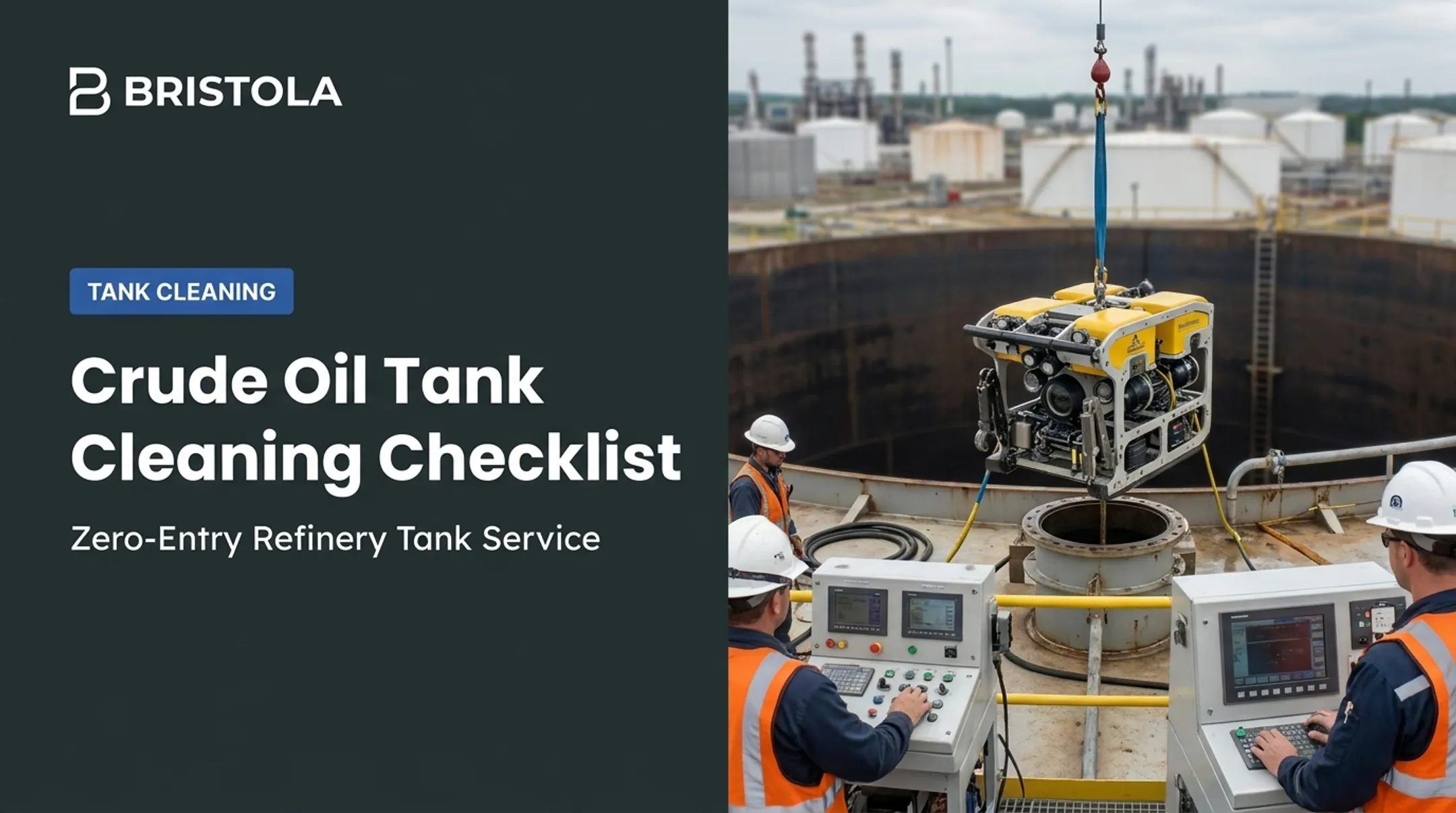
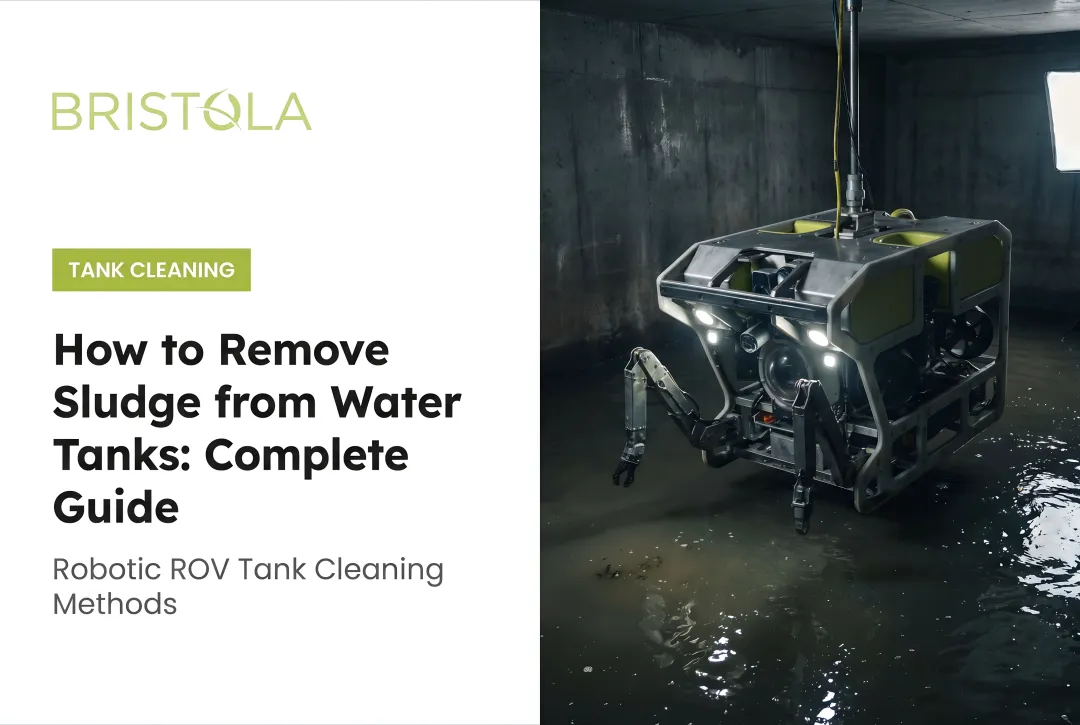
Bristola's zero-human-entry robotic system is built for that reality. A submersible ROV enters through an existing manhole using a patented equalization chamber—no draining, no human entry, and no shutdown required.
How it works:
- ROV enters through manholes 24 inches or larger
- A winch lowers the robot to the tank floor while the tank stays full and operational
- Sonar navigation guides the robot through opaque liquid
- A flexible hose carries removed sludge to surface processing
- The system logs tank condition data throughout the clean
One documented case study puts annualized traditional cleaning costs at $250,000, versus $170,000 with the robotic approach—an $80,000 saving per tank, per year.

For oil and gas, refinery, and liquid storage operators, protecting working capacity is the point. Every barrel of usable storage preserved is a barrel that doesn't feed hub-wide shortfalls like the one Cushing experienced in 2026.
Frequently Asked Questions
What does oil tank bottom mean?
Tank bottoms are the minimum unusable volume of sludge, water, and sediment sitting at a tank's base. This layer stays below the normal suction line and is needed to keep pumps functioning, but it can't be drawn out during standard operations.
What is an oil tank bund?
A bund is a secondary containment wall built around a storage tank to catch leaks or spills. It's an external structure for spill protection, completely separate from tank bottoms, which are internal, unusable product sitting inside the tank itself.
Why is Cushing, Oklahoma important to oil prices?
Cushing is the physical delivery point for NYMEX WTI futures contracts, making it the pricing benchmark for US crude. Nearly two dozen pipelines converge there, connecting Midwest refineries and Gulf Coast export terminals into one critical pricing hub.
What happens if Cushing storage runs out?
Inventories near operational floors can strain pipeline pressure and disrupt supply to landlocked Midwest refineries. In extreme cases, operators may declare force majeure if they cannot deliver contracted volumes.
How often should tank bottoms be cleaned?
There's no universal schedule since it depends on tank use and crude type. Modern robotic systems allow continuous maintenance without production downtime, replacing the old model of scheduled, disruptive shutdowns.
Can tank bottom sludge be prevented entirely?
No. Sludge accumulation is a natural physical process driven by gravity and temperature shifts as heavier compounds settle out. Proactive cleaning technology can manage it continuously and keep it from becoming an operational risk.