For facility operators and project developers, the question isn't whether AD makes sense — it's which companies actually deliver the financial returns they promise.
This post evaluates five top anaerobic digestion companies not by reputation alone, but by technology capability, feedstock strategy, U.S. market track record, and the operational factors that ultimately determine whether an AD project hits its ROI targets.
Key Takeaways
- The global AD market is growing at 9.6% CAGR through 2035, with U.S. investment at record highs
- Top performers differentiate on feedstock flexibility and multiple revenue streams — biogas volume alone doesn't determine project success
- ROI is driven by tipping fees, RIN credits, energy sales, and digestate value — not output volume alone
- The five companies below were selected for verifiable U.S. project delivery, technology diversity, and measurable performance outcomes
- Sludge management directly impacts biogas output and is consistently underweighted in company evaluations
Overview of Anaerobic Digestion in the Renewable Energy Industry
Anaerobic digestion is a biological process where microorganisms break down organic material in the absence of oxygen, producing biogas (primarily methane and CO₂), renewable natural gas (RNG), and nutrient-rich digestate. That dual function — waste diversion and energy generation from the same feedstock — is what's drawing large-scale infrastructure capital into the sector.
The U.S. Market Opportunity
The EPA's AgSTAR program counts approximately 400 manure-based AD systems as of June 2024 — 343 dairy, 50 hog, 8 poultry, and 9 beef operations. That's a fraction of what's possible. Food waste alone represented roughly 24% of all landfilled municipal solid waste in 2018, and the EPA's Excess Food Opportunities Map identifies over 960,000 potential waste generators in commercial and institutional sectors.
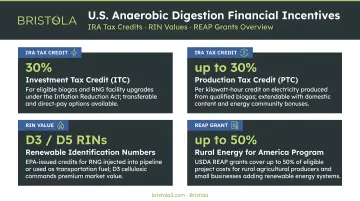
Federal support is also substantial. The Inflation Reduction Act offers an Investment Tax Credit of up to 30% (with a potential 10% energy-community adder), and USDA's REAP program provides guaranteed loans and grants to agricultural producers investing in renewable energy systems. D3 RIN prices — the renewable fuel credits earned by RNG — have historically ranged from $0.05 to $3.50 per RIN, creating meaningful but variable revenue upside.
With this much financial upside on the table, the gap between operators who capture it and those who leave it behind comes down to technology choices, feedstock management, and operational discipline. The five companies below represent some of the strongest performers across all three dimensions in the current U.S. market.
Top Anaerobic Digestion Companies by ROI & Performance
These companies were evaluated across feedstock versatility, technology deployment at scale, demonstrated U.S. project delivery, and measurable return on investment for clients and partners.
EnviTec Biogas
Founded in 2002 and headquartered in Lohne, Germany, EnviTec Biogas AG is Germany's largest biogas producer with 700+ plants commissioned across 18 countries. Their U.S. subsidiary, EnviTec Biogas USA Inc., operates out of Beaverton, Oregon, handling planning, construction, and commissioning of AD and gas upgrading plants across the country.
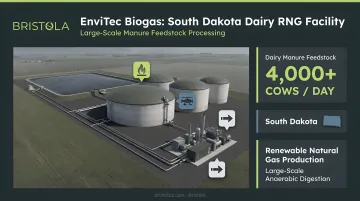
Their most prominent U.S. reference: a South Dakota dairy RNG plant developed in partnership with SJI Renewable Energy Ventures, processing over 300,000 gallons per day of manure from more than 9,500 dairy cows. EnviTec also operates 87 owner-operated plants globally, providing recurring operational revenue that most EPC-only contractors can't match.
| Category | Detail |
|---|---|
| Primary Feedstock | Dairy manure, poultry litter, food waste; large dairy clusters |
| Technology Approach | Full value chain: AD design + gas upgrading + ammonia stripping + bio-LNG capability |
| Key ROI Drivers | RNG commodity sales, D3 RIN revenue, ammonium sulfate from ammonia stripping, digestate compost, multi-year service contracts |
Why it matters for ROI: EnviTec's ammonia stripping capability adds a revenue stream most U.S. dairy AD projects leave on the table — converting nitrogen-rich effluent into ammonium sulfate fertilizer sold at market prices.
Brightmark
Brightmark is a U.S.-based renewable energy company whose RNG operations run through Brightmark RNG Holdings LLC, a joint venture with Chevron U.S.A. Inc. Their model focuses on aggregating multiple dairy farms under a coordinated biogas network — converting individual farm digesters into a portfolio-scale RNG operation.
The JV reached first gas at 10 Midwest RNG projects and currently owns and operates 15 projects across Iowa, Michigan, South Dakota, Wisconsin, and Ohio. They've also commissioned Florida's largest family dairy RNG project at Larson Family Farms using lagoon digesters. Brightmark has CARB Tier 2 pathway approvals for carbon intensity scoring, which supports LCFS credit monetization in California — a premium market for RNG producers.
Bristola's robotic tank cleaning system supports operational continuity across Brightmark's digester portfolio — keeping tanks active during maintenance rather than pulling them offline.
| Category | Detail |
|---|---|
| Primary Feedstock | Dairy manure; multi-farm lagoon and covered lagoon systems |
| Technology Approach | Digester infrastructure + gas upgrading + pipeline injection + CARB pathway certification |
| Key ROI Drivers | D3 RIN revenue, LCFS credits, long-term offtake agreements, reduced methane emissions credits |
Vanguard Renewables
Vanguard Renewables, based in Wellesley, Massachusetts, takes a differentiated approach: co-digestion of agricultural waste and food company organics at farm-based AD facilities. They co-founded the Farm Powered Strategic Alliance (FPSA) in 2020 alongside founding members including Unilever, Starbucks, and Dairy Farmers of America.
The FPSA model creates a committed, recurring supply of food waste from corporate partners — a significant advantage over farm-only operations that rely solely on manure feedstock. Active sites include Jordan Dairy Farms in Spencer, MA and Dinnerbell Farms in Eden, WI, among others across the Northeast and Midwest. Bristola provides digester cleaning services at Vanguard facilities, supporting uptime across their co-digestion network.
| Category | Detail |
|---|---|
| Primary Feedstock | Dairy manure base + food and beverage organic waste through FPSA co-digestion agreements |
| Technology Approach | Co-digestion model: higher-energy food waste added to manure base for greater biogas yield per unit volume |
| Key ROI Drivers | Tipping fees from food waste generators + RNG or electricity output — dual revenue that manure-only projects can't access |
The economics of co-digestion: Organic food waste carries far higher volatile solids content than manure alone, which directly increases biogas yield per cubic meter of digester volume. The tipping fee revenue from waste generators front-loads project economics before a single cubic foot of RNG is sold.
Ameresco, Inc.
Ameresco (NYSE: AMRC) is a publicly traded energy efficiency and renewable energy company headquartered in Framingham, Massachusetts. Unlike pure-play AD developers, Ameresco bundles AD projects into broader energy performance contracts — which lowers the capital barrier for municipalities and institutions that would otherwise struggle to finance standalone biogas infrastructure.
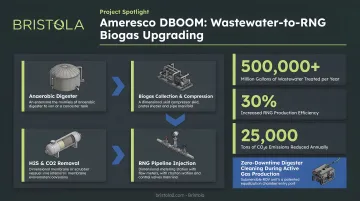
Their design-build-own-operate-maintain (DBOOM) model is best illustrated by the City of Phoenix 91st Avenue Wastewater Treatment Plant project. It processes 3,250 scfm of raw biogas into approximately 693,500 Dth per year of RNG under a 20-year contract, with a 3-mile injection pipeline and projected annual emissions reduction of ~44,671 tCO₂e.
| Category | Detail |
|---|---|
| Primary Feedstock | Wastewater biosolids, landfill gas, municipal organic waste |
| Technology Approach | EPC + DBOOM structures; Ameresco finances, builds, owns, and operates — clients pay for energy output, not capital assets |
| Key ROI Drivers | Energy cost savings, utility revenue, RECs, bundling AD into multi-facility energy performance contracts |
Hitachi Zosen Inova (HZI)
Headquartered in Zurich and a subsidiary of Hitachi Zosen Corporation, HZI specializes in engineered AD systems for high-solids feedstocks — specifically municipal solid waste organics and source-separated food waste that wet AD systems struggle to process efficiently.
Their proprietary dry fermentation BioCell system can handle organic material at dry matter contents up to approximately 50%, suited for feedstocks with high contamination or low moisture content. Their U.S. reference project: a Kompogas facility in San Luis Obispo, California processing roughly 36,500 tonnes per year of source-separated organics and green waste, generating renewable electricity while supporting California's organics diversion mandates. Bristola has worked directly with HZI on digester cleaning at active facilities — a natural fit given HZI's emphasis on continuous operational throughput.
| Category | Detail |
|---|---|
| Primary Feedstock | Municipal solid waste organics, source-separated food waste, industrial organic residuals |
| Technology Approach | Dry fermentation BioCell batch system; high-solids processing at up to ~50% DM content |
| Key ROI Drivers | Gate fees from municipal contracts, biogas-to-electricity revenue, tipping fee income, integration with existing waste infrastructure |
How We Chose These Anaerobic Digestion Companies
These five companies were selected based on demonstrated U.S. market activity, verifiable project deployment, feedstock and technology diversity, and evidence of delivering measurable financial returns. Global brand size wasn't the filter — operational track record was.
One mistake many operators make: selecting AD partners based on marketing materials rather than client references, total cost of ownership analysis, and post-commissioning service depth. A technology that performs well at commissioning but lacks responsive ongoing support can steadily erode returns across a 20-year project life.
Why Operational Uptime Is Inseparable from ROI
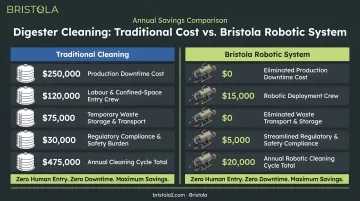
A digester that goes offline for cleaning, desludging, or unplanned maintenance stops generating revenue — and the financial impact compounds fast. Traditional tank cleaning for a 1.2-million-gallon digester carries a total cost of approximately $980,000 per cycle (occurring roughly every five years), including $200,000 in lost revenue during the shutdown period alone. Annualized, that's $250,000 per year in cleaning-related costs.
The yield consequences of deferred cleaning are just as significant. One documented EnviTec digester that had not been cleaned in over four years showed a 20% drop in daily biogas yield and was unable to maintain mesophilic operating temperatures (95–101°F) during winter months.
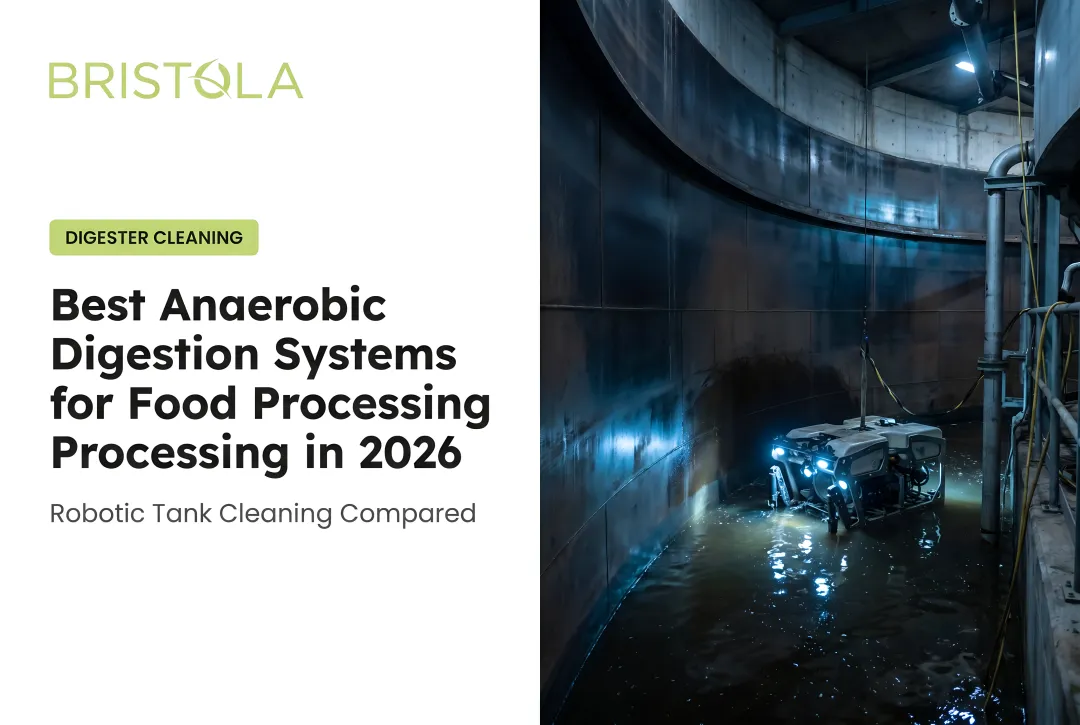
That's the cost of inaction. Facilities that address this with Bristola's zero-human-entry robotic tank cleaning system — which cleans digesters through a patented equalization chamber while the tank remains in full production — carry an annualized cleaning cost of approximately $170,000, representing $80,000 in annual savings per tank with no production interruption.
Beyond cleaning, buyers should evaluate:
- Post-commissioning biological services and monitoring
- Multi-year service contract availability
- Remote performance monitoring capabilities
- Response time to feedstock variability and process upsets — ask for documented SLA commitments
Conclusion
The top anaerobic digestion companies earn their reputation through the right feedstock strategy, proven engineering at scale, and the operational discipline to keep facilities running at capacity year after year.
When evaluating AD partners, look beyond the commissioning milestone. Ask about scalability, multi-revenue-stream potential, service depth after project handover, and demonstrated performance with feedstocks similar to yours. Then factor in the full cost of maintenance-related downtime — because that number is typically larger than the project pro forma accounts for.
For AD facilities already operational or in development, Bristola's patented robotic tank cleaning system addresses one of the most overlooked variables in digester performance: sediment accumulation that reduces biogas output without triggering an obvious alarm. The system cleans tanks while they remain in active operation — no human entry, no production shutdown, no need to empty the vessel. Get in touch with Bristola to see how it fits your facility.
Frequently Asked Questions
How much does an anaerobic digestion system cost?
Costs vary based on scale, feedstock type, and technology configuration. Farm-scale digesters range from a few hundred thousand dollars for basic covered lagoon systems to over $5 million for complex dairy RNG setups. Large municipal or commercial AD plants regularly exceed $20–$50 million.
Are anaerobic digesters profitable?
Yes, with the right structure. Profitability depends on feedstock availability, revenue mix (D3 RINs, tipping fees, energy sales, digestate value), and operational efficiency. Projects stacking tipping fees with RNG or electricity sales and capturing IRA tax credits or USDA REAP grants can achieve strong returns.
What industries use anaerobic digestion?
The primary sectors are agriculture (dairy, swine, poultry), food and beverage processing, municipal wastewater treatment, food waste management, and pulp and paper. Each generates high-volume organic material suited to AD feedstock. Industrial facilities are also adopting AD as both a waste management tool and an energy cost offset.
What is the ROI timeline for an anaerobic digestion plant?
Payback periods typically range from 5 to 15 years depending on scale, financing structure, incentive capture, and operating costs. Facilities with stable, high-energy feedstock and diversified revenue streams — particularly those with tipping fee income from food waste — reach profitability faster than manure-only operations relying primarily on RNG commodity pricing.
What factors affect anaerobic digester performance?
Key variables include feedstock quality and consistency, operating temperature (mesophilic digesters require 95–101°F), microbial community health, mixing efficiency, and solids accumulation. Sludge buildup reduces active digester volume and impairs temperature management, cutting biogas output — often before operators identify the cause.
How do you maintain an anaerobic digester for maximum output?
Routine maintenance covers biological parameter monitoring, mixing and pumping system inspections, feedstock quality tracking, and periodic sludge removal. Bristola's zero-human-entry ROV systems address solids buildup without taking the digester offline, eliminating the downtime and revenue loss of traditional drain-and-clean methods.