Neglected lagoons build up sludge, lose treatment capacity, and eventually trigger permit violations. The EPA's own troubleshooting guidance flags sludge depth at or above 25% of operating depth as a red flag requiring action (EPA lagoon troubleshooting manual). Ignore that threshold, and you're looking at odor complaints, regulatory scrutiny, and eventually an emergency dredging bill nobody budgeted for.
This guide covers why maintenance matters, the different types of lagoon maintenance, the warning signs operators should watch for, and a general schedule to keep your facility ahead of problems instead of reacting to them.
TL;DR
- Lagoon maintenance protects treatment capacity, water quality, and regulatory standing
- Work runs from routine inspections through major dredging and full overhauls
- Watch for sludge buildup, odor, algae blooms, and slipping effluent quality
- A structured schedule (daily, monthly, annual) beats costly emergency fixes
- Zero-human-entry robotic systems clean covered lagoons without shutdowns
Why Maintenance of Wastewater Lagoons Is Important
Consistent maintenance is the difference between a lagoon that runs for decades and one that needs emergency intervention within a few years.
Treatment efficiency drops as sludge accumulates. Every inch of sludge on the lagoon floor eats into detention time, the period wastewater spends being treated before discharge. Less detention time means less biological treatment, which shows up as declining effluent quality.
Lifespan depends heavily on upkeep. The Kansas Department of Health and Environment notes that domestic lagoons generally need desludging every 15-25 years to restore rated design capacity (KDHE desludging guidance). University of Missouri Extension goes further, stating that regular sludge removal can extend an anaerobic lagoon's functional life almost indefinitely. Skip that maintenance, and you're looking at early rehabilitation instead.
Compliance isn't optional. Any facility discharging to waters of the United States needs an NPDES permit under the Clean Water Act, and that permit sets firm limits on what can leave the lagoon. Operators must sample discharge, report results, and notify regulators the moment they fall out of compliance. A poorly maintained lagoon makes hitting those numbers much harder.
Preventive care costs less than emergency repairs. Mobilizing dredging equipment is expensive on its own. KDHE specifically recommends completing desludging as one continuous project rather than in stages, because remobilization costs add up fast. Planned maintenance avoids that scramble entirely.

Types of Maintenance for Wastewater Lagoons
Maintenance needs shift based on lagoon type — aerobic, anaerobic, aerated, or covered — and how much stress the system is under.
Routine / Preventive Maintenance
This is the baseline every lagoon needs, regardless of condition:
- Scheduled visual inspections for erosion, vegetation, and debris
- Mowing embankments to prevent burrowing animals and berm damage
- Checking aerator function and monitoring influent/effluent quality
- Measuring sludge depth on a regular cycle Routine care alone is sufficient when sludge accumulation is low and effluent quality is stable. It is also the lowest-cost option, and the one that prevents most corrective and overhaul work later.
Corrective / Reactive Maintenance
This kicks in when something's already wrong: odor complaints, a permit violation, aerator failure, or visible overflow. Common corrective actions include:
- Repairing damaged pipes and control structures
- De-sludging overloaded cells
- Adding supplemental aeration when runtime falls short The problem with relying on reactive fixes alone is cost and timing. Emergency work almost always costs more than planned work, and it often forces production downtime while the issue gets sorted out. Operators who wait for failures typically pay more and lose more uptime than those who plan the work.
Predictive / Condition-Based Maintenance
Instead of waiting for a problem to surface, predictive maintenance tracks key indicators over time to catch drift before it becomes a violation:
- Sludge depth
- Dissolved oxygen
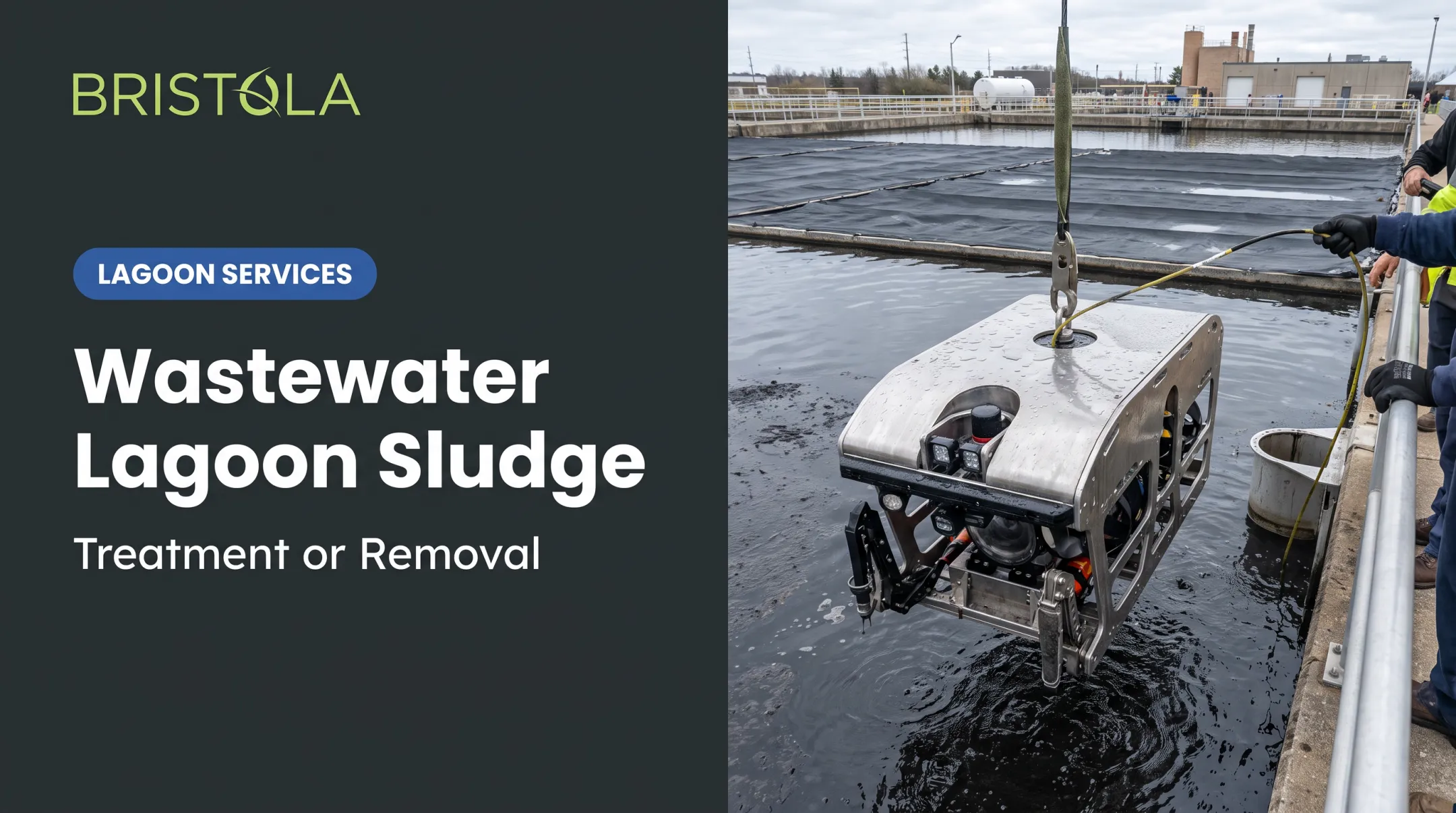
- Biogas output Technology has expanded what operators can do without a shutdown. For covered lagoons and anaerobic digesters, zero-human-entry robotic systems (such as the submersible ROV platform Bristola operates) support inspection and sludge removal without draining the lagoon, removing the cover, or sending anyone into a confined space. Facilities that once treated inspection as a disruptive, high-risk event can now gather condition data and remove sludge while the system stays online.
Major / Overhaul Maintenance
Eventually, even well-maintained lagoons need deep intervention: full sludge dredging, liner repair or replacement, or an aerator overhaul. This is typically required after years of accumulation or a significant, measurable loss of capacity. Costs vary widely by site. KDHE points to several cost drivers worth planning around:
- Equipment mobilization (favor continuous, single-phase projects to limit repeat mobilizations)
- Wet-volume handling, because dredging moves large amounts of water with the sludge
- Disposal or land-application arrangements for removed material
- Site access, slope, and liner protection during the work One real-world example: a 1.2-million-gallon EnviTec digester in New York had gone more than four years without cleaning. Volatile-solids reduction had dropped below 25%, and biogas production was down 20%. The customer had separate proposals exceeding $300,000 for roof work and another $300,000+ for the cleanout. Bristola completed a broader scope (cleaning, roof replacement, concrete repair, and mixer replacement) for $411,000 total, and retrofitted an access point for future live cleanings without a shutdown.

How to Check If a Wastewater Lagoon Needs Maintenance
Between formal inspections, operators should watch for these early indicators.
Performance or Output Changes
- Effluent quality slipping or failing permit parameters
- Slower breakdown of organic waste
- Reduced hydraulic capacity or detention time
Unusual Behavior or Odor
A septic, rotten-egg odor typically signals hydrogen sulfide from anaerobic conditions where oxygen has run out. Other flags include:
- Excessive foaming, discoloration, or surface scum
- Aerator noise or inconsistent mixing
Visible Wear or Irregularities
- Sludge blanket rising close to the surface, cutting into freeboard
- Algae blooms or dead zones pointing to nutrient imbalance
- Liner damage, erosion, or berm deterioration
Excess algae is a higher-risk version of that imbalance. It can create nighttime oxygen deficits, spike effluent TSS and BOD, and push effluent pH above 9.0, which is its own compliance problem.
Recurring Issues or Compliance Flags
- Repeated permit exceedances or regulator notices
- Frequent need for chemical dosing to control odor or algae
- Unplanned shutdowns or emergency storage due to lost capacity
Any one of these on its own might be manageable. Several showing up together usually means the lagoon is overdue for attention.

Wastewater Lagoon Maintenance Schedule (General Guidelines)
Exact frequency depends on lagoon type, loading rate, and climate, but the EPA and several state agencies recommend a similar schedule.
| Frequency | Typical Tasks |
|---|---|
| Daily/Weekly | Visual checks, aerator/blower function, odor monitoring, dissolved oxygen checks |
| Monthly/Quarterly | Sludge depth measurement, water quality sampling, vegetation control, mowing |
| Annual | Comprehensive inspection, liner check, pH/DO/temperature review, permit compliance audit |
| Every 5-15+ years | Major dredging or overhaul, based on sludge accumulation rate |
Loading strength changes the math. High-strength waste from livestock operations or food processing accumulates sludge faster than typical municipal waste.
Oklahoma State Extension publishes sludge-volume factors by species. Dairy waste, for example, accumulates faster than swine or poultry waste because the solids are larger and less compressible.
Facilities handling high-strength waste should lean toward the shorter end of every inspection interval, not the longer one.

Maintenance Is Cheaper Than the Alternative
A wastewater lagoon inspected on schedule and dredged before capacity loss gets severe will outperform one fixed only after something breaks. That pattern shows up consistently in state guidance and EPA documents.
Proactive care costs less than emergency response because it:
- Avoids unplanned shutdowns and temporary storage expenses
- Protects treatment capacity before sludge forces a crisis dredge
- Extends facility life and lowers environmental compliance risk
For covered lagoons, zero-human-entry robotic systems remove a major barrier to staying ahead: draining the lagoon, pulling the cover, and shutting down just to inspect or clean inside.
Frequently Asked Questions
Do you need a septic tank if you have a lagoon?
Not always. Many industrial and municipal lagoons operate independently without one. In some residential systems, a septic tank pretreats wastewater before it reaches the lagoon.
How often should a wastewater lagoon be cleaned or dredged?
It depends on sludge accumulation rate, but many municipal and industrial lagoons need desludging every 15-25 years to restore design capacity. Annual inspections help track when that point is approaching.
How long do wastewater lagoons last?
There's no universal figure, but well-maintained lagoons with regular sludge removal can operate for decades before major rehabilitation is needed. Anaerobic lagoons with consistent solids management can last especially long.
Do sewage lagoons smell?
Some seasonal odor is normal, particularly during temperature shifts. Strong or persistent smells usually point to hydrogen sulfide from anaerobic overload and signal a maintenance need.
What is the difference between aerobic and anaerobic lagoon maintenance?
Aerobic and aerated lagoons need regular aerator and dissolved oxygen checks to keep bacteria supplied with oxygen. Anaerobic lagoons need less oxygen management but require systematic sludge surveys and controlled solids removal.
What happens if a wastewater lagoon isn't maintained?
Expect reduced treatment capacity, declining effluent quality, and eventually permit violations. Odor complaints and costly emergency dredging typically follow once the problem becomes visible.