But running these tanks isn't simple. Solids build up. Scum layers form. Cleaning traditionally means draining the tank, sending workers into a confined space, and losing days or weeks of production. This guide breaks down how digester tanks work, the main tank types used in the US, what they cost, and how maintenance practices affect biogas yield and worker safety.
Key Takeaways
- Sealed, oxygen-free digester tanks turn organic waste into usable biogas and nutrient-rich digestate
- Match tank type—complete mix, plug flow, or covered lagoon—to your feedstock and operation
- Regular cleaning protects biogas yield, worker safety, and equipment lifespan
- Zero-entry robotic cleaning maintains digesters without downtime or confined-space risk
What Is an Anaerobic Biogas Digester Tank and How Does It Work?
An anaerobic digester is an airtight, oxygen-free container where microbes break down organic feedstocks such as manure or food scraps into biogas and a nutrient-rich effluent called digestate.
The Four Biological Stages
Digestion happens in sequence:
- Hydrolysis – complex organic material breaks into soluble compounds
- Acidogenesis – those compounds convert into organic acids and intermediates
- Acetogenesis – intermediates become acetate, hydrogen, and CO2
- Methanogenesis – methanogens produce the final methane and CO2
Each stage relies on a different microbial community, which is why sudden changes in feedstock or temperature can throw off the whole system.
What Comes Out: Biogas and Digestate
Raw biogas typically runs 55%-75% methane, 24%-44% carbon dioxide, with trace gases making up the rest, according to the American Biogas Council. That gas gets used for heat, electricity generation, upgraded renewable natural gas (RNG), or vehicle fuel.
Digestate, meanwhile, doesn't go to waste. It's commonly reused as:
- Fertilizer for crop fields
- Livestock bedding
- Soil amendment for nutrient management
Mesophilic vs. Thermophilic Operation
Digesters run at one of two temperature ranges. Mesophilic systems operate at 86-100°F, while thermophilic systems run at 122-140°F, according to the EPA.
Thermophilic digestion moves faster but demands more heat input and tighter management. The microbial community is less forgiving of fluctuations. Most US farm and food-waste digesters stick with mesophilic operation for stability.
Types of Anaerobic Digester Tanks Used in the US
Tank design should match feedstock characteristics, not the other way around. EPA AgSTAR's livestock database (data through June 2024) tracks 400 operating manure-based systems. The three most common tank types break down as follows:
| Tank Type | Count | Share |
|---|---|---|
| Covered lagoon | 174 | ~43.5% |
| Plug flow | 107 | ~26.8% |
| Complete mix | 105 | ~26.3% |

Complete Mix Digesters
Complete mix systems are widely used for diluted manure streams, especially where milking-center wastewater adds liquid volume. These enclosed, heated steel or concrete tanks use mechanical, hydraulic, or gas mixing to keep solids in suspension.
Plug Flow Digesters
Plug flow units are long, narrow, minimally mixed tanks built for scraped dairy manure. EPA reports plug flow is the most popular dairy-specific design, processing manure from more than 260,000 dairy cattle across roughly 91 sites nationwide.
Covered Lagoon Systems
Covered lagoons are low-cost, unheated systems that use a flexible cover to capture methane from dilute manure streams. Some designs combine digestion and storage in a single basin, which suits farms with available land and lower capital budgets.
Dry digesters handle high-solids feedstocks that don't flow easily through conventional tanks, such as stacked manure or food-waste solids. Landfill gas capture is related but distinct: it collects methane as waste decomposes in a landfill rather than in a sealed digester tank.
Key Industries Using Biogas Digester Tanks
Four sectors drive most US digester activity:
- Agriculture and dairy — manure-based systems on farms of all sizes
- Food and beverage processing — standalone digesters handling process waste
- Wastewater treatment — municipal and industrial water resource recovery facilities
- Renewable energy and RNG producers — facilities upgrading biogas to pipeline-quality gas
Many operators boost output through co-digestion, blending manure with food waste and fats, oils, and grease (FOG). Adding these higher-energy feedstocks increases biogas yield beyond what manure alone produces.
Case in point: Keewaydin Farm in Vermont ran a dairy digester receiving 1,280 gallons/day of manure through a 28,000-gallon vessel. Average output reached 4,500–6,600 standard cubic feet/day at 62%–64% methane, or roughly 2,605 kWh/month net electricity.
Bristola supports digester operators across similar agricultural and RNG facilities—including Vanguard Renewables, Regenis, and Brightmark—so tanks stay productive without extended outages.
Cost, ROI, and Planning Considerations
Digester costs vary widely by scale. The University of Maryland Extension puts a typical on-farm unit at around $1.2 million (2025 data), while a Penn State Extension modeled scenario used $1.3 million in capital costs.
Key cost drivers:
- Tank material (steel vs. concrete) and size
- Mixing and heating system complexity
- Permitting and environmental review
- Site preparation and grading
- Ongoing operations, maintenance, and tank cleaning
Payback Periods and Revenue Streams
Penn State's modeled scenario found a 10.2-year payback at a $24.26/ton tipping fee, dropping to just over 6 years at $55/ton. Without tipping fees, payback stretched to nearly 22 years . Tipping fee revenue is often the difference between a project that pencils out and one that does not.

Common revenue sources include:
- Onsite electricity or heat savings
- Grid electricity sales
- RNG sales (pipeline injection or vehicle fuel)
- Tipping fees for accepting outside waste
- Digestate and nutrient product sales
- Tax credits, RECs, and carbon credits
Build lifecycle costs into the same model. Unplanned downtime for cleaning or sludge removal can wipe out months of energy and tipping-fee gains, so plan for maintenance methods that keep the digester online.
Permitting
EPA requires digesters to satisfy local, state, and federal requirements covering air quality, water discharge, and solid waste handling. Build permitting timelines into your project plan early — they can add months before construction even starts.
Why Maintenance and Tank Cleaning Matter for Digester Performance
Solids buildup, scum layers, and sediment accumulation quietly eat into a digester's active volume over time. Less usable volume means less biogas, even though feedstock input stays the same.
The Traditional Cleaning Problem
Conventional cleaning means:
- Draining the tank completely
- Sending workers into a confined space
- Halting biogas production for days or weeks
- Arranging temporary waste storage during the outage
That confined-space entry carries real risk. Bureau of Labor Statistics data cited by OSHA shows 1,030 US workers died from confined-space-related occupational injuries between 2011 and 2018.
That all-industry figure is why digester interiors demand rigorous safety protocols: atmospheric testing, ventilation, permits, and trained rescue personnel.
A Different Approach
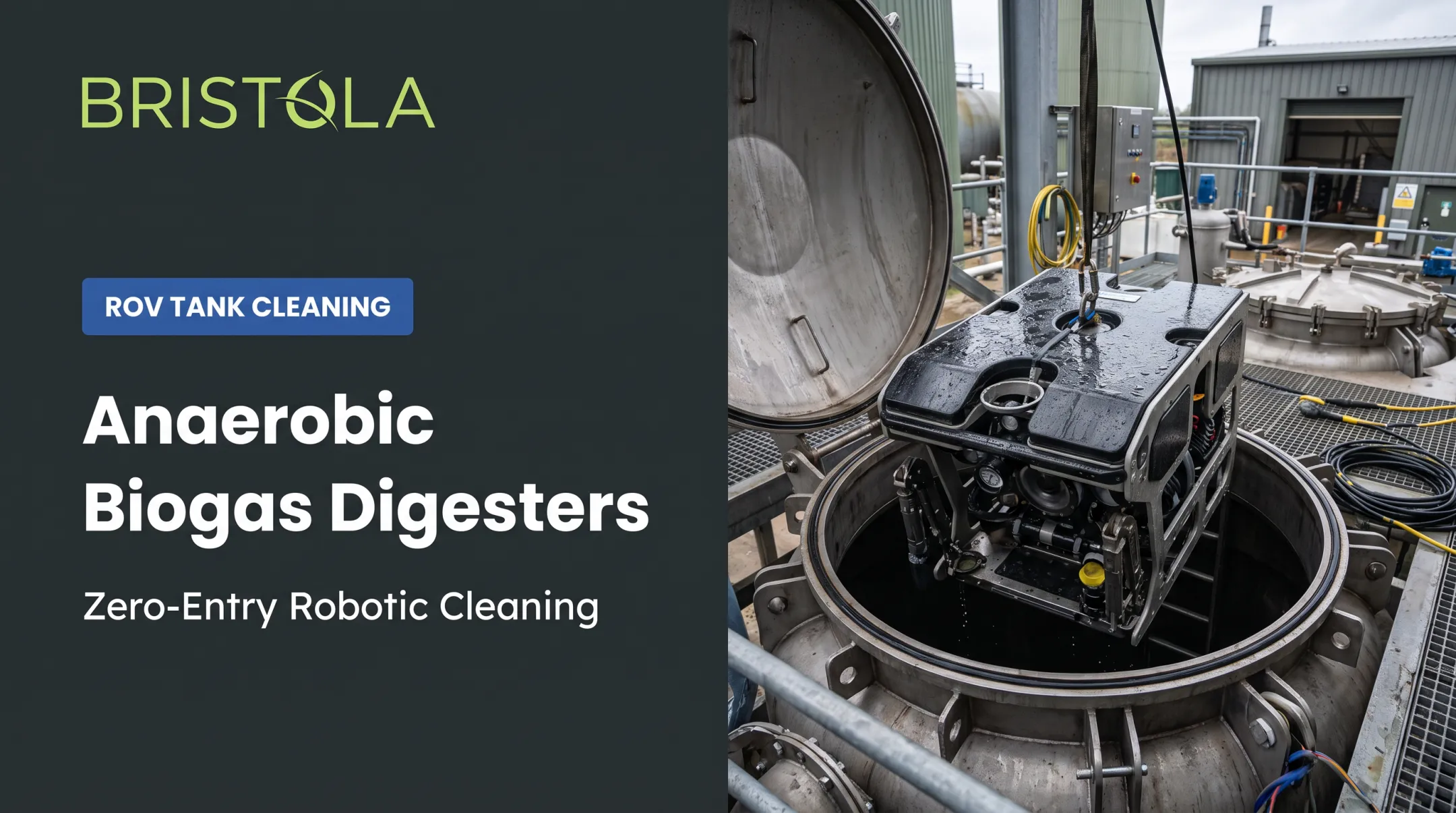
Those downtime and safety costs are exactly what zero-human-entry cleaning is built to avoid. Bristola's robotic system removes sludge and sediment through a patented equalization chamber, an airlock-style portal fitted over the tank's manhole.
A remote-controlled submersible robot enters on a winch, works the tank floor, and sends material out through a flexible hose. No one enters the tank, no draining is required, and the digester keeps producing biogas throughout.
A documented cost comparison puts traditional tank cleaning at about $250,000 annually per tank, including lost production revenue, chemical treatment, and cleanout costs. Bristola's system is estimated at roughly $170,000 annually, saving around $80,000 per tank per year by keeping the facility in production and skipping temporary storage.

Operational benefits include:
- Restores active tank volume and biogas output
- Cuts carbon impact by avoiding production outages
- Lowers operating costs with no temporary storage
- Removes confined-space entry risk for maintenance crews
Frequently Asked Questions
How much does an anaerobic digester cost?
Costs range from smaller farm-scale systems to multimillion-dollar industrial installations. A typical on-farm unit runs around $1.2 million, though size, tank type, and feedstock handling can shift that figure a lot.
What is the purpose of an anaerobic digester?
It converts organic waste — manure, food scraps, wastewater solids — into renewable biogas and nutrient-rich digestate. This reduces landfill waste and methane emissions while recovering usable energy and fertilizer.
How often should an anaerobic digester be fed?
Most digesters need daily or continuous feeding to keep bacterial activity stable. NC State Extension recommends transporting manure to the digester as often as possible, ideally at least once per day.
Do anaerobic digesters smell?
Properly sealed and maintained digesters keep odor far lower than raw manure or open waste storage. Poor maintenance, leaks, or scum buildup can cause noticeable odor problems over time.
Is a biodigester better than a septic tank?
They serve different purposes entirely. Biodigesters recover energy and nutrients from organic waste, while septic tanks exist solely to treat and dispose of household wastewater without energy recovery.