Introduction
The U.S. generates roughly 66 million tons of food waste annually, and according to EPA data, approximately 35.3 million tons of that ends up in landfills — making food the single largest component of landfilled municipal solid waste at around 24%.
That buried food doesn't just disappear. When organic material decomposes in a landfill without oxygen, it generates methane — a gas at least 28 times more effective than CO₂ at trapping heat over a 100-year period. MSW landfills are the third-largest source of human-related methane emissions in the U.S., and food waste alone drives an estimated 58% of those fugitive emissions.
Anaerobic digestion (AD) addresses this directly: it captures that same decomposition process in a controlled environment and converts it into usable energy. This guide covers how AD works biologically, what goes in and comes out, where it's deployed, and what keeps these systems running at capacity.
Key Takeaways
- 35.3 million tons of food waste go to U.S. landfills annually, releasing uncontrolled methane — AD intercepts that methane and converts it into usable energy
- AD runs through four sequential stages: hydrolysis, acidogenesis, acetogenesis, and methanogenesis
- Two outputs: biogas (renewable energy) and digestate (nutrient-rich fertilizer)
- Over 2,600 operational biogas systems now run in the U.S., a number that has grown steadily each year
- Consistent feedstock, stable operating temperatures, controlled pH, and routine sludge removal all determine how well a digester performs
What Is Anaerobic Digestion?
Anaerobic digestion is a biological process where microorganisms break down organic matter inside a sealed, oxygen-free vessel — a digester — producing biogas and digestate as outputs.
AD is distinct from incineration (no burning), aerobic composting (no oxygen, no energy output), and basic wastewater treatment. It's an active energy recovery system that converts organic material into measurable renewable outputs.
System Types and Operating Temperatures
AD systems fall into two main categories:
- Wet (low-solids) systems — process feedstocks with less than 15% solids content. Most common in the U.S., handling pumpable slurries from food waste, biosolids, and manure
- Dry (high-solids) systems — handle stackable material above 15% solids, typically used for more fibrous agricultural or food processing waste
Operating temperature also determines how a system performs:
| Parameter | Mesophilic | Thermophilic |
|---|---|---|
| Temperature range | 95–105°F (35–40°C) | 130–140°F (55–60°C) |
| Process speed | Slower | Faster |
| Pathogen reduction | Limited | High — enables Class A Biosolids |
| Operational sensitivity | More forgiving | More sensitive to fluctuations |
Thermophilic systems process faster and kill more pathogens, but any temperature deviation can destabilize the microbial community. That sensitivity is why most U.S. facilities default to mesophilic operation.
How Does Anaerobic Digestion Work?
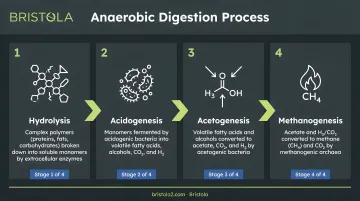
AD isn't a single reaction — it's a four-stage sequential process, each stage performed by distinct microbial communities that hand off substrates to the next. Disruption at any stage cascades through the rest.
Stage 1: Hydrolysis
Hydrolytic bacteria secrete enzymes that break complex organic molecules — carbohydrates, proteins, fats — into simpler, soluble compounds: sugars, amino acids, and fatty acids.
This is the rate-limiting step of the entire process. Feedstock complexity controls how fast everything downstream can proceed — smaller particle sizes, higher moisture content, and pre-treatment all improve hydrolysis efficiency.
Fibrous or lignocellulosic materials like crop residues are especially slow to hydrolyze, which is why many facilities use mechanical or thermal pre-treatment before the feedstock enters the digester.
Stage 2: Acidogenesis
Acidogenic bacteria convert the soluble compounds from hydrolysis into volatile fatty acids (VFAs), alcohols, hydrogen gas, and carbon dioxide. This stage builds the chemical substrate the next stage depends on.
VFA concentration becomes a critical monitoring parameter here — if acidogenesis outpaces the downstream stages, acids accumulate and pH drops, threatening the entire process.
Stage 3: Acetogenesis
Acetogens convert VFAs and alcohols into acetic acid, hydrogen, and CO₂ — the direct precursors to methane. One key operational constraint: hydrogen partial pressure must be kept low for acetogenesis to proceed efficiently. Maintaining that balance between microbial communities isn't a fine-tuning detail — it's what keeps the stage functional.
Stage 4: Methanogenesis
Methanogenic archaea — the most sensitive organisms in the system — consume acetic acid, hydrogen, and CO₂ to produce methane and carbon dioxide. Together, these form biogas.
Methanogens operate within a narrow tolerance:
- Optimal pH: 6.8–7.2 (below 6.0 causes significant inhibition)
- VFA threshold: ~8,000 mg/L (exceeding this can cause process failure)
- Temperature swings, even minor ones in thermophilic systems, can destabilize methanogenic activity
When VFA buildup from overfeeding or feedstock shock drops the pH, the digester goes "sour," and methane production slows or stops entirely. Recovery means carefully rebalancing microbial populations through controlled refeeding — a slow process. This is the most common cause of digester failure, and why continuous monitoring is standard practice at high-throughput facilities.
Feedstocks, Byproducts, and Landfill Diversion Impact
What Goes In
AD handles a wide range of wet organic materials that composting can't manage effectively. Food waste typically runs 75–80% moisture content — far too wet for aerobic composting to work, but ideal for AD.
Primary feedstocks include:
- Food scraps and source-separated organics
- Fats, oils, and greases (FOG)
- Animal manure
- Beverage and food processing residuals
- Sewage sludge (biosolids)
- High-strength industrial wastewater
High-energy additions like FOG can significantly increase biogas yield when co-digested with lower-energy feedstocks like biosolids — a common strategy at water resource recovery facilities.
What Comes Out
Biogas is the primary energy output — roughly 50–70% methane and 30–50% CO₂. It can be:
- Combusted on-site to generate electricity and heat
- Upgraded to renewable natural gas (RNG) by removing CO₂ and trace gases, then injected into pipelines or used as vehicle fuel
According to EESI, a single facility processing 100 tons of food waste per day can generate enough energy to power 800 to 1,400 homes annually.
The second output stream is digestate — the biological matter remaining after biogas extraction. It separates into:
- Liquid digestate — applied as a liquid fertilizer with readily plant-available nitrogen
- Solid digestate — composted or applied directly to agricultural land as a soil amendment
Research documented across multiple growing seasons shows digestate can match or outperform synthetic mineral fertilizers by the third year of application. That closes the nutrient loop rather than sending those nutrients to a landfill.
The Landfill Diversion Argument
Those captured outputs — energy and nutrients — point to the fundamental case against landfilling organic waste. Organic material sent to a landfill decomposes anaerobically regardless. The difference is control. In a landfill, methane escapes uncontrolled into the atmosphere. In a digester, it's captured as a usable energy resource.
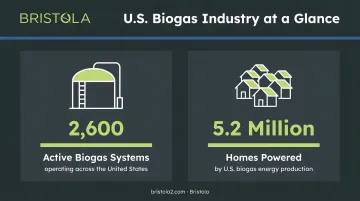
The American Biogas Council reports that biogas projects can carry a carbon intensity 50% to 700% lower than fossil fuels. As of 2025, approximately 2,600 operational biogas systems in the U.S. collectively produce enough energy to power 5.2 million homes annually — and the industry added 70 new projects with over $2 billion in new investment in 2025 alone.
Types of Anaerobic Digesters and Where They're Used
AD is deployed across three main operational contexts, each with different feedstock profiles and scale:
- Stand-alone digesters — Located at food or beverage processing sites, or as dedicated organic waste processing facilities accepting material from multiple generators for a tipping fee
- On-farm co-digesters — Process livestock manure alongside food waste or FOG to boost biogas yields; approximately 631 operating farm digesters in the U.S. as of 2025
- Co-digestion at water resource recovery facilities (WRRFs) — Over 1,200 U.S. WRRFs use AD for wastewater solids treatment; roughly 200 also co-process food waste alongside biosolids
Beyond these three categories, covered lagoon digesters offer a lower-cost, lower-tech alternative — sealed lagoons that capture biogas passively from slurry waste. They're most common in warm climates where ambient temperatures sustain mesophilic operation without additional heating infrastructure, making them a practical entry point for smaller agricultural and food processing sites.
AD performs best with a high-volume, consistent organic waste stream — elevated moisture content and reliable feedstock supply are the two conditions that drive optimal biogas production. Composting fills a different role, handling drier materials closer to their source. In practice, the two technologies work together across a complete organics diversion strategy rather than displacing one another.
Keeping Digesters Running: Operational Performance and Maintenance
A digester that ran at full capacity on day one won't stay there without active management. The most predictable cause of gradual performance loss is one that most operators don't detect until biogas output has already dropped: sludge accumulation.
The Sludge Problem
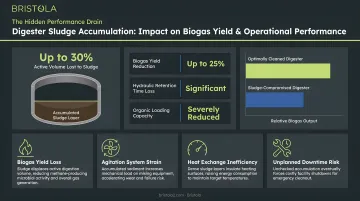
Inorganic materials (sand, grit) and heavy organic solids that resist digestion settle on the floor of the digester tank over time. This sediment doesn't digest away. It accumulates, progressively reducing the active working volume available for biological treatment.
As working volume shrinks, hydraulic retention time (HRT) shortens. Research shows that reducing HRT from 60 to 20 days can decrease average biogas production from 89.1 to 46.8 mL/g total solid — roughly a 47% reduction in yield.
In one documented case at a 1.2 million gallon digester, a facility that hadn't been cleaned in over four years saw volatile solids reduction drop below 25%, lost the ability to maintain mesophilic temperature during winter months, and experienced a 20% drop in daily biogas production — all traceable to accumulated sediment reducing effective digester capacity.
The Traditional Cleaning Problem
That sediment has to be removed eventually. Historically, that meant taking the digester offline, draining it, and sending workers inside to clear accumulated solids manually — a process that creates two serious problems:
- Revenue loss — Traditional drain-and-clean methods can result in approximately $200,000 in lost revenue per cleaning event due to downtime
- Safety exposure — Digester tanks are classified as permit-required confined spaces under OSHA 29 CFR 1910.146. Atmospheric hazards include residual methane, hydrogen sulfide, and oxygen-deficient conditions. From 2011 to 2018, 1,030 workers died from occupational injuries involving confined spaces nationally
Robotic Cleaning: No Downtime, No Human Entry
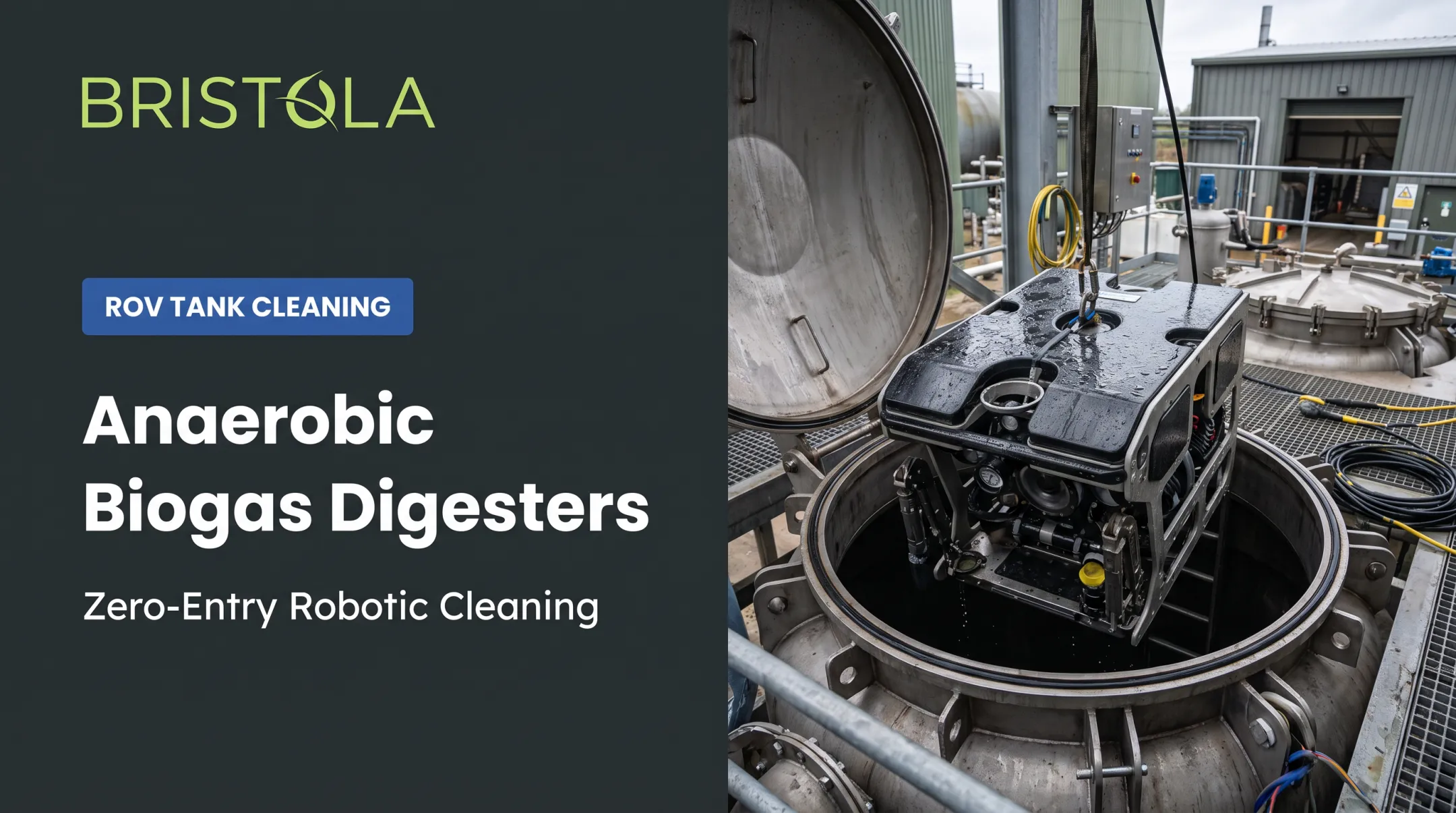
Bristola's zero-human-entry cleaning system addresses both problems at once. A remote-controlled submersible ROV enters the active digester through the tank roof via a patented equalization chamber: an airlock-type mechanism compatible with any manhole 24 inches in diameter or larger — without stopping production.
The process:
- Bristola's entry portal replaces the existing manhole cover, functioning as a pressure equalization chamber
- The ROV is lowered via winch to the tank floor
- Accumulated sediment is extracted through a flexible hose to a processing point of the operator's choice
- When cleaning is complete, the ROV returns to its home position and is retracted through the entry box
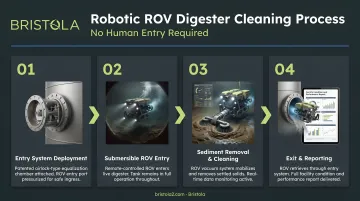
The tank stays full. Production continues. No worker enters the vessel.
The system can be retrofitted to existing digesters or built into new facilities from the start. Bristola also offers a permanent installation option with annual subscription cleaning at roughly $170,000 annually, compared to $250,000 for traditional methods. That's $80,000 in savings per tank per year — with the confined-space risk eliminated entirely.
Clients including Brightmark, BERQ RNG, Vanguard Renewables, and Maas Energy Works have relied on Bristola for digester maintenance across the U.S. and internationally.
Frequently Asked Questions
What are the four stages of anaerobic digestion in order?
The four stages are hydrolysis, acidogenesis, acetogenesis, and methanogenesis. Hydrolysis breaks complex organics into simple soluble molecules; acidogenesis converts those into VFAs and gases; acetogenesis produces acetic acid and hydrogen; methanogenesis converts those precursors into methane and CO₂ (biogas).
What is the difference between anaerobic digestion and composting?
AD is oxygen-free and produces biogas plus digestate; composting is aerobic, produces only compost, and generates no energy. AD also handles high-moisture organic material (like food waste at 75–80% moisture) that composting cannot process effectively.
What types of organic waste can be processed through anaerobic digestion?
High-moisture organic materials are best suited: food scraps, animal manure, fats/oils/greases, beverage processing waste, sewage sludge, and food processing residuals. Generally, higher moisture content and organic load mean stronger performance in a wet AD system.
What is digestate and how is it used?
Digestate is the solid and liquid residue remaining after biogas is extracted from the digester. It contains plant-available nitrogen, phosphorus, and potassium, and is applied to agricultural land as a fertilizer or soil amendment — often in place of synthetic chemical fertilizers.
How does anaerobic digestion help reduce greenhouse gas emissions?
AD captures methane that would otherwise escape uncontrolled from decomposing organic waste in landfills, converting it into usable energy instead. It also displaces fossil fuel consumption through biogas and RNG production, cutting net greenhouse gas emissions per ton of organic waste diverted.
What causes a drop in biogas output at an anaerobic digestion facility?
The main causes include temperature fluctuations, pH imbalance from VFA accumulation, overfeeding or toxic feedstock inputs, and sludge accumulation that reduces active digester volume over time. That last cause is the most deceptive: it builds slowly and often goes unnoticed until output has already fallen.