Poor maintenance leads to:
- Fuel contamination that damages engines and equipment
- Corrosion that shortens tank lifespan
- Unplanned downtime and costly emergency repairs
- Safety hazards for personnel
- Regulatory non-compliance and potential fines
This guide covers why maintenance matters, the different types of maintenance available, warning signs to watch for, and how often you should actually be checking your tanks.
TL;DR
- Fuel tanks need regular inspection, cleaning, and water/contaminant control to protect fuel quality
- Maintenance falls into four categories: routine, corrective, predictive, and major overhaul
- Watch for cloudy fuel, odors, sediment, and dropping equipment performance
- Zero-human-entry robotic cleaning cuts downtime and safety risk versus traditional drain-and-clean methods
- Schedules should reflect tank usage, environment, and fuel type — not a one-size-fits-all calendar
Why Fuel Storage Tank Maintenance Is Important
Maintenance isn't a box-checking exercise. It directly protects fuel quality, equipment, and the tank's usable life.
Fuel performance takes the first hit. Cummins identifies common diesel-fuel contaminants that wear or stick modern injector internals and can spread damage to other engine components (Cummins, Diesel Fuel Contaminants):
- Water
- Microorganisms
- Wax
- Hard particles, debris, and sediment
Water is especially damaging. It supports microbial growth in the tank, and those organisms feed on hydrocarbons, leaving living and dead matter as fresh contaminants.
Tank lifespan shrinks without attention. Corrosion and unaddressed wear reduce structural integrity over time, pushing tanks toward early replacement instead of decades of reliable service. Left unchecked, that same deterioration raises leak and spill risk — which is why regulators treat maintenance as a compliance issue, not just an operations preference.

Safety and Compliance Aren't Optional
Federal regulations set hard requirements for underground storage tank (UST) owners:
- Suspected releases must be reported within 24 hours under 40 CFR 280.50
- Spills over 25 gallons, or any spill causing a sheen on nearby water, require immediate containment, cleanup, and reporting under 40 CFR 280.53
- Aboveground tank owners must inspect containers regularly using industry standards like STI SP001
Florida alone tracked nearly 24,000 regulated storage-tank facilities and ran over 11,000 compliance inspections in 2023, according to the Florida Department of Environmental Protection. That is the scale of enforcement attention this industry gets.
Preventive maintenance is a known, budgeted expense. Reactive repairs after contamination or failure bring unplanned downtime, emergency service premiums, and regulatory penalties — costs far harder to absorb or forecast.
Types of Fuel Tank Maintenance
Not every tank needs the same approach. Maintenance strategy depends on tank size, fuel type, usage rate, and how critical continuous operation is to your facility.
Routine / Preventive Maintenance
This is the baseline: scheduled, low-cost, ongoing work that catches small issues before they grow.
Typical tasks include:
- Visual inspections of tank exterior and fittings
- Fuel sampling for contamination
- Vent and valve checks
- Filter changes on a set schedule
Cost: Relatively low and predictable, since it's built into regular operations rather than triggered by a failure.
Corrective Maintenance (Tank Cleaning & Polishing)
This gets triggered when contamination is already visible — cloudy fuel, sludge buildup, or filters clogging faster than normal.
Traditionally, corrective cleaning means:
- Draining the tank completely
- Sending personnel into a confined space
- Extended downtime while the tank is out of service
- Confined-space safety controls, gas-freeing, and inspection before re-entry is even allowed
Those steps add safety risk and lost production for what is still a cleaning job.
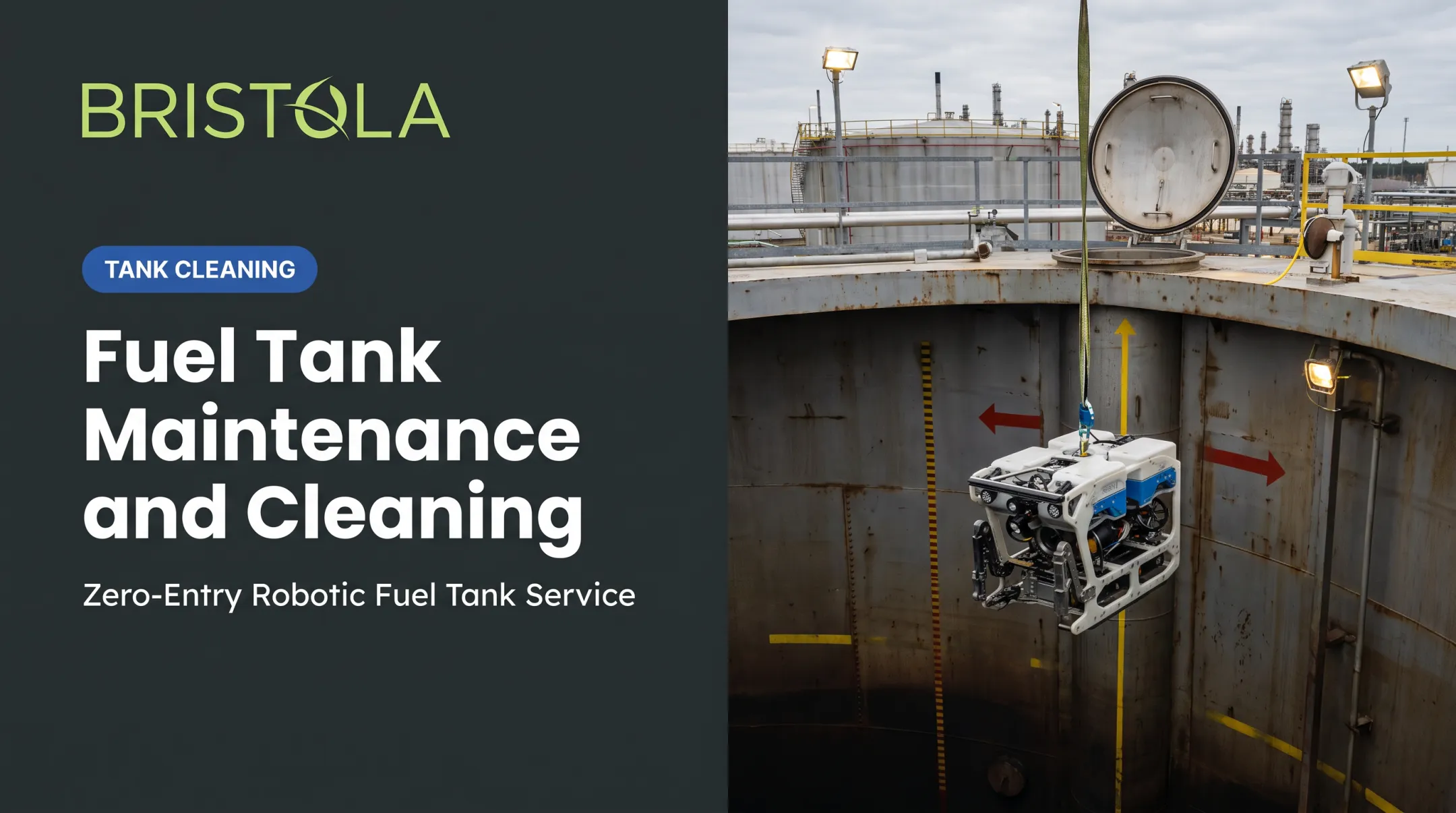
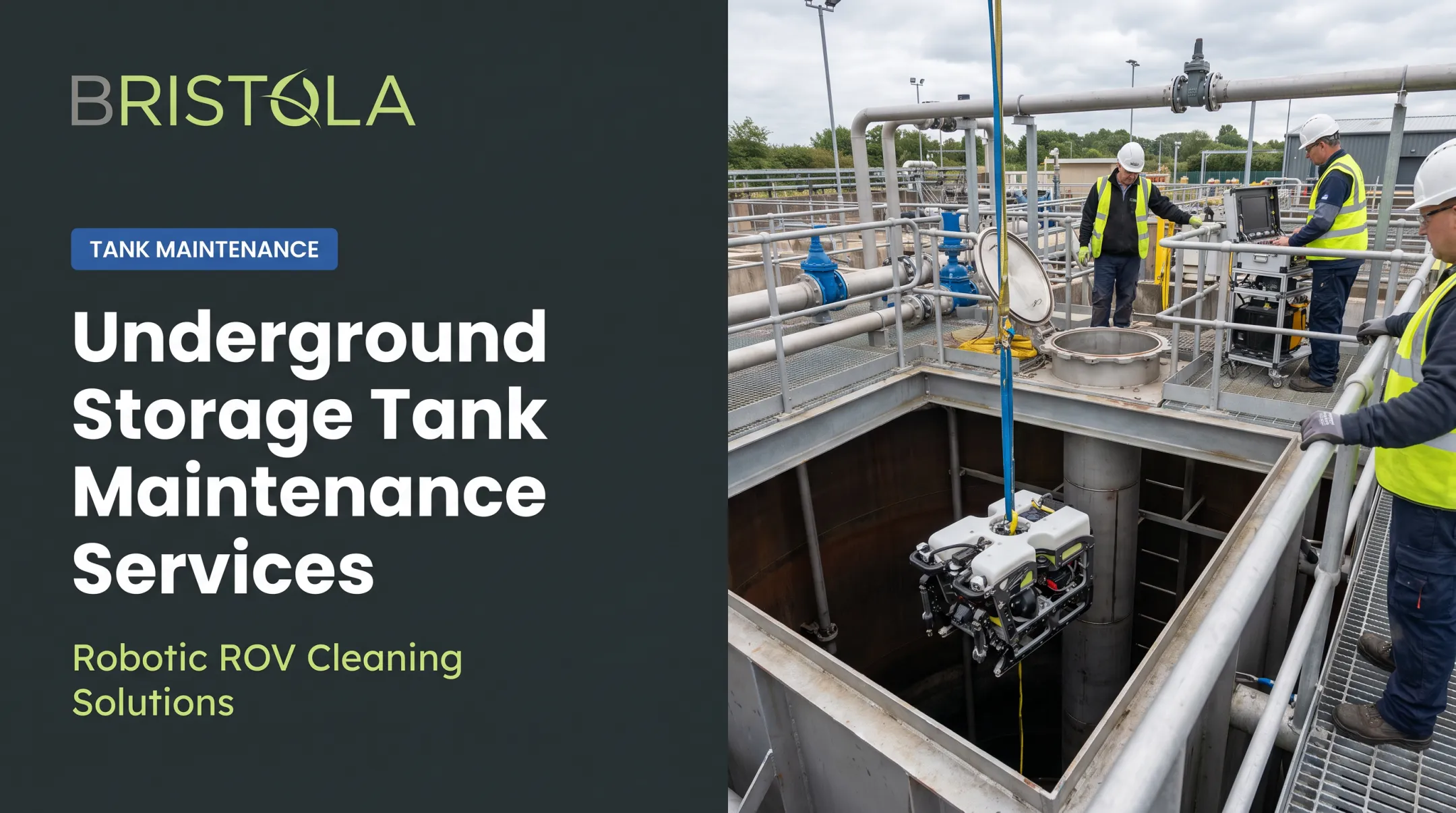
Bristola's zero-human-entry robotic system takes a different path. A submersible robot enters through a maintenance port on manholes 24 inches or larger, using a patented equalization chamber so the tank can stay full and online.
From there, the process is straightforward:
- A winch guides the robot to the tank floor
- Sludge and sediment are removed through a flexible hose
- Sonar supports navigation and real-time monitoring
No draining, no confined-space entry, and no stopped production.

Cost comparison: Bristola internal case data puts traditional cleaning at roughly $250,000 per tank per year versus about $170,000 for the robotic alternative. That is roughly $80,000 saved per tank annually (about 32%). Initial tank modification is typically around $150,000, with a $150,000 annual service subscription. Treat these figures as directional for budgeting; they are not a published third-party benchmark.
Predictive / Condition-Based Maintenance
Instead of waiting for a schedule or a visible problem, this approach monitors tank data continuously and flags issues early.
- Automatic tank gauges (ATGs) track inventory and site conditions remotely
- Sensor data and alarms (like high-water alerts) catch problems before they escalate
- Statistical inventory reconciliation helps identify leaks or losses early
Cost: Higher upfront technology investment, offset by long-term savings from catching problems before they become expensive.
Major Overhaul Maintenance
Reserved for severe cases: structural failure, extensive corrosion, or a regulatory mandate that forces action.
This tier covers deep structural repairs, full tank decommissioning, or replacement. It is the highest-cost category and the least frequent when routine, corrective, and predictive work stay on track.
How to Check If Your Fuel Tank Needs Maintenance
Some warning signs are obvious. Others show up quietly in fuel quality or equipment behavior before anyone notices the tank itself.
Fuel Quality Changes
- Cloudy or discolored fuel
- Strong or unusual odors
- Visible sediment or sludge in fuel samples
Equipment Performance Issues
According to Donaldson, rapid fuel-filter plugging, unplanned shutdowns, low-power events, and injector damage are recognized warning signs of fuel problems. Watch for:
- Filters clogging more often than usual
- Reduced fuel efficiency or engine performance
- Difficulty starting equipment or inconsistent operation
Visible Tank Wear or Warning Signs
- Corrosion, rust, cracks, or dents on the tank's exterior or interior
- Water accumulation (check with water-finding paste on a gauge stick)
- High-water alarms or unusual alerts from monitoring systems
Water buildup usually comes from condensation caused by venting and daily temperature swings, or from rain and humidity entering through vents or seals. Keeping tanks fuller limits the airspace where condensation can form.

Fuel Storage Tank Maintenance Schedule (General Guidelines)
Schedules vary based on tank type, fuel volume, usage, and environment. Federal rules for underground storage tanks set clear minimums, and it's smart to layer condition-based checks on top.
| Frequency | Recommended Tasks |
|---|---|
| Weekly | Visual leak checks, vent and valve inspection |
| Monthly | Fuel level and quality checks, hinge/lock lubrication |
| Quarterly/Semiannual | Fuel sampling, filter replacement, physical tank inspection |
| Annual | Full inspection, tank grounding test, professional cleaning if needed |
For reference, federal UST rules require walkthrough inspections of spill-prevention and release-detection equipment every 30 days, annual checks of containment sumps, and spill/overfill equipment testing at least every three years (40 CFR 280.36).

A few notes on adjusting this baseline:
- High-use commercial tanks need more frequent physical checks than low-usage backup or emergency tanks—treat your regulatory schedule as the floor, not the ceiling.
- Facilities that can't tolerate downtime (continuous fueling, refineries, terminals) benefit from no-downtime cleaning that keeps the tank online.
- Alarms, delivery frequency, and corrosion history should trigger checks beyond the fixed calendar.
Conclusion
Fuel tank maintenance keeps fuel clean, equipment running, and your facility compliant with federal and state regulations. The right maintenance mix balances cost, safety, and uptime. Routine checks catch small issues, predictive monitoring spots trends, and corrective or overhaul work handles what has already gone wrong. For facilities where every hour of downtime counts, zero-human-entry cleaning removes the trade-off between staying compliant and staying operational. A structured plan, built around your tank's actual usage and environment, protects fuel quality and extends the tank's working life far more reliably than reacting after something fails.
Frequently Asked Questions
What is the proper procedure for cleaning a fuel storage tank?
Traditional cleaning means draining the tank, removing sludge and water, scrubbing surfaces, rinsing, drying, and applying biocide. Larger tanks can use zero-human-entry robotic systems that skip draining and confined-space entry entirely.
How long can fuel sit in a tank before it goes bad?
Bulk diesel and gasoline have no fixed shelf life—it depends on storage conditions, temperature, and whether stabilizers are used. Keeping tanks full and controlling water intrusion both extend usable fuel life.
How often should a fuel storage tank be inspected?
Weekly visual checks, monthly quality and level checks, and full annual inspections form a solid baseline. Federal UST rules require specific intervals as tight as every 30 days for certain equipment checks.
What are the signs of a contaminated fuel tank?
Cloudy or discolored fuel, unusual odors, visible sediment or sludge, and equipment issues like frequent filter clogging or reduced performance are the main red flags.
Can a fuel tank be cleaned without shutting down operations?
Yes. Zero-human-entry robotic systems, like Bristola's submersible ROV technology, clean tanks through a maintenance port while the tank stays full and running, avoiding the need to drain it or halt production.
What causes water to build up in a fuel storage tank?
Condensation from venting and daily temperature swings causes most buildup, along with rain, humidity, and small leaks. Keeping tanks fuller reduces airspace and limits condensation.