The numbers tell a clear story. According to an ABB survey of 3,600 industrial decision-makers, 83% report that unplanned downtime costs a minimum of $10,000 per hour — and 44% experience equipment-related interruptions at least monthly.
This guide covers why preventive maintenance matters, the four core maintenance types, the warning signs operators should never ignore, and a practical inspection schedule built for real industrial environments.
Key Takeaways
- Preventive tank maintenance protects uptime, worker safety, regulatory compliance, and long-term asset value
- Four maintenance types cover different needs: routine/preventive, corrective/reactive, predictive/condition-based, and major overhaul
- Warning signs include reduced output, sludge buildup, abnormal sounds, and recurring minor faults
- Tier inspections across three intervals: daily visual checks, monthly system reviews, and annual certified inspections
- Proactive maintenance costs less than emergency repair and eliminates the most dangerous confined space entry scenarios
Why Preventive Tank Maintenance Matters
A reactive approach to tank maintenance defers costs while compounding them. By the time a problem is visible, it's already expensive.
Performance and Output
Sludge and sediment accumulation is one of the most direct threats to tank performance, particularly in anaerobic digestion applications. Research published in PMC/National Library of Medicine found that grit and scum buildup can reduce effective digester volume by 30% to 50% over time, directly cutting hydraulic retention time and gas production yield.
Bristola's internal data shows the same pattern at scale. One 1.2-million-gallon EnviTec digester that hadn't been cleaned in over four years saw volatile solids reduction drop below 25% and daily biogas output fall by 20% — a measurable revenue loss for any facility running on biogas.
That data point makes the diagnostic value of baselines clear. When throughput drops or gas yields trend downward without an obvious feedstock explanation, sludge accumulation is often the cause — and catching it early is the difference between a cleaning cycle and a production crisis.
Asset Lifespan
The lifespan gap between maintained and neglected tanks is significant. Welded steel aboveground storage tanks (ASTs) typically last around 25 years under normal conditions — but with proper maintenance, they can exceed 100 years.
| Tank Material | Typical Lifespan | With Proper Maintenance |
|---|---|---|
| Welded steel AST | ~25 years | 100+ years |
| Aboveground storage tanks (general) | ~25 years | Up to 40 years |
| Fiberglass (FRP) | 20–30 years | 20–40 years |
| Concrete | 40+ years | Extended further |
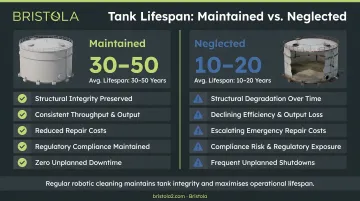
Unchecked corrosion and structural stress accelerate failure at every point on that table. Those lifespan gaps translate directly into capital replacement schedules — and the cost of a maintenance program is typically a fraction of early tank replacement.
Safety and Regulatory Compliance
Industrial tanks qualify as permit-required confined spaces under OSHA 29 CFR 1910.146. From 2011 to 2018, 141 workers died in incidents specifically involving tanks, bins, and vats — a figure that underscores how dangerous these environments become when maintenance is deferred and conditions deteriorate.
Regulatory exposure adds another layer. EPA SPCC violations carry real financial consequences:
- Tyson Foods: $3.95 million
- Halliburton Energy Services: $1.8 million
- Ashland Oil: $680,000 (tank collapse and spill)
Facilities must retain inspection documentation for a minimum of three years under 40 CFR 112.8(c)(6). Approximately 55% of SPCC-regulated facilities were found out of compliance in a 2011 study.
Cost Comparison
Those compliance costs make the ROI on preventive maintenance straightforward. The U.S. Department of Energy's FEMP O&M Best Practices Guide documents that preventive maintenance programs yield 12% to 18% cost savings over purely reactive approaches — and predictive maintenance adds another 8% to 12% on top of that.
The bigger savings, though, come from avoiding low-frequency, high-cost events. A traditional tank cleanout conducted every five years typically involves $300,000 in direct cleaning costs, $200,000 in lost production revenue, plus chemical treatment and storage, totaling roughly $250,000 annualized per tank. Bristola's cost analysis of its own subscription-based model puts the annualized cost at approximately $170,000, representing $80,000 in savings per tank per year by eliminating downtime entirely.
Types of Tank Maintenance
Industrial tank maintenance isn't a single activity. A well-structured program combines four distinct approaches, each serving a different function at a different stage of the asset lifecycle.
Routine / Preventive Maintenance
Scheduled preventive maintenance is the foundation of any reliable tank program. In practice, it includes:
- Regular visual checks for leaks, corrosion, and wear
- Inspection of fittings, connections, valves, and vents
- Monitoring fill levels and secondary containment
- Scheduled cleaning cycles before sediment accumulates
Routine maintenance is generally sufficient for lower-risk applications, newer tanks, and clean-liquid storage. It's consistently the lowest-cost intervention available — far less expensive than the corrective work that follows when it's skipped.
Corrective / Reactive Maintenance
Corrective maintenance is triggered by something that's already gone wrong: a leak, structural damage, equipment failure, or a regulatory finding. Facilities that operate primarily in reactive mode face:
- Higher costs — emergency mobilization, unplanned waste disposal, rushed structural repairs
- Extended downtime — unscheduled shutdowns are harder to manage than planned ones
- Greater safety exposure — deteriorated tanks that require emergency entry create maximum confined space risk
- Environmental liability — leaks and spills that weren't prevented may trigger SPCC enforcement
Facilities that run on purely reactive maintenance don't have a strategy — they have recurring emergencies, each one more expensive than the last.
Predictive / Condition-Based Maintenance
Condition-based maintenance uses real-time performance monitoring and inspection data to schedule service before failure occurs — rather than on a fixed calendar or after breakdown. This is where inspection data drives decisions that actually prevent failures.
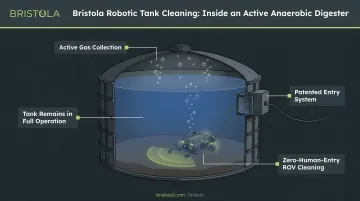
Bristola's zero-human-entry robotic cleaning system fits directly into this model. The system collects sonar-based condition data and performance metrics during active cleaning operations, while the tank remains in full production. No shutdown required. The full-service approach evaluates, stores, and reports on facility condition over time, giving operators the trend data needed to schedule maintenance with confidence.
Major / Overhaul Maintenance
Major overhauls involve full interior inspection, lining replacement, structural repairs, sediment removal, and testing against standards like API 653 or STI SP001. Under API 653, external inspections are required every five years, with the first internal inspection at 10 years post-construction.
A documented example: Bristola's work on a 1.2-million-gallon EnviTec digester in New York required a $411,000 overhaul. The scope included:
- Cleaning, roof replacement, and concrete repair with corrosion-resistant epoxy
- Replacement of five mixers
- Retrofitting an entry port for future live robotic cleanings
During the cleanout, heavy corrosion damage was discovered on the interior concrete walls — invisible until the cleaning phase exposed it. The entry port retrofit eliminated the need for another full shutdown on future service intervals.
Warning Signs Your Tank Needs Maintenance
The faster operators identify these signals, the lower the cost and risk of intervention.
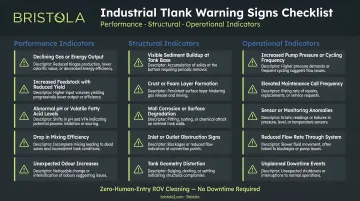
Performance and Output Changes
Output degradation is often the first observable indicator:
- Declining gas yield in digester applications without a feedstock explanation
- Slower processing cycles or reduced throughput
- Variable product quality or inconsistent fill/drain cycle timing
- Equipment requiring more frequent manual adjustment than baseline
Establishing documented output benchmarks during normal operation makes these deviations detectable. A 20% drop in biogas yield — like the EnviTec case above — is measurable. Without a baseline, it can go unnoticed for months.
Visible Wear and Structural Indicators
External signs to watch:
- Corrosion at fitting points or valve connections
- Staining or residue around seals
- Discoloration on exterior tank walls
- Soft spots or visible deformation in the shell
Internal indicators are harder to observe without confined space entry or remote tools:
- Sludge accumulation on the tank floor
- Fouling on agitator components
- Scaling on heat exchange surfaces
Direct visual inspection triggers OSHA confined space protocols, so many facilities rely on performance trends as a proxy — or use robotic inspection tools to assess interior condition safely.
Unusual Operational Behavior
These patterns suggest internal pressure issues, obstructions, or failing mechanical components:
- Gurgling, hammering, or pressure-release sounds
- Unexpected pressure fluctuations or irregular valve operation
- Blocked venting
- Unexplained increases in energy consumption
- More frequent pump cycling or increased agitation system demand
Elevated internal resistance — typically from sediment loading — drives energy use up even when output stays flat. A sustained 10–15% rise in energy draw with no corresponding output gain is a reliable threshold for scheduling an inspection.
Recurring Issues and Unplanned Downtime
Those behavioral warning signs rarely stay isolated. When the same minor faults keep reappearing — clogged filters, tripped alarms, small leaks that re-emerge after patching — the tank likely has an underlying condition that temporary fixes aren't addressing. Repeated band-aid repairs are a signal to schedule a thorough inspection.
Unplanned shutdowns are the clearest indicator that maintenance has fallen behind. For chemicals and oil and gas operations, unplanned downtime costs between $15,000 and $40,000 per hour. For food and beverage facilities, it runs $10,000 to $30,000 per hour. Catching these signs early — before a forced shutdown — is where inspection programs pay for themselves.
Industrial Tank Maintenance Inspection Schedule
Inspection frequency depends on tank type, contents, age, environmental exposure, and operational intensity. A continuously running anaerobic digester has meaningfully different needs than a seasonal chemical storage tank.
| Frequency | Key Tasks |
|---|---|
| Daily / Per Shift | Visual checks for leaks, abnormal sounds, or pressure readings; verify fill levels and vent operation |
| Weekly | Inspect bund and containment area; check pumps, valves, and fittings; review alarm logs |
| Monthly / Quarterly | Assess sediment indicators and output trends; check structural components, seals, and piping; test safety systems |
| Annual / Certified | Full professional inspection per API 653 or STI SP001; ultrasonic wall thickness testing; complete interior assessment; documentation update |
A few important notes on this framework:
- Continuous or high-throughput operations such as anaerobic digesters, covered lagoons, and industrial process tanks often require more frequent professional assessment than this baseline schedule suggests
- EPA SPCC regulations require inspection records to be retained for a minimum of three years under 40 CFR 112.8(c)(6)
- EPA AgSTAR guidance for on-farm digesters recommends daily temperature and pressure checks, weekly safety device reviews, and annual interior inspections as standard minimums
- Bristola's robotic cleaning and data monitoring service integrates condition tracking between annual cleanings, giving operators a continuous performance baseline rather than point-in-time snapshots
A tiered program works best when daily operator checks catch obvious problems early and professional assessments surface what those checks can't reach.
Conclusion
Preventive tank maintenance isn't a cost center. It's a risk management strategy that protects workers, preserves regulatory standing, and extends asset life by decades. A structured program that combines routine operator checks, condition-based monitoring, and periodic professional inspection keeps facilities running at capacity — and avoids the compounding costs of deferred maintenance.
Proactive programs consistently outperform reactive ones — on cost, on safety exposure, and on long-term asset performance. That's true whether you're managing a municipal wastewater tank or an anaerobic digester at a renewable energy facility. The companies seeing the best outcomes are those treating inspection and cleaning as operational discipline, not an afterthought. Companies like Bristola have taken this further, developing robotic cleaning systems that allow tanks to be serviced without human entry or production downtime — removing one of the largest barriers to consistent, scheduled maintenance.
Frequently Asked Questions
How often should tanks be inspected?
Most industrial tanks require at minimum an annual professional inspection, plus monthly visual checks and daily monitoring. High-throughput facilities like anaerobic digesters typically need more frequent professional assessment. EPA SPCC rules require inspection records to be retained for at least three years.
How often do tanks need to be cleaned?
Cleaning frequency depends on tank contents, sludge accumulation rate, and process type. Anaerobic digesters and covered lagoons are generally cleaned every 3–5 years, though the right interval is best determined by monitoring sediment accumulation, gas production trends, and effective volume data rather than a fixed calendar.
What are the different types of tank inspections?
The main categories are: routine operator-level visual inspection, non-destructive testing (ultrasonic wall thickness measurement, camera or sonar inspection), and certified professional inspection to standards such as API 653 or STI SP001. Each serves a different purpose and operates at a different level of technical depth.
What are the 4 types of preventive maintenance?
The four types are: time-based (scheduled on a fixed calendar), usage-based (triggered by operational cycles or throughput), condition-based (triggered by monitored performance indicators), and failure-finding (testing safety systems to confirm they work before they're actually needed).
What are the risks of skipping preventive tank maintenance?
Skipping maintenance causes reduced output from sediment buildup, structural failures that trigger EPA regulatory violations, and elevated safety risk when deteriorated tanks require emergency confined space entry. That last scenario carries the highest injury and fatality rates in industrial maintenance.
Can tank maintenance and cleaning be performed without shutting down operations?
Traditional cleaning requires taking the tank offline, which causes significant production loss. Bristola's robotic cleaning system works while the tank stays in active operation — it actually requires the tank to remain full during cleaning, meaning no draining and no production interruption.