The question isn't if your lagoon needs attention. It's when, and whether you treat that sludge in place or remove it entirely.
Ignore it too long and you'll face reduced capacity, foul odors, and potential permit violations. The EPA notes that excess sludge reduces retention time and treatment effectiveness, and can create short-circuiting channels that let untreated wastewater pass through faster than intended.
This article breaks down both approaches, what they cost, and how robotic cleaning technology is changing the math entirely.
Key Takeaways
- Unmanaged sludge shrinks hydraulic detention time and hurts treatment performance
- In-situ treatment costs less but works slowly; dredging is faster, costlier, and more disruptive
- Zero-entry robotic systems clean lagoons without draining, downtime, or confined-space entry
- Keep sludge depth under 25% of operating depth to protect treatment capacity
Why Sludge Accumulates in Wastewater Lagoons
Settling is how lagoons work. Solids, biological floc, inorganic compounds, and nutrients sink to the bottom as part of normal treatment. Anaerobic organisms break down some of this material, but they never eliminate all incoming solids.
Over years, that residual layer thickens into sludge.
Monitoring requirements vary by permit and location:
- North Carolina DEQ commonly requires annual sludge surveys after the first five years
- Missouri guidance recommends depth checks every two years, maintaining at least 18 inches of water above sludge
- Many facilities plan for full sludge removal on a multi-decade cycle, though the exact interval depends on lagoon type and permit terms
Those checks matter because unmanaged sludge buildup creates three problems:
- Reduced treatment capacity
- Worsening odors
- Diminished effluent quality
The EPA recommends sampling at 12–24 points across the lagoon and keeping sludge depth below 25% of operating depth as a general benchmark.

Treatment vs. Removal: Understanding the Two Approaches
Treatment addresses sludge biologically, in place. Removal physically extracts it. That's the core distinction, and the practical gaps show up in cost, timeline, and downtime.
| Factor | Treatment | Removal |
|---|---|---|
| Cost | Typically much lower | Often hundreds of thousands; can exceed $1M |
| Speed | Months to years | Days to weeks |
| Disruption | Minimal | Often requires draining or shutdown |
| Best for | Preserving compliance margin | Restoring capacity urgently |
A useful comparison comes from Lemoore, California. The city estimated dredging Pond 2 would cost $341 per dry ton, or roughly $1.19 million for 3,502 dry tons of sludge. Instead, they ran an in-place oxidation program for two years, reduced sludge by 1,268 dry tons biologically, and reported saving $321,388.
That's one case, not a guarantee. Still, it puts the tradeoff in concrete numbers.
Which approach fits your facility depends on:
- Current sludge depth relative to operating capacity
- Available budget and timeline
- Regulatory deadlines or corrective-action orders
- How urgently capacity needs restoring
Many operators land on a hybrid strategy: routine treatment to slow accumulation, with periodic removal when treatment alone can't keep pace.

Treating Lagoon Sludge In Place
Aeration and Bioaugmentation
Aeration improves oxygen distribution and mixing throughout the water column, helping microbes contact and break down biodegradable solids faster. Bioaugmentation takes this further, introducing specific bacterial strains to accelerate organic matter breakdown. The two are often paired.
This approach is safer and lower-cost than dredging. It also requires patience.
A 2022 industry article tracking 11 lagoons across eight U.S. states found treatment durations ranging from 2 months to 1 year, with an average sludge reduction of 56%, though results varied significantly (33% standard deviation). Three of the eleven lagoons were too obstructed for accurate measurement.
The Three Stages of Sludge Digestion
In-place treatment takes months because digestion itself is staged. Under anaerobic conditions, that process has three phases:
- Acid formation — carbohydrates convert to volatile fatty acids, and pH drops
- Acid regression — volatile acids and nitrogenous compounds form ammonia and amines, and pH begins rising
- Alkaline fermentation — methane-forming organisms convert remaining acids into carbon dioxide, methane, and water
This staged process explains why unstable anaerobic conditions produce strong odors, and why biological stabilization isn't instant. Treatment can reduce sludge volume, but it requires ongoing monitoring across months.

Removing and Disposing of Lagoon Sludge
The Dredging Process
Mechanical or floating dredge pumps extract settled solids without necessarily taking the lagoon fully offline, though many projects still require partial drawdown. Once removed, sludge needs dewatering before disposal.
Common dewatering methods:
- Drying beds: practical in dry climates, but need significant land area and favorable weather
- Geotextile bags: permeable containers that drain water while solids stay contained
- Belt filter press: polymer conditioning plus progressive pressure between porous belts

Disposal Options and Regulatory Limits
Dewatered sludge typically goes to landfill, composting, or land application. Land application must meet EPA Part 503 metal content limits. Ceiling concentrations include:
- Arsenic: 75 mg/kg dry weight
- Lead: 840 mg/kg
- Zinc: 7,500 mg/kg
Pathogen reduction and vector attraction requirements apply as well.
Costs vary enormously by site. A Missouri project reported 118.4 dry tons removed for over $75,000, while an Idaho project bundling lagoon cleaning with other infrastructure work totaled over $1.5 million. The EPA recommends estimating costs only after measuring sludge volume and characterizing its chemical makeup, not by lagoon acreage alone.
Removal is thorough but labor-intensive. It requires permitting, sampling, and often significant downtime, which is why many facilities treat it as a last resort rather than routine maintenance.
A Modern Alternative: Maintaining Lagoons Without Downtime or Human Entry
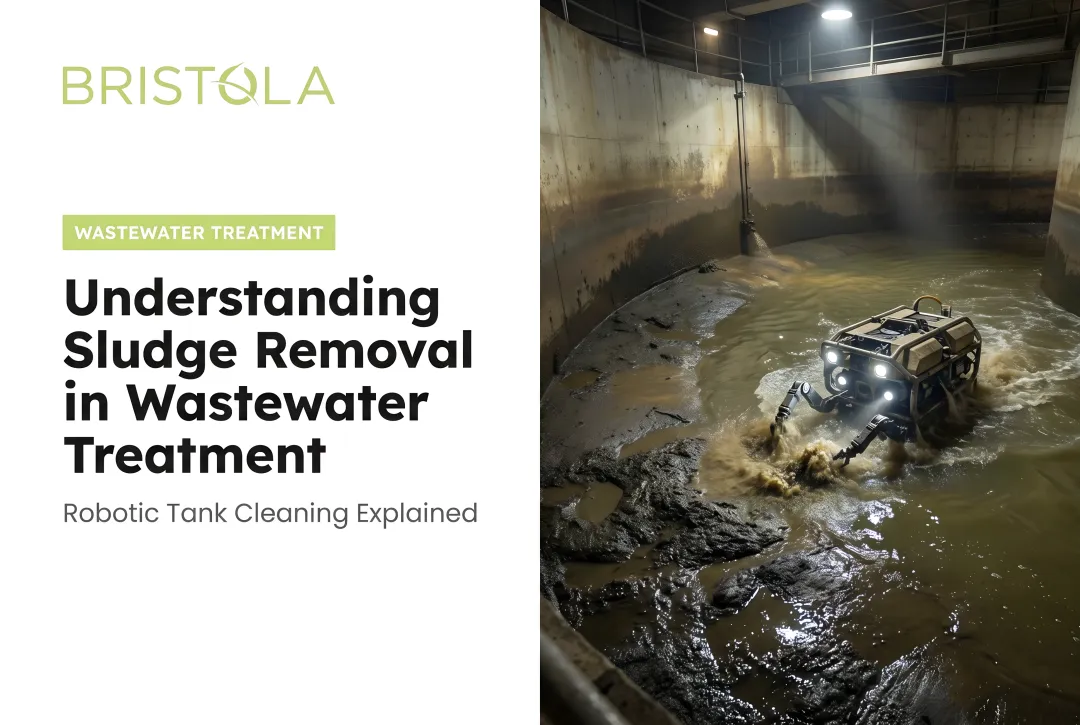
Robotic cleaning lets operators remove sludge mechanically while the lagoon stays full and online. That option sits between slow biological treatment and disruptive dredging—without forcing a full shutdown.
Bristola's zero-human-entry robotic system works through a patented equalization-chamber entry portal, compatible with manholes 24 inches in diameter or larger. Here's how it functions on a covered lagoon:
- Initial setup: A section of the lagoon berm is modified to accept a prefabricated concrete wall, with a manhole installed below the liquid level
- Robot deployment: The submersible ROV enters through the portal without draining the lagoon or removing the cover
- Sludge removal: Using sonar navigation, the robot locates and removes accumulated solids, pumping sludge through a flexible hose for processing

The one caveat: initial installation on an existing covered lagoon does require temporary draining and partial cover removal. After that one-time setup, subsequent cleanings happen with the lagoon full and running.
Why this matters for operators:
- No confined-space entry required for routine cleaning
- No production downtime after the initial installation
- No temporary storage arrangements for incoming waste streams
- No crew exposure to the hazards of traditional dredging
For facilities weighing treatment against removal, this represents a third path: mechanical sludge removal without the operational cost of a full dredging shutdown.
Frequently Asked Questions
How much does it cost to dredge or drain a sludge lagoon?
Lagoon size and sludge volume drive cost, and larger projects can reach hundreds of thousands of dollars. Measure sludge volume, characterize composition, then get a site-specific quote.
How often do sludge lagoons need to be cleaned?
Many facilities plan full removal on a multi-decade cycle and check depth every few years. Confirm your permit requirements—intervals vary by state and lagoon type.
Do sludge lagoons smell?
Yes, and odor typically worsens as sludge depth grows and anaerobic conditions intensify. Regular depth monitoring helps catch buildup before odor becomes a nuisance complaint.
What are the three stages of sludge digestion?
Acid formation breaks carbohydrates into volatile fatty acids, acid regression converts nitrogenous compounds into ammonia, and alkaline fermentation turns remaining acids into methane and carbon dioxide.
Is it better to treat or remove wastewater lagoon sludge?
Treatment is more cost-effective for ongoing management when you have compliance margin and time. Removal becomes necessary once sludge severely impacts capacity or a permit deadline forces the issue.