Introduction
Bristola founder Jared Burma knows firsthand what can go wrong inside a storage tank. A near-death experience during a confined space cleaning operation became the catalyst for a company built around one idea: no worker should ever have to enter a tank again.
That close call reflects a broader industry reality. Confined space cleaning remains one of the most dangerous operations in industrial maintenance. Tanks, digesters, covered lagoons, and reactor vessels create conditions — toxic atmospheres, oxygen deficiency, extreme heat, no escape routes — that turn routine maintenance into life-threatening work.
Traditional methods have changed little over decades. Workers still enter. Workers still die. Robotic systems are finally changing that.
This guide covers the real hazards of manual confined space cleaning, how robotic systems structurally eliminate those risks, the efficiency gains from cleaning without stopping production, what to look for in a system, and which industries benefit most.
Key Takeaways
- 1,030 workers died in confined space incidents from 2011–2018, with atmospheric hazards as the leading cause
- Traditional tank cleaning requires full shutdown, human entry, and weeks of lost production
- Robotic systems remove workers from the hazard entirely — not just manage the risk
- Bristola's zero-human-entry system cleans tanks while they stay in active operation
- Annualized cost savings can reach $381,885 per digester compared to traditional methods
The Hidden Dangers of Traditional Confined Space Cleaning
Under OSHA's 29 CFR 1910.146, a confined space is any space large enough to enter and perform work, with limited means of entry or exit, and not designed for continuous occupancy. Storage tanks, anaerobic digesters, culverts, vessel reactors, and covered lagoons all qualify — and most become permit-required confined spaces because they contain or can generate hazardous atmospheres.
Permit-required status triggers a chain of mandatory employer obligations: written entry programs, atmospheric testing, rescue team availability, and documented entry permits for every entry event.
Hazards Workers Face During Manual Cleaning
The physical environment inside a liquid storage tank creates multiple simultaneous hazards:
- Toxic and oxygen-deficient atmospheres — anaerobic digesters and wastewater tanks generate hydrogen sulfide (H2S), methane, and CO2 through organic decomposition. H2S reaches NIOSH's immediately dangerous to life or health (IDLH) threshold at just 100 ppm; at 500–700 ppm, collapse can occur within five minutes
- Oxygen displacement — methane and CO2 displace breathable air, creating deficient atmospheres below OSHA's 19.5% oxygen floor without visible warning
- Extreme heat and humidity — enclosed tanks trap heat, accelerating worker fatigue and heat stress
- Slippery, unstable surfaces — sludge-covered floors and sloped walls make footing treacherous during manual scraping or high-pressure blasting
- Restricted escape routes — a single manhole entry point means any emergency evacuation is slow, requiring retrieval equipment
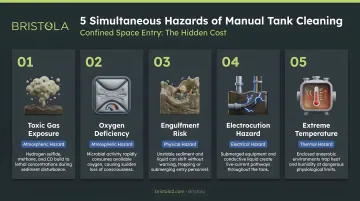
According to BLS data, 1,030 workers died in confined space incidents from 2011 to 2018 — an average of roughly two fatalities per week. Atmospheric hazards caused the majority. Over 60% of confined space deaths involve would-be rescuers who entered without proper equipment.
The Operational Cost of Human Entry
Those fatality numbers reflect physical risk alone. The compliance burden begins well before anyone enters — and the financial toll extends far beyond the cleaning itself.
Before a single worker sets foot inside a tank, OSHA requires facilities to complete a documented sequence:
- Identify and classify the permit-required space
- Test the atmosphere (oxygen, flammable gases, toxic gases — in that order)
- Set up forced ventilation
- Issue a written entry permit specifying conditions, duration, testers, and rescue contacts
- Station a trained attendant outside the space for the entire duration
- Ensure a rescue team capable of retrieval within five feet of vertical spaces
That permitting process consumes time and labor before any cleaning begins. The tank must then be fully drained — typically 20+ days for a large digester — with product moved to temporary storage if available. Restart after cleaning adds another 20+ days. For a large digester, total production loss routinely spans 40+ days, not counting permitting labor, temporary storage logistics, or restart costs.
How Robotic Systems Eliminate Confined Space Entry Risks
The core safety shift is structural, not procedural. Traditional safety management tries to make human entry survivable through permits, monitors, and rescue teams. Robotic systems make human entry unnecessary.
When no one enters the tank, atmospheric poisoning, drowning, entrapment, and rescue-related deaths become structurally impossible — not just statistically less likely.
How the Bristola Zero-Human-Entry System Works
Bristola's system centers on a patented airlock-type equalization chamber entry system developed by CTO Ian Dunlap:
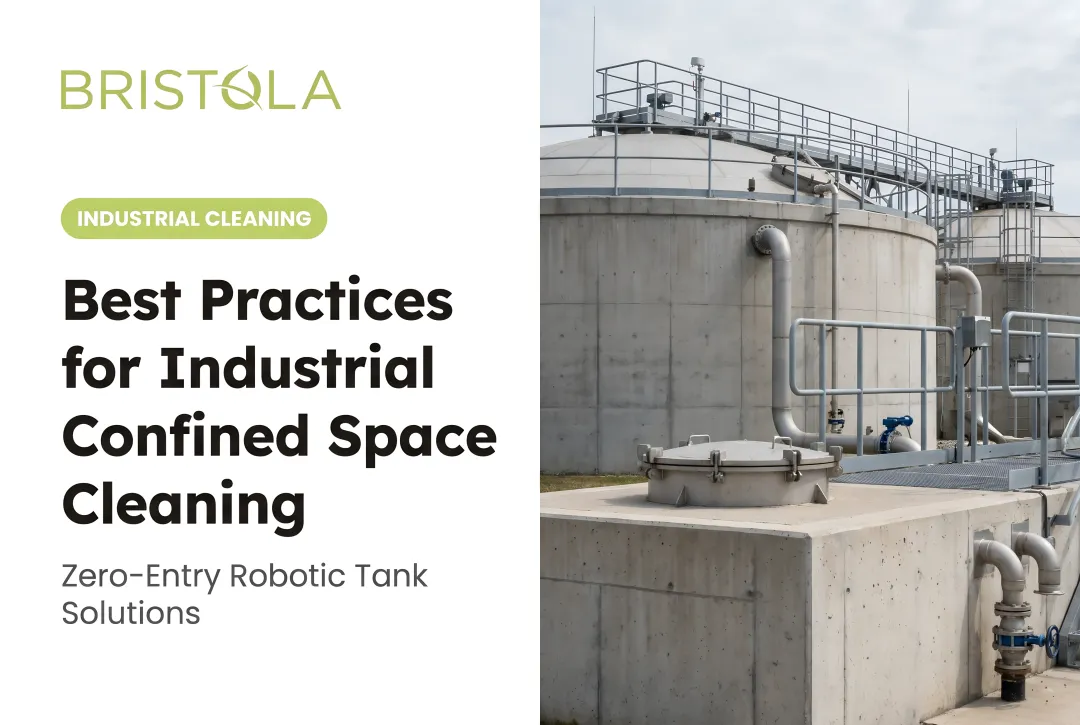
- A purpose-built entry portal installs on the tank's manhole (compatible with any manhole 24 inches in diameter or larger)
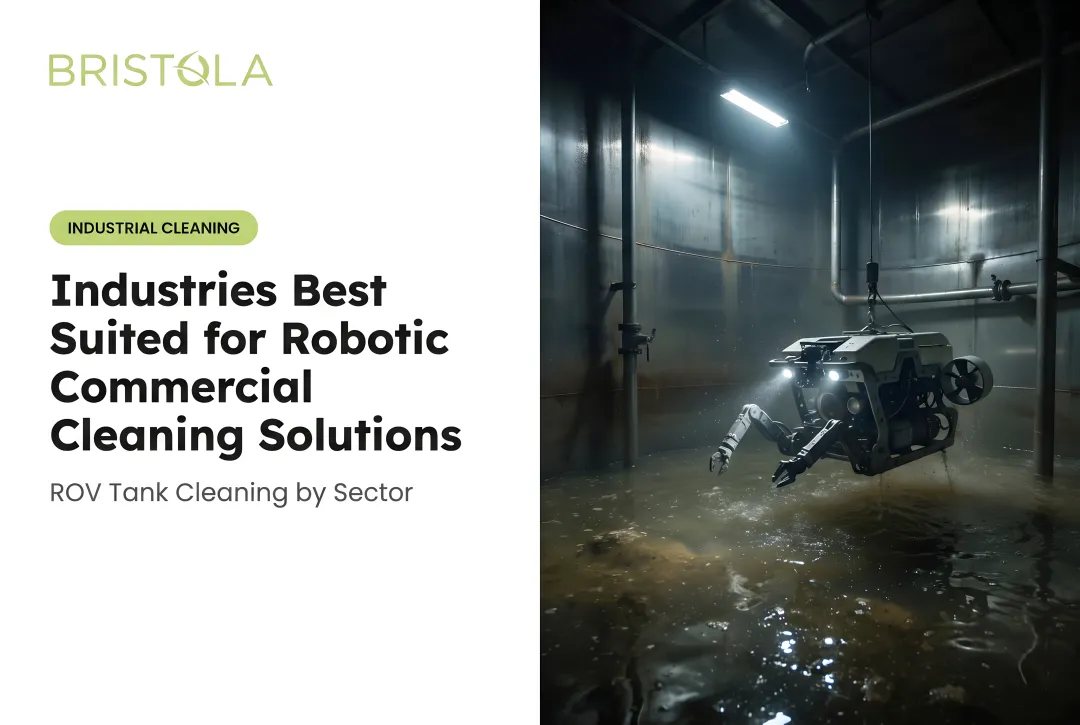
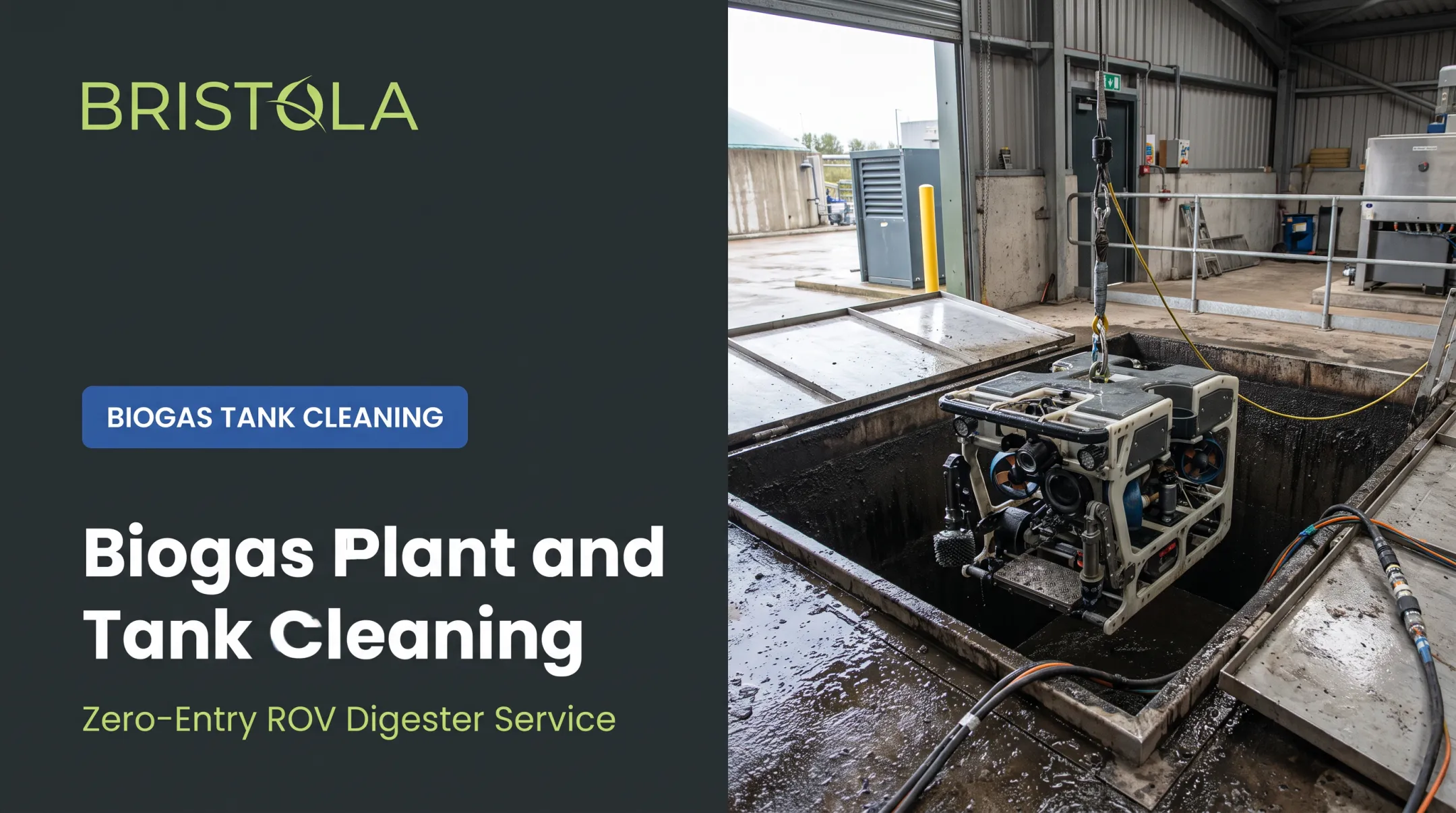
- A remote-controlled submersible ROV enters through the portal via the patented pressure equalization chamber
- The ROV descends via a winch system to the tank floor, removing sludge and sediment using vacuum suction
- Removed material travels through a flexible hose to the customer's preferred processing point
- The operator remains completely outside the tank at all times, controlling the ROV remotely
- When cleaning is complete, the winch retrieves the ROV, which retracts back into the pressure box for removal
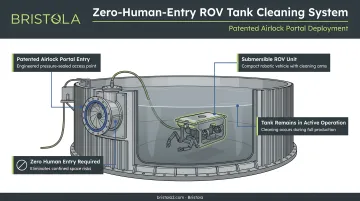
No confined space entry. No entry permit. No standby rescue team — and no atmospheric testing protocol to trigger.
Documentation and Risk Reduction
Eliminating entry is only part of the equation. Onboard sonar navigation, cameras, and sensors capture real-time data on tank conditions throughout every cleaning operation. Bristola's proprietary system evaluates, stores, and reports that data — creating a verifiable audit trail for compliance tracking and predictive maintenance planning.
For facilities that haven't yet eliminated human entry across every operation, robotic systems still deliver measurable risk reduction:
- Fewer exposure hours for workers near the hazard zone
- No work-at-height requirements inside tanks
- Reduced personnel count required during cleaning operations
Efficiency Gains: Cleaning Tanks Without Stopping Production
Safety drives the argument for robotic cleaning — but the financial case is just as hard to ignore, especially for facilities that run around the clock.
The True Cost of a Traditional Cleaning Shutdown
Bristola's published case study documents the full cost picture for a 1.2-million-gallon, 90-foot-diameter anaerobic digester cleaned using traditional methods:
| Cost Component | Amount |
|---|---|
| Tank drain time | 22 days |
| Active cleaning time | 10 days |
| Refill and restart time | 22 days |
| Total downtime | ~54 days |
| Cleaning cost | ~$220,000 |
| Tank top removal/replacement | ~$200,000 |
| Lost gas revenue (44 offline days) | ~$283,800 |
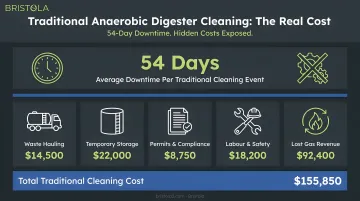
These figures reflect a standard cleaning cycle, not an outlier.
Cleaning While the Tank Runs
Bristola's system is engineered to clean while the facility stays in active production. The patented entry portal lets the ROV access the tank through the roof or manhole — no draining required, no operations halted, no temporary storage needed.
One operational requirement: the tank must remain in service during cleaning. Bristola's system depends on liquid being present — it serves as a dilution medium for removed sediment during the vacuuming process.
The one exception is covered lagoons, which require a one-time modification during initial installation (draining the lagoon to install the berm infrastructure). After that first setup, all subsequent cleanings happen with the lagoon in full operation.
The Compounding Value of Regular Cleaning
Sludge accumulation doesn't just create a cleaning problem — it reduces facility performance. In an anaerobic digester, grit buildup follows a predictable progression:
| Year | Estimated Grit Buildup | Performance Impact |
|---|---|---|
| 1 | 5% (1.25 ft in a 25-ft tank) | Minimal |
| 3 | 20% (5.0 ft) | 14–17% biogas loss |
| 5 | 30% (7.5 ft) | Significant capacity reduction |
At 20% buildup, estimated revenue loss runs approximately $1,050 per day. Over five years, deferred cleaning compounds to roughly $1.9 million in lost production. Regular robotic cleaning prevents that accumulation from reaching critical levels — preserving both gas output and tank capacity continuously rather than trying to recover lost ground in a massive, expensive cleanout.
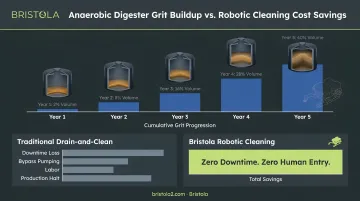
Annualized cost comparison for the same 1.2-million-gallon digester: $524,010 with traditional methods vs. $142,125 with Bristola's system — a potential annual savings of approximately $381,885 per digester.
Key Features to Look for in a Confined Space Cleaning Robot
Not all robotic cleaning systems deliver the same level of safety or operational value. Here's what separates a true zero-entry solution from a partial improvement.
Entry Mechanism
The single most critical feature. A genuine zero-human-entry system requires a purpose-built entry port — not just a smaller access point that still requires a worker to position hoses or equipment near the opening. Look for patented or proprietary systems with pressure equalization technology that maintains tank integrity during robot deployment.
In-Service Compatibility
The system should clean while the facility operates. If a robotic system still requires draining or a production halt, it eliminates the safety risk of human entry but preserves most of the operational downtime costs. True efficiency gains require both.
New Build and Retrofit Capability
A practical system must work for existing facilities, not just greenfield installations. Bristola's entry portal adapts to any manhole 24 inches or larger, making it viable as a retrofit for most operating tanks and digesters.
Data and Reporting
Strong systems include onboard sonar, cameras, and software that capture real-time tank conditions, sediment levels, and cleaning performance. This supports:
- Compliance documentation and audit-ready reporting
- Benchmarking against historical performance data
- Predictive maintenance scheduling before small issues become costly ones
Deferred cleaning compounds fast. Without this visibility, routine maintenance can quietly escalate into a six-figure emergency.
Industries That Benefit Most from Robotic Confined Space Cleaners
The strongest case for robotic cleaning exists wherever three conditions overlap: continuous operations that can't afford downtime, tank environments that generate toxic or explosive atmospheres, and a cleaning frequency requirement that puts workers at recurring risk.
Highest-impact sectors:
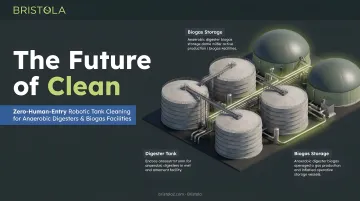
- Anaerobic digesters and biogas/RNG facilities — sludge accumulation directly reduces gas output and RNG revenue. The U.S. has nearly 2,600 operational biogas facilities, with the RNG sector adding a record 130 new facilities in 2025 alone, each requiring frequent cleaning under hazardous conditions
- Wastewater and water treatment plants — wet wells and digesters generate H2S and methane continuously, creating permit-required spaces that must be cleaned on regular cycles under hazardous conditions
- Oil and gas refineries and liquid storage terminals — large-volume tanks with hydrocarbon residue, flammable atmospheres, and significant liability exposure during manual entry operations
Strong secondary fit:
- Food and beverage processing facilities and slaughterhouses/protein operations
- Pulp and paper mills — covered lagoon cleaning is a documented application across production facilities
- Steel mills and industrial process tank operators
- Barge, railcar, and specialized transport tank cleaning
Bristola's work spans this full range of sectors: biogas operators like Brightmark, Vanguard Renewables, and Maas Energy Works; food processors like JBS; industrial operators like ADM; and energy majors like Shell. That cross-industry depth reflects a consistent pattern — wherever liquid storage facilities run continuously and manual entry creates real risk, robotic cleaning delivers a measurable advantage.
Frequently Asked Questions
How much does a confined space cleaning robot cost?
Pricing depends on tank size, system type, and whether you purchase outright or use an annual service agreement. For a 1.2-million-gallon digester, Bristola's annualized cost runs approximately $142,125 — compared to $524,010 for traditional methods. Contact Bristola for a facility-specific assessment.
What is considered a confined space in an industrial setting?
Under OSHA's definition in 29 CFR 1910.146, a confined space is large enough to enter and perform work, has limited means of entry or exit, and is not designed for continuous occupancy. Common examples include storage tanks, anaerobic digesters, culverts, silos, and reactor vessels.
Can a robotic tank cleaner operate while the tank is still in production?
Most conventional robotic systems still require the tank to be offline. Bristola's patented zero-human-entry system is designed to clean tanks while they remain in active operation — no draining, no shutdown, no temporary storage required.
What industries use confined space cleaning robots?
Primary sectors include biogas and RNG facilities, wastewater and water treatment plants, oil and gas refineries, and food and beverage processing — along with any industrial operation running liquid storage tanks or enclosed process vessels.
How do robotic cleaning systems support OSHA compliance?
By eliminating human entry, robotic systems remove the trigger conditions for permit-required confined space procedures under 29 CFR 1910.146 — reducing or eliminating the need for entry permits, standby rescue teams, and continuous atmospheric monitoring during cleaning operations.
How is robotic confined space cleaning different from traditional methods?
Traditional cleaning requires human entry, full tank shutdown, atmosphere testing, rescue team standby, and weeks of downtime. Robotic systems perform the same work remotely — with an operator outside the tank at all times.