COD, or Chemical Oxygen Demand, measures the total oxygen required to oxidize organic and inorganic pollutants in water. Typical levels vary drastically by industry: municipal wastewater runs 250–800 mg/L, dairy processing 2,000–6,000 mg/L, and cheese whey can reach 50,000–100,000 mg/L. That range matters because COD non-compliance is rarely about the pollutant itself—it's about treatment systems that weren't designed for the actual load, operations that drift from optimal parameters, or vessels that accumulate sediment until capacity quietly erodes.
This guide approaches COD reduction across three dimensions: treatment design decisions, operational management, and system-level configuration. Identifying which dimension your problem lives in is the first step to fixing it.
Key Takeaways
- High COD in effluent signals an overloaded system, the wrong treatment method, or poor operational discipline—not an uncontrollable variable
- Match treatment technology to COD load: aerobic below ~1,000 mg/L, anaerobic above 4,000 mg/L, combined for the range between
- Implement source control, primary separation, and nutrient balancing to prevent compliance failures at the source
- Consistent control of DO, SRT, pH, temperature, and vessel cleanliness is what separates a well-designed system from a performing one
How COD Accumulates in Wastewater Systems
COD doesn't spike from a single event. It builds progressively as organic waste from multiple sources—process effluents, cleaning chemicals, food residues, biological sludge, and industrial byproducts—enters the wastewater stream continuously.
The accumulation is compounding. Undertreated loads carry over between process stages, increasing the oxygen demand placed on downstream biological systems and reducing their effectiveness at each step. Autotrophic nitrifying biomass is roughly 10 times more sensitive to organic overload than heterotrophic bacteria, meaning a modest upstream treatment failure can create a disproportionate downstream compliance problem.
High COD often goes undetected until a discharge test fails. Routine monitoring is inconsistent across many facilities, and the true pollutant load is frequently hidden before it ever reaches the treatment stage — buried in:
- Stored sludge accumulating at tank bottoms
- Sediment layers in holding and equalization tanks
- Combined waste streams that dilute and mask actual concentrations
Key Drivers of High COD in Industrial Wastewater
Three root causes explain the majority of persistent COD compliance failures.
Organic Input Strength and Variability
Industries like food and beverage processing, slaughterhouses, dairy, biogas facilities, and pulp and paper generate wastewater that is high in soluble organics, fats, oils, and biological material. COD concentrations vary widely by source:
- Slaughterhouse effluent: 2,333–8,627 mg/L
- Cheese whey: 50,000–100,000 mg/L
The stronger and more variable the influent load, the harder it is for treatment systems to keep pace with average-load design assumptions.
Treatment Mismatch
Matching the treatment technology to influent strength is critical. General thresholds to guide system selection:
- Below 1,000 mg/L: Aerobic biological treatment is typically sufficient
- 1,000–4,000 mg/L: Combined anaerobic-aerobic sequences should be evaluated
- Above 4,000 mg/L: Anaerobic systems are better suited to handle the load
Research from Pasmionka et al. (2022) found that industrial wastewater with COD above 400 mg/L caused nitrification inhibition above 50% in certain streams—and that diluting the COD didn't reduce inhibition, confirming the presence of recalcitrant compounds that resist biological degradation entirely. Chlorobenzene inhibited nitrification at concentrations as low as 0.75 mg/L.
Operational and Infrastructure Degradation
Poor sludge management, insufficient aeration capacity, imbalanced nutrient ratios, and sediment buildup inside treatment vessels drive COD non-compliance even when the right technology is in place. Before investing in new equipment, auditing these operational variables often reveals faster, lower-cost paths to compliance.
Strategies to Reduce COD in Wastewater
Effective COD reduction requires matching the strategy to where the problem originates. The wrong fix applied to the right system wastes resources without resolving the issue.
Strategies That Reduce COD Through Better Treatment Decisions
These are decisions made during system design or technology selection that determine how much COD the treatment system is realistically capable of removing.
Match treatment technology to COD concentration and type:
| COD Range | Recommended Approach |
|---|---|
| < 1,000 mg/L (biodegradable) | Aerobic biological treatment |
| 1,000–4,000 mg/L | Combined anaerobic-aerobic sequence |
| > 4,000 mg/L | Anaerobic digestion as primary stage |
| > 50,000 mg/L | Evaporation or incineration |
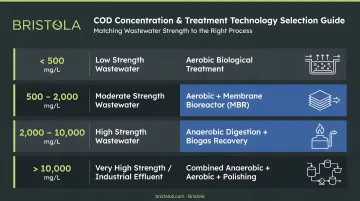
Running aerobic treatment on a 30,000 mg/L waste stream creates persistent non-compliance regardless of how well the system is operated. The technology ceiling is the binding constraint, not operational execution.
Use primary separation before biological treatment:
Dissolved air flotation (DAF) combined with coagulation-flocculation achieved up to 90% COD removal and 98% TSS removal in meat industry wastewater. DAF removes suspended solids, fats, oils, and colloidal organics before the soluble COD fraction reaches biological stages—reducing load on aeration systems and improving overall removal efficiency.
Apply chemical pre-treatment for toxic or recalcitrant fractions:
Compounds like pesticides, phenols, chlorinated solvents, and certain industrial dyes inhibit biological treatment. Pre-treatment with oxidants—ozone, hydrogen peroxide, or advanced oxidation processes (Fenton's reagent, UV/H₂O₂)—breaks carbon-carbon bonds in these compounds, converting them into biodegradable intermediates. Fenton oxidation achieved 89% COD removal on industrial textile wastewater at an operating cost of $10.55/m³. The COD:BOD₅ ratio (a value below 2.2 indicates biological treatability) is a practical screening tool for determining whether AOPs are needed before biological stages.
Strategies That Reduce COD Through Operational Control
These are the day-to-day management variables that determine whether a correctly designed system delivers consistent results.
Optimize aeration and dissolved oxygen levels:
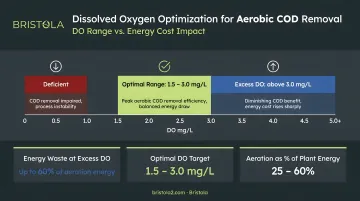
The optimal dissolved oxygen range for aerobic COD removal is 2–4 mg/L. At DO below 1 mg/L, COD removal drops to 15–25%. Above 8 mg/L, energy costs climb from 1.7 kWh/m³ to 2.63 kWh/m³ with diminishing treatment returns. Temperature changes, peak loading events, and seasonal variation all affect oxygen transfer efficiency—each requires active compensation, not passive monitoring.
Manage sludge retention time and F:M ratio:
| Treatment Mode | F:M Ratio | SRT (days) |
|---|---|---|
| Conventional activated sludge | 0.2–0.5 | 5–15 |
| Extended aeration | 0.05–0.15 | 20–30 |
| High-rate | 0.4–1.5 | 1–5 |
SRT that's too short washes out the slow-growing organisms responsible for COD removal; push it too long and inert sludge accumulates, dragging down treatment efficiency. Balancing the F:M ratio—pounds of incoming BOD relative to pounds of active biomass—keeps microorganisms operating within their effective degradation range.
Maintain treatment vessel cleanliness and active volume:
Sediment and sludge accumulation inside anaerobic digesters, covered lagoons, and wastewater storage tanks progressively reduces the effective treatment volume available for COD breakdown. Grit and sediment can occupy 20–30% of total digester volume, directly cutting hydraulic retention time. Resuspended deposits during high-flow events cause sudden COD spikes in effluent.
For facilities operating anaerobic digesters or covered lagoons, Bristola's patented Equalization Chamber Entry System addresses this problem without requiring downtime. The airlock-type system allows Bristola's submersible ROV to enter tanks through a unique manhole portal—compatible with any opening 24 inches or greater—while the facility remains full and in production. The ROV removes accumulated sludge via a flexible hose to an external processing point, with no human entry required.
Bristola has deployed this system at covered lagoon facilities specifically managing COD and BOD treatment objectives, including pulp and paper production sites using lagoons to reduce influent chemical oxygen demand. Traditional drain-and-clean approaches require stopping production, coordinating temporary storage, and sending personnel into confined spaces—a process that costs facilities roughly $250,000 annualized per tank compared to approximately $170,000 with the robotic system.

Control pH and temperature within optimal biological ranges:
Microbial activity responsible for COD removal roughly doubles for every 10°C rise in temperature within the mesophilic range (optimum near 35°C). pH deviations and temperature extremes can inhibit or crash biological treatment entirely. Industrial process inputs can cause rapid shifts in both parameters—active monitoring and adjustment, not periodic checks, is what separates compliant systems from non-compliant ones.
Strategies That Reduce COD by Addressing System-Level Factors
These are external factors—influent variability and system architecture—that drive COD non-compliance regardless of how well individual treatment components perform.
Install equalization basins to buffer shock loads:
COD non-compliance is frequently triggered by sudden high-concentration inputs: end-of-shift cleaning events, process upsets, seasonal production surges. Equalization basins absorb these spikes and release wastewater at a controlled, steady rate—giving biological systems a consistent, manageable feed. Typical sizing targets 10–30% of average daily flow. Benefits extend to reduced chemical usage, lower energy consumption, and more stable performance from primary clarifiers and biological reactors.
Segregate and pre-treat high-strength waste streams separately:
Mixing a high-COD process stream (concentrated food processing waste at 20,000+ mg/L) with lower-strength general wastewater creates a combined stream that is too concentrated for municipal-style aerobic systems but too dilute for efficient standalone anaerobic treatment. The result is a worst-of-both-worlds scenario. Treating high-strength streams in dedicated pre-treatment units before combining with the main flow allows each treatment step to operate within its effective concentration range.
Ensure adequate nutrient balance for biological systems:
Biological COD removal requires sufficient nitrogen and phosphorus for microbial synthesis. The standard nutrient mass ratio is 100:5:1 for BOD:N:P. Industrial wastewaters—particularly food processing streams that are carbon-heavy—frequently require nitrogen and phosphorus supplementation. Deficiency in either nutrient limits microbial growth and reduces COD removal efficiency regardless of how well aeration, SRT, and pH are managed.
Conclusion
Reducing COD in wastewater is not a matter of finding the most advanced technology. It requires first identifying whether the problem originates in treatment design, operational control, or system configuration—then targeting the right intervention at the right stage.
Compliance is also not a one-time engineering achievement. Discharge limits vary by jurisdiction and receiving body. COD sources shift with production cycles. Treatment systems degrade over time without consistent monitoring and maintenance. Sediment accumulates, nutrient ratios drift, and aeration efficiency declines.
Facilities that treat COD management as an ongoing operational discipline—rather than a box checked at commissioning—achieve sustained compliance at lower cost. The interventions with the highest return are often the least glamorous:
- Equalization basins to buffer load variability
- Routine nutrient monitoring to keep biological treatment on track
- Regular sediment removal to maintain treatment vessel capacity before performance degrades
Sediment buildup in treatment tanks is a slow, invisible problem—until it isn't. Robotic cleaning systems like those offered by Bristola remove accumulated solids without halting production, making it practical to address buildup on a schedule rather than in response to a failed discharge test.
Frequently Asked Questions
What causes high COD in industrial wastewater?
High COD in industrial wastewater stems from organic-rich process inputs (food residues, animal waste, chemicals, and petroleum byproducts), compounded by inadequate treatment capacity, poor load balancing, or recalcitrant compounds that biological systems cannot break down. Variable influent strength paired with mismatched treatment capacity is the most common pattern.
How do you reduce COD in wastewater treatment?
COD is reduced through physical separation (screening, DAF), biological treatment (aerobic or anaerobic depending on concentration), and chemical oxidation for toxic or resistant fractions. The most effective approach depends on COD type, concentration, and discharge requirements; no single method addresses all scenarios.
Does aeration reduce COD?
Aeration supports aerobic microbial activity that breaks down biodegradable COD, making it a core component of biological treatment. It does not address non-biodegradable or recalcitrant COD fractions, which require chemical oxidation or advanced processes such as activated carbon adsorption or membrane filtration.
Can RO reduce COD?
Reverse osmosis physically rejects dissolved organics and works best as a polishing step after primary and secondary treatment, not as a standalone method for high-strength wastewater. Applying RO before adequate biological pre-treatment significantly increases the risk of organic membrane fouling.
What is the permissible limit of COD in wastewater?
There is no single national COD limit in the U.S. Limits are set through NPDES discharge permits based on facility type, discharge destination, and receiving body. Direct discharge to surface water typically requires 75–250 mg/L COD; discharge to a POTW may allow 200–1,000 mg/L.
How do you reduce BOD and TSS in wastewater?
BOD is reduced through the same biological and chemical methods used for COD. TSS is primarily addressed through physical separation—screening, sedimentation, and filtration—typically as a primary treatment step before biological stages. Combining both approaches in the correct sequence delivers the greatest overall reduction.