This guide is written for wastewater treatment operators, plant engineers, and industrial facility managers who rely on this process daily for compliance and effluent quality. We'll cover how the process works, its stages, where it's applied, and the factors that determine whether your plant runs smoothly or struggles with bulking, foaming, and permit violations.
TL;DR
- Secondary treatment that uses aerated tanks and microbial flocs to break down organics
- Industry standard for municipal and industrial plants thanks to reliability and scale
- Core stages: aeration, settling/clarification, then sludge return or wasting
- Key controls: dissolved oxygen, MLSS, sludge age, and equipment upkeep
- Tight stage control prevents bulking, foaming, and treatment efficiency losses
What Is the Activated Sludge Process?
Activated sludge is a biological treatment method where wastewater is mixed with a bacteria-rich sludge and aerated to oxidize organic material. Microorganisms consume dissolved and suspended organic pollutants, converting them into carbon dioxide, water, and new microbial cells. Those cells then settle out and are removed from the water stream.
It differs from other common treatment approaches:
- Primary treatment: Physical settling only—no biological action
- Trickling filters: Fixed-film systems where bacteria grow on media
- Membrane bioreactors (MBRs): Membranes replace gravity settling for separation
Why the Activated Sludge Process Is Used in Wastewater Treatment
A 2022 peer-reviewed study describes activated sludge as the most widely used biological wastewater treatment process in developed regions. Decades of refinement against strict regulatory demands made it the industry standard.
In the US, secondary treatment standards require:
- Consistent BOD5 and TSS removal per EPA secondary treatment standards
- A 30-day average removal of at least 85% under 40 CFR Part 133
- pH control within permitted ranges
Municipal and industrial plants need a treatment method that scales with flow and handles variable organic loads without constant redesign. Without adequate secondary treatment, untreated organics enter waterways, deplete dissolved oxygen, kill aquatic life, and trigger regulatory violations.
Cost matters too. Compared to alternatives like MBRs, activated sludge typically offers lower capital and operating costs at scale, which is why it remains the default choice for most permit-driven facilities.
How the Activated Sludge Process Works (Conceptual Flow)
Wastewater enters an aeration tank, mixes with microbial biomass, and is aerated before flowing to a clarifier for separation.
Inputs and mechanics:
- Feed: settled wastewater (post-primary treatment) plus returned activated sludge (RAS)
- Core action: bacteria and protozoa metabolize organic pollutants using oxygen from diffusers or surface aerators
- Control levers: aeration rate, RAS recycling ratio, sludge wasting
- Result: reduced organic load, increased biomass, clarified effluent
Step 1: Aeration
Wastewater and activated sludge mix in the aeration tank while oxygen is introduced via diffused or mechanical aeration. This sustains microbial activity for several hours. According to EPA's process-control manual, conventional aeration runs 6-10 hours, while extended aeration systems run 18-36 hours depending on design and loading.
Step 2: Settling/Clarification
The aerated mixture flows to a secondary clarifier where flocs settle by gravity. This separates treated water — headed toward discharge or further polishing — from the biomass that needs to be recycled or wasted.
Step 3: Sludge Return and Wasting
A portion of settled sludge (RAS) is pumped back into the aeration tank to maintain microbial concentration. Excess biomass, known as waste activated sludge (WAS), is removed for further handling. Per EPA guidance on activated sludge, conventional RAS rates commonly run 20-30% of raw wastewater flow; rates above 50% can impair clarification instead of helping it.

Where the Activated Sludge Process Is Applied
Activated sludge operates as the secondary treatment stage, coming after preliminary screening and primary sedimentation. Facilities typically use it to meet discharge permits or to treat high-organic-load effluent before discharge or reuse.
Common applications include:
- Municipal wastewater treatment plants
- Food and beverage processing facilities
- Breweries with high-strength organic wastewater (PMC brewery wastewater study)
- Pulp and paper plants after primary clarification (pulp and paper industry review)
Unlike batch treatments, this is a continuous process. Aeration tanks and clarifiers run around the clock, so maintenance has to be planned around live operation—not downtime windows.
Key Factors That Affect the Activated Sludge Process
Several variables determine whether your system meets permit limits or struggles with poor effluent quality:
- Influent characteristics — organic load (BOD/COD) and any toxic or inhibitory substances entering the system
- Operating conditions — dissolved oxygen levels, temperature, and pH, all of which directly affect microbial activity
- Equipment reliability — aerators, blowers, clarifiers, and RAS pumps must function consistently
- Scale and flow variability — hydraulic and organic shock loads can overwhelm biomass capacity
- Regulatory constraints — permitted effluent limits for BOD, TSS, and nutrients set the performance bar
Equipment condition is often the hidden constraint. Unmaintained tanks and clarifiers accumulate sludge that cuts treatment efficiency and raises downtime risk. Traditional cleaning means draining the tank, sending crews into confined spaces, and stopping treatment—a poor fit for a process that has to run continuously.
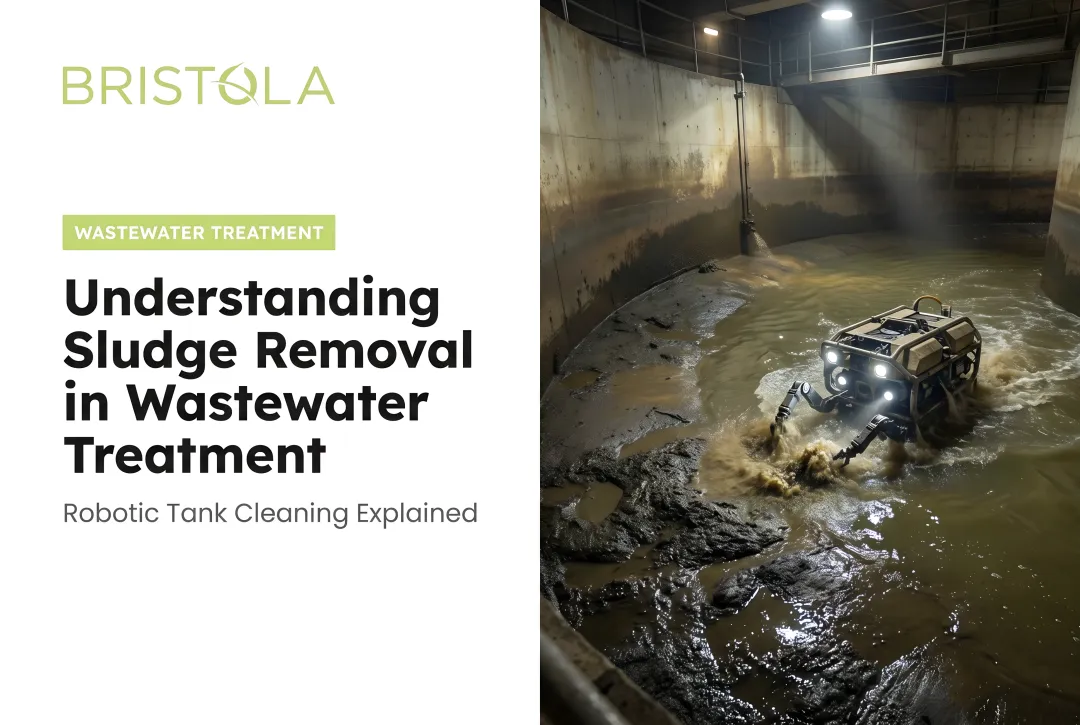
Robotic tank cleaning removes that tradeoff. Bristola's zero-human-entry submersible system uses a patented equalization-chamber entry portal to reach tanks without draining them or shutting down. A remote-controlled ROV pulls sludge and sediment out through a flexible hose while the tank stays full and online. No confined-space entry is required. For plants that cannot spare aeration tanks or clarifiers for long outages, that continuity matters as much as the cleaning itself.

Common Issues and Misconceptions
"More sludge always means better treatment." Not true. Over-wasting biomass reduces treatment capacity; under-wasting leaves old, poorly settling sludge. Both directions cause problems. The goal is balance, not maximization.
"Aeration just means adding air." Too little dissolved oxygen promotes filamentous growth and bulking; too much wastes energy without improving treatment. DO control is a setpoint problem, not an on/off air valve.
"Activated sludge and clean effluent are the same thing." Activated sludge is the biological treatment method; clean effluent is the result. Treating them as interchangeable muddies troubleshooting when effluent quality drops.
"MLSS or SVI alone proves the system is healthy." These are diagnostic tools, not standalone verdicts. Use them together, with operating context:
- MLSS: suspended solids concentration in the mixed liquor
- SVI: settled sludge volume per gram after 30 minutes
Neither number tells the whole story on its own.
When the Activated Sludge Process May Not Be Appropriate
Activated sludge isn't always the right fit. Consider these scenarios:
- Very small flows or remote sites: EPA's SBR fact sheet notes most US SBR installations serve systems below 2 MGD, and skilled operator availability matters more at small scale.
- Cold climates: Reduced microbial activity limits capacity, though EPA research shows extended aeration can still achieve over 80% BOD removal below 7°C at conservative loading rates.
- Simpler alternatives fit better: Trickling filters offer high reliability at low, stable loadings with lower power needs; lagoons work when land is available and operational goals are simpler.
- Energy costs outweigh benefits: If flow volume or effluent requirements don't justify aeration energy demand, a lower-energy alternative may serve the facility better. These conditions don't mean the process failed. They signal that a different treatment approach fits the job better.

Conclusion
The activated sludge process uses aeration and microorganisms to break down organic pollutants through three connected stages: aeration, settling, and sludge recycling. Each stage depends on the others functioning correctly.
Getting those stages right protects compliance, cost control, and plant reliability. Steady monitoring, disciplined sludge wasting and return rates, and consistent maintenance are what keep a plant inside its permit limits year after year instead of fighting recurring upsets.
Frequently Asked Questions
What is the difference between TSS and MLSS?
TSS measures total suspended solids in any water sample and is generally used to assess effluent quality. MLSS specifically measures suspended solids concentration within the aeration tank's mixed liquor.
What is the difference between sludge and activated sludge?
Sludge refers to settled solid waste from treatment processes. Activated sludge specifically means biologically active sludge rich in live microorganisms used to treat incoming wastewater.
What is the purpose of a sludge tank?
A sludge tank stores, thickens, or stabilizes sludge removed from the treatment process before further handling, dewatering, or disposal. EPA guidance recommends sizing these tanks conservatively to handle disruptions like inclement weather.
How long does the activated sludge process take?
Conventional aeration typically runs 6-10 hours, while extended aeration systems run 18-36 hours. Total treatment time varies based on organic load, tank design, and desired effluent quality.
What causes sludge bulking in the activated sludge process?
Bulking is typically caused by filamentous bacteria overgrowth, often triggered by low dissolved oxygen, nutrient imbalance, or a low food-to-microorganism (F/M) ratio.
Can the activated sludge process be used for industrial wastewater?
Yes. It's widely used in food processing, breweries, and pulp and paper plants with high organic loads, often with pretreatment to handle industry-specific contaminants.