
Costs range from $5,000 for a basic screening to well over $150,000 for investor-grade analysis. The spread isn't arbitrary. It reflects the depth of research required, the complexity of the financial model, and — critically — who will be reading the results.
This guide breaks down cost ranges by project type, the variables that push prices up or down, and how to build a realistic budget before you engage a consultant.
Key Takeaways
- U.S. feasibility study costs range from $5,000 (pre-feasibility screening) to $150,000+ (investor/lender-grade)
- Most decision-quality studies for business, real estate, and industrial projects land between $15,000–$50,000
- Rule of thumb: budget 0.75%–3% of total project cost for the feasibility study
- The audience determines the floor: internal go/no-go decisions cost less than lender or investor submissions
- Biggest mistake: scoping for internal use when the audience is external — the rework will cost more than getting the scope right upfront
How Much Does a Feasibility Study Cost? Pricing Overview
Feasibility study costs don't follow a fixed price list. They scale with the decision at stake, the depth of analysis required, and who will use the results.
When cost is misunderstood, three things tend to go wrong:
- Underbudgeting produces incomplete analysis that can't support a real decision
- Choosing an underpowered study for an investor or lender audience requires expensive rebuilds
- Skipping feasibility entirely on complex projects often costs far more in failed commitments
Typical Cost Ranges
According to consulting industry guidance, U.S. feasibility studies cluster into three tiers:
| Tier | Cost Range | Best For |
|---|---|---|
| Pre-feasibility / Screening | $5,000–$15,000 | Early-stage idea filtering |
| Standard feasibility | $15,000–$50,000 | Most business, real estate, and industrial decisions |
| Complex / investor-grade | $50,000–$150,000+ | Capital raises, M&A, regulated industries, infrastructure |
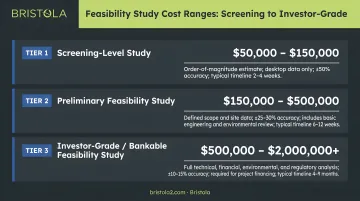
Pre-feasibility ($5,000–$15,000): High-level demand check, basic financial screening, go/no-go recommendation. Uses secondary data only — no primary research. Suitable for filtering ideas before committing to full analysis, not for presenting to outside stakeholders.
Standard study ($15,000–$50,000): Market sizing, competitive analysis, financial modeling, risk assessment, and a clear recommendation. Secondary data is typically sufficient at this tier, with deliverables structured for internal leadership rather than external scrutiny.
Investor/lender-grade ($50,000–$150,000+): Primary research, multi-scenario financial modeling, defensible sourcing, and sensitivity analysis built to withstand scrutiny. Required for capital raises, regulated industry projects, and any submission to a bank or investment committee.
Cost by Project Type
Sector complexity, regulatory depth, and financial model requirements create meaningful cost differences across industries:
- Real estate development: $6,000–$75,000+ depending on market complexity and deal size
- Startup / new venture: $10,000–$35,000 for market and financial feasibility
- Manufacturing / industrial expansion: $25,000–$100,000+ due to capex schedules, utilities, and permitting
- Business acquisition: $20,000–$70,000 for demand validation and pro forma testing
- Energy and infrastructure: $20,000–$500,000+ for large-scale or PPP-oriented work
The higher end of that energy and infrastructure range isn't arbitrary. Biogas facilities, wastewater treatment systems, and liquid storage infrastructure each carry site-specific permitting requirements, detailed capex schedules, and technical inputs that a commercial study simply doesn't need — all of which drive scope and cost upward.
Key Factors That Affect the Cost of a Feasibility Study
Two studies labeled identically can differ by 5x in price based on these variables. Understanding them upfront prevents budget surprises.
Project Complexity and Industry
Regulated or technically complex industries — healthcare, energy, industrial manufacturing, and financial services — demand more specialist input, more validation steps, and stronger documentation. A biogas digester study, for example, requires engineering inputs, permitting analysis, and operational cost modeling that a retail feasibility study simply doesn't.
Geographic and Market Scope
A single-market study costs less than multi-market or multi-state work. Projects where location directly drives demand — real estate, retail siting, industrial facility placement — require localized data gathering that adds both time and cost. Each additional geography effectively multiplies the research workload.
Data Depth: Secondary vs. Primary Research
This is often the single largest cost variable:
- Secondary research — published reports, licensed databases — is faster and lower cost
- Primary research — buyer interviews, surveys, site visits — adds substantial time and cost but is required for lender- or investor-grade work
A licensed IBISWorld industry report runs approximately $2,850 per report — and most complex studies require multiple data sources beyond that.
Financial Model Complexity
The scope of financial modeling separates budget studies from investor-grade ones. A basic financial summary covers revenue projections and rough cost estimates. A full operational model goes further — unit economics, capex schedules, ramp-up assumptions, and sensitivity analysis across multiple scenarios.
The operational model costs more. It's also the only version that can answer a lender's question: "What does the project look like if revenue comes in 20% below forecast?" Without that answer, the study won't support a funding decision.
Timeline and Intended Use
Compressed timelines increase cost due to parallel tasks and resource prioritization. Studies for external audiences — banks, investors, regulators — require stricter sourcing and additional quality review compared to internal decision tools, pushing costs toward the upper range of each tier.
Cost Breakdown of a Feasibility Study
Total cost goes beyond the consulting fee. Project sponsors frequently underestimate several line items when budgeting.
The three primary cost components are:
| Cost Component | What's Included | Typical Range |
|---|---|---|
| Professional / consulting fees | Market research, analysis, financial modeling, report delivery | $150–$500/hr (usually quoted as fixed fee) |
| Data acquisition & primary research | Licensed industry reports, geographic/demographic platforms (ESRI, CoStar), field assessments | $800–$2,850 per report; platform access negotiated separately |
| Revisions and scope changes | Rework triggered by audience changes, format upgrades, or undefined scope at project start | Varies; can approach the cost of starting over |
Data acquisition costs deserve a separate line in your budget. Licensed market data, surveys, site visits, and field assessments are routinely excluded from flat consulting fees — and they add up quickly:
- Industry research reports: ~$800–$2,850 per report
- Geographic/demographic platforms (ESRI, CoStar): contract-based, negotiated separately
- Primary fieldwork: travel, surveys, and on-site assessments are real cost drivers that vary significantly by project type
Scope changes are the most common source of cost overruns. PMI data shows that 52% of projects experience scope creep, and feasibility studies are no exception. A study scoped for internal use that later needs to satisfy investor or lender review can require substantial rework — sometimes approaching the cost of starting over.
To avoid that outcome, define the audience, deliverable format, and revision rounds before signing any engagement letter.
How to Estimate the Right Budget for a Feasibility Study
The right budget isn't the lowest price that produces "a study." It's the minimum investment needed to answer the actual decision with enough confidence to act.
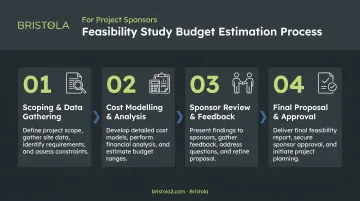
Step 1 — Define the decision. Is this for internal go/no-go, capital raising, lender submission, or M&A validation? Each has a different bar for evidence and documentation. That bar determines your floor cost before any other variable comes into play.
Step 2 — Scope the market and geography. Identify how many markets need validation and whether reliable secondary data exists or primary research is required. Projects involving industrial or infrastructure siting — biogas digesters, wastewater facilities, liquid storage expansions — often require site-specific analysis.
Operational inputs must be captured in the financial model: maintenance technology, cleaning frequency, production downtime costs. For instance, Bristola's robotic tank cleaning system eliminates downtime during cleaning, producing $80,000 in annual savings per tank — the kind of documented cost avoidance that belongs as a named assumption in any credible feasibility model.
Step 3 — Estimate financial model depth. Determine whether a simple revenue/cost model is sufficient or whether detailed unit economics, capex schedules, sensitivity testing, and operating cost breakdowns are required. Be honest about who will be scrutinizing the model.
Step 4 — Apply the percentage rule of thumb. A standard planning benchmark in consulting puts feasibility studies at 0.75%–3% of total project budget. Straightforward projects with clear secondary data land at the lower end. Regulated industries, primary research requirements, or external stakeholder audiences push toward the higher end. PPP and large infrastructure projects often go beyond that range entirely.
What Most People Get Wrong About Feasibility Study Costs
Focusing only on the upfront fee
Two quotes at different price points often cover fundamentally different scopes. Compare quotes by examining deliverables, research methodology, and who is actually doing the work — not just the total number on the proposal.
Ignoring the cost of getting it wrong
A $10,000 study that produces incomplete or indefensible analysis on a $5 million project decision is not cost-efficient. The true cost comparison is between the study investment and the downside of a bad commitment — not between two consulting proposals.
Scoping for internal use when the audience is external
Commissioning a basic study and then needing to rebuild it to meet investor or lender standards is one of the most expensive mistakes in feasibility planning. The rebuild often costs more than the original study. Define the audience before scoping, not after.
Key questions to answer before scoping:
- Who will review this study — internal stakeholders, lenders, or equity investors?
- Will it be used to satisfy due diligence requirements?
- Does the audience expect third-party validation or internal analysis?
Treating the study as a one-time document
Assumptions get challenged. Market conditions shift. That rebuild risk from the previous point applies here too: a study that can't absorb new inputs without starting over will cost you twice. Ask any consultant how their model handles scenario updates before signing. If the answer is vague, treat that as a red flag.
Frequently Asked Questions
Frequently Asked Questions
What is the average cost of a feasibility study?
U.S. feasibility study costs range from roughly $5,000 for basic screening to $150,000+ for complex investor-grade work. Most standard, decision-quality studies land between $15,000–$50,000 depending on scope, industry, and intended audience.
What are the 4 types of feasibility study?
The four main types are technical feasibility, financial/economic feasibility, market feasibility, and operational feasibility. Full studies cover all four dimensions rather than evaluating each one separately.
Why are feasibility studies so expensive?
Cost reflects the amount of uncertainty the study must resolve — including research depth, financial modeling complexity, primary data collection, and the defensibility standard required for the intended audience. More uncertainty, higher stakes, or an external audience each push the price up.
What is a cost feasibility analysis?
A cost feasibility analysis (also called economic or financial feasibility) evaluates whether projected revenues and available funding are sufficient to cover project costs. It's one of the core components of a complete feasibility study — not a deliverable on its own.
What are the 5 major components of a feasibility study?
Most complete studies cover five areas:
- Market and demand analysis
- Technical viability
- Financial modeling and projections
- Operational and resource requirements
- Risk assessment with a go/no-go recommendation
Who pays for a feasibility study?
The project sponsor or primary decision-maker funds the study. In partnership structures, costs are split based on equity share or decision ownership. The party most dependent on the outcome — whether an operator, developer, or investor — leads the engagement.