Solids handling represents a real chunk of plant operating budgets. An EPA analysis of municipal wastewater O&M costs found solids-handling allocations ranging from 20% to 30% depending on treatment type. Mixing efficiency inside that category directly shapes those numbers.
Here's the problem: many operators know mixing needs to happen, but not why blending tanks are built the way they are. That gap leads to wrong mixer choices, stratified sludge, and expensive downtime. This guide breaks down how sludge mixing actually works—not just why it matters.
TL;DR
- Sludge mixing blends solids and liquid to keep sludge uniform, pumpable, and ready for digestion or storage
- Mixing moves through initiation, core blending, and intensity control tuned to sludge viscosity
- Good mixing improves digestion, cuts disposal costs, and prevents hardened "plugs"
- Used in digesters, sludge holding tanks, and pre-dewatering stages
- Poor mixing forms hardened caps that often need costly, dangerous manual removal
What Is Sludge Mixing in Blending Tanks?
What Is sludge Mixing in Blending Tanks?
Sludge mixing is the mechanical or hydraulic agitation of settled solids and liquid inside a blending tank to keep the mixture uniform and pumpable.
It exists because sludge doesn't behave like water. It's a non-Newtonian, shear-thinning fluid, meaning it gets less viscous under agitation but thickens and stratifies the moment it sits still.
Peer-reviewed rheology research confirms this behavior is strongly tied to total suspended-solids concentration. Left alone, sludge separates into layers and eventually forms dense mats that are hard to remove.
Sludge mixing also differs from related processes:
- Thickening, which relies on settling (the opposite goal)
- Digestion, which mixing supports but does not replace
Even with modern dewatering technology, mixing remains essential. Blending tanks still function as buffer or equalization stages before sludge moves to presses or digesters.
Common Mixing Methods
Method choice depends on whether the tank is running aerobic, anoxic, or anaerobic conditions:
- Mechanical top/side-entry agitators – direct impeller-driven agitation
- Submersible mixers – positioned below the surface for continuous suspension
- Gas or pump recirculation systems – biogas or pumped digester contents that create flow
An industry technical overview from BioCycle notes that top-entry mixers typically create top-to-bottom circulation, while gas and pumped systems generally push flow from bottom to top.

How Does Sludge Mixing Work in Blending Tanks?
Sludge mixing moves through four stages: initiation, core blending, control, and output. Each stage shapes what happens downstream.
Initiation
Mixing usually starts when sludge enters the tank from clarifiers or holding tanks, either continuously or in scheduled batches. This can be automated through level sensors and timers, or manually triggered by an operator watching incoming flow.
The common bottleneck is uneven feed rates. When sludge arrives faster than the tank can blend it, localized thick spots form before mixing even gets going.
Core Operation
Impellers, agitators, or recirculation pumps create bulk flow loops that keep solids suspended. Under agitation, shear-thinning sludge becomes less viscous, which allows better circulation and prevents cake formation at the tank bottom.
Performance here hinges on a few variables:
- Mixing intensity (power density) – older EPA guidance recommended 0.2–0.3 hp per 1,000 ft³, a range still cited by industry sources today, per Water Research
- Retention/turnover time – typical designs target 30–60 minutes for full turnover
- Tank geometry – conical bottoms reduce dead-zone volume compared with flat-bottom tanks, according to peer-reviewed flow visualization research

Regulation / Control
Mixing intensity has to be dialed in carefully. Too much agitation in anoxic zones introduces oxygen and disrupts denitrification.
EPA's nitrogen control manual notes reduced denitrification rates above just 0.2 mg/L dissolved oxygen. Submerged mixers need to disperse substrate without whipping in air from surface turbulence.
Variable speed drives and mixer placement let operators match agitation to the process in that tank: aerobic, anoxic, or anaerobic. Get this wrong consistently, and dead zones form and stratification sets in. Eventually you're dealing with a "plugged" tank, one of the most common and costly maintenance headaches in sludge handling.
Output / Result
The end result should be a homogeneous, pumpable sludge stream ready for digestion, dewatering, or disposal. Consistent output quality:
- Reduces polymer and chemical dosing needs
- Improves dewatering press efficiency
- Lowers disposal weight and hauling costs
Why Sludge Mixing Matters: Key Benefits and Risks of Poor Mixing
Proper mixing disperses chemicals and organic load evenly, which reduces localized toxicity to the microorganisms doing the digestion work. It also improves microbial contact with organic matter. More intensity is not always better.
Effective sludge mixing typically delivers:
- Even chemical and organic-load distribution that protects digester microbes
- Stronger contact between microbes and feedstock for more complete digestion
- Better biogas yield when mixing intensity matches process needs instead of running flat-out
A 2014 peer-reviewed study in Waste Management found that lower-intensity mixing regimes (25 rpm continuous, or minimal intermittent mixing) produced more total biogas than a high-intensity 150 rpm regime over 31 days. A 2020 review in Critical Reviews in Biotechnology reports the same pattern: vigorous continuous mixing can hurt biogas quality and quantity while raising power and maintenance costs.
Risks When Mixing Fails
Inadequate agitation lets sludge settle into a hardened cap or plug that traps gases underneath. Clearing that cap often means confined-space entry, one of the most dangerous tasks in wastewater operations.
Common consequences include:
- Hydrogen sulfide and other gas pockets building under settled solids
- NIOSH-documented fatal incidents during sludge-related confined-space work (including H₂S above 500 ppm on a routine sampling task)
- Unplanned downtime and costly manual tank cleaning from hardened sludge buildup
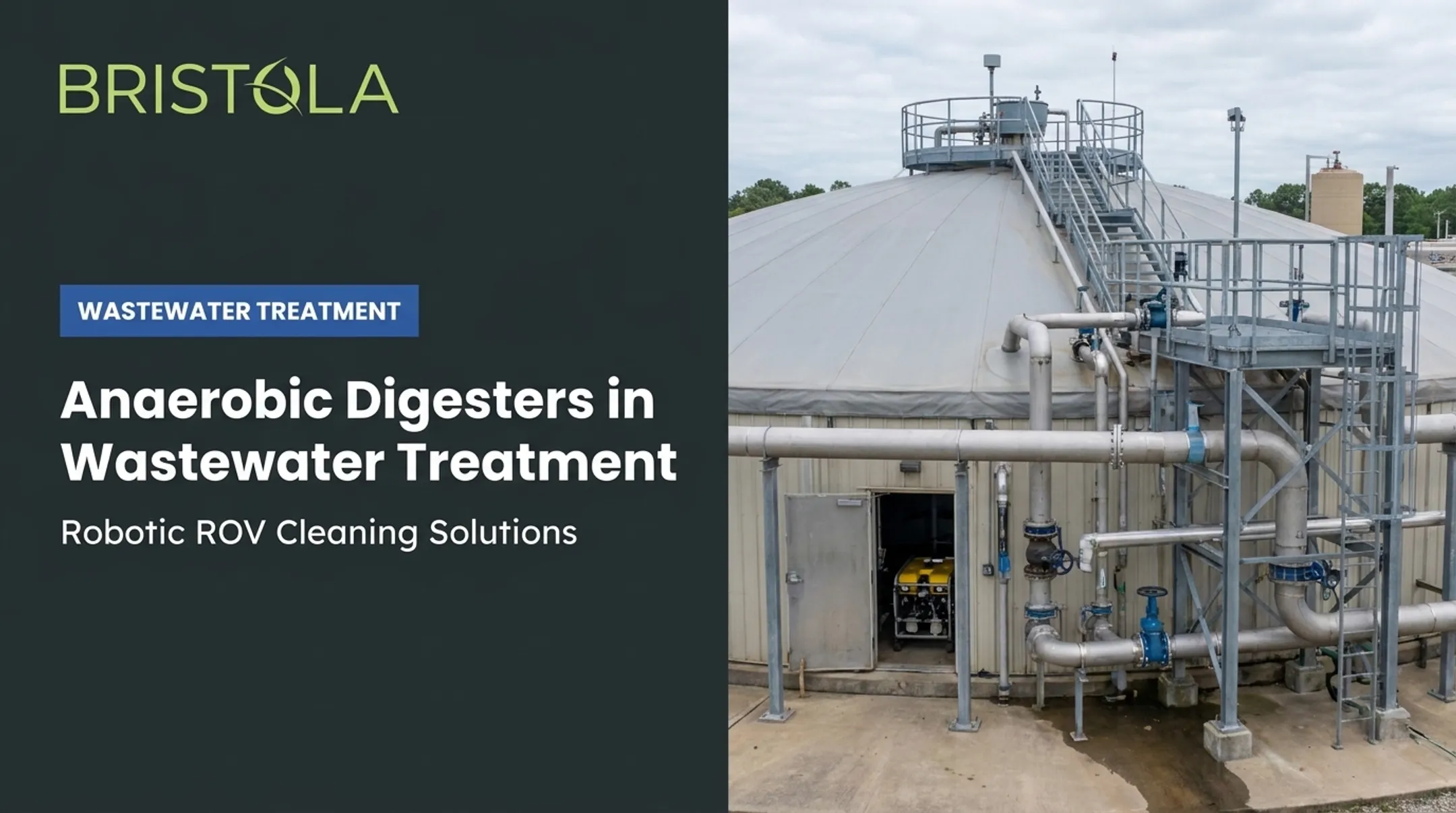
When settled solids reach that point, Bristola's zero-human-entry robotic cleaning system can remove them without taking the tank offline. A remotely operated vehicle enters through a patented airlock-type entry system, reaches the tank floor, and pulls heavy solids and sediment out through a flexible hose while the tank stays in production—no draining, confined-space entry, or shutdown required.

Where Sludge Mixing Blending Tanks Are Used
Blending tanks show up at several points in the treatment workflow:
- Post-clarifier holding – moderate agitation to keep solids suspended before the next step
- Pre-digestion equalization – blending incoming sludge to a consistent feedstock
- Pre-dewatering conditioning – final homogenization before presses or centrifuges
Mixing intensity varies by purpose. Holding and equalization tanks need moderate, steady agitation. Anaerobic digesters need higher-contact mixing to maximize microbial interaction with organic matter, without agitation aggressive enough to undercut biogas yield.
These tanks appear across industries:
- Municipal wastewater plants
- Food and beverage processing
- Slaughterhouse and protein facilities
- Biogas and anaerobic digester operations
EPA's national digester inventory shows beverage-processing waste making up the majority of feedstock at stand-alone digesters. That volume of wet, high-moisture waste is why consistent blending capacity matters so widely.
Conclusion
Sludge mixing in blending tanks is a multi-stage process: suspension, distribution, and control. Understanding each stage helps operators choose the right mixer, avoid dead zones, and cut unplanned downtime.
Good mixing practice lowers the chance of hardened residue. When buildup still occurs, Bristola's robotic tank cleaning system clears it without stopping production or sending anyone into a confined space.
Frequently Asked Questions
What is the purpose of a sludge holding tank in a STP?
A sludge holding tank equalizes flow, allows partial biological stabilization, and thickens solids before dewatering or disposal. Storage capacity depends on hauling schedules and sludge-generation rate.
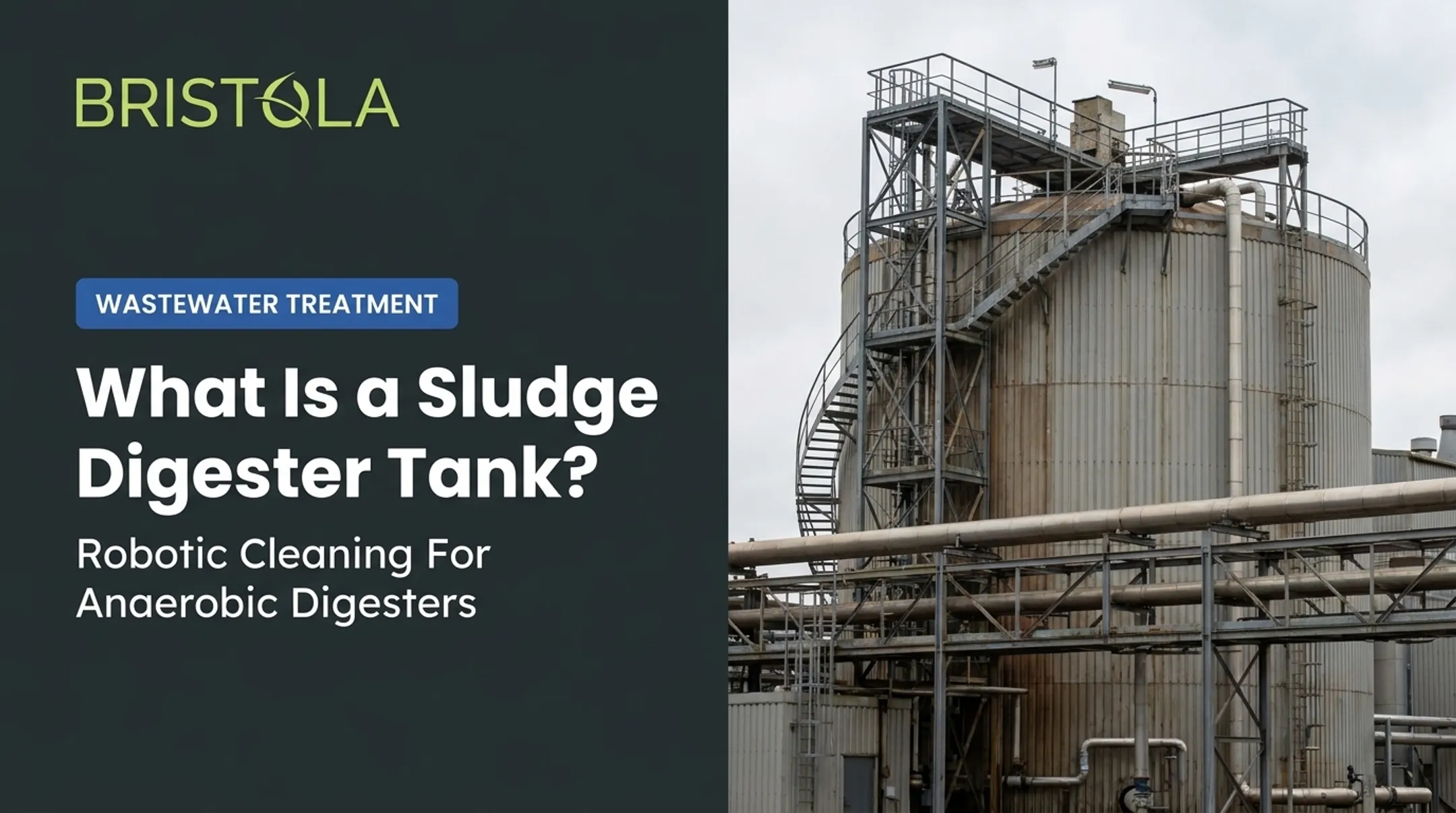
What is a sludge digester tank?
Unlike a holding or blending tank, a digester is built for biological breakdown of organic solids over several weeks. It produces biogas as a byproduct, which many facilities capture for energy use.
What are the three stages of sludge digestion?
Commonly cited as hydrolysis, acidogenesis, and methanogenesis. EPA documentation breaks this into four steps: hydrolysis, acidogenesis, acetogenesis, and methanogenesis. The three-stage version is simplified shorthand.
How do you know if a blending tank needs better mixing?
Watch for uneven sludge consistency, foul odor buildup, and hardened deposits at the tank bottom or walls. Reduced active tank volume and increased foam or scum are also warning signs.
Can sludge mixing prevent tank cleaning needs entirely?
No. Mixing reduces buildup but doesn't eliminate the need for periodic cleaning, especially for grit and other hardened residue that settles regardless of agitation.
What happens if sludge is left unmixed for too long?
Unmixed sludge stratifies, turns septic, and produces hydrogen sulfide odor. Eventually it forms a hardened plug that traps gas and can require confined-space entry to remove.