What makes confined space cleaning particularly dangerous is that the hazards don't announce themselves. A tank that appears empty can hold lethal gas concentrations. A space that smells clean can have oxygen levels that cause incapacitation within seconds.
This guide covers what facility managers and operations teams need to know: how to classify and assess confined spaces correctly, what OSHA requires before any entry, which equipment is non-negotiable, and why an increasing number of facilities are moving away from human-entry cleaning altogether.
Key Takeaways
- 1,030 confined space fatalities occurred between 2011–2018, with atmospheric hazards (H₂S, oxygen depletion, CO) as the primary killers
- OSHA 29 CFR 1910.146 mandates written programs, entry permits, assigned roles, and a documented rescue plan — all required before entry
- Pre-entry hazard assessment, continuous four-gas monitoring, and mechanical ventilation are non-negotiable — not optional
- More than 60% of confined space fatalities involve would-be rescuers — rescue readiness is the highest-impact safety investment
- Zero-human-entry robotic systems represent the highest-ranked control under OSHA's hierarchy, eliminating the hazard at its source
Why Industrial Confined Space Cleaning Is Classified as High-Risk Work
What Qualifies as a Confined Space
Under OSHA 29 CFR 1910.146, a confined space must meet all three criteria:
- Large enough for a worker to fully enter and perform assigned tasks
- Has limited or restricted means of entry or exit
- Not designed for continuous occupancy
Common industrial examples include storage tanks, anaerobic digesters, biogas digesters, covered lagoons, process vessels, silos, pipelines, pits, and wet wells.
Most of these qualify as permit-required confined spaces — a more serious classification that applies when any one of four conditions exists: hazardous atmosphere, engulfment risk, converging internal configuration that could trap an entrant, or any other recognized serious safety hazard.
The Four Hazard Categories
| Category | Specific Hazards |
|---|---|
| Atmospheric | Oxygen deficiency, H₂S, CO, methane, flammable vapor accumulation |
| Physical | Engulfment, entrapment, falls into the space or within it |
| Chemical | Hazardous residues reacting with cleaning agents or ambient air |
| Psychological | Limited visibility, disorientation, fatigue in tight or dark spaces |
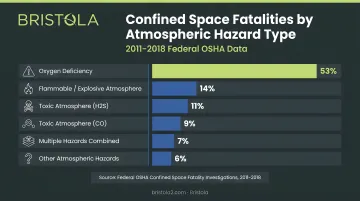
Atmospheric hazards are the leading cause of death. BLS data from 2011–2018 shows 39 oxygen-depletion fatalities, 38 H₂S fatalities, 23 CO fatalities, and 58 deaths from fires and explosions. H₂S at high concentrations causes instant incapacitation. Workers have no time to react before losing consciousness.
Why the Hazards Compound
Those fatality numbers reflect another hard reality: confined spaces rarely present just one hazard at a time. A biogas digester may simultaneously carry methane (flammable, oxygen-displacing), H₂S (acutely toxic), and CO₂ (asphyxiant) — three distinct life threats in a single vessel.
Introducing high-pressure water jetting or chemical cleaning agents adds reactive hazard potential on top of whatever residue already exists. If conditions deteriorate mid-operation, the limited entry and exit points mean workers face severely restricted escape options.
Safety Guidelines for Industrial Confined Space Cleaning
Safe confined space cleaning depends on three interlocking elements: rigorous pre-entry preparation, disciplined in-space protocols, and continuous environmental monitoring. Skipping any one of them doesn't just create a gap — it exposes workers to compounding hazards that can escalate faster than any rescue plan can respond.
Pre-Entry Planning and Hazard Assessment
Every confined space cleaning project must begin with a written hazard assessment. Before any equipment is deployed:
- Identify prior contents: what was stored, residue type, and any known reactive properties
- Document space geometry: baffles, mixers, coils, drain locations, entry port dimensions, and construction material
- Sketch the space to scale to plan ventilation placement and equipment routing
Tank isolation (LOTO) is mandatory before any entry:
- All energy sources (electrical, mechanical, pressure) locked out and tagged out
- All connected lines blanked or blinded — not just closed, physically blocked
- All internal mechanical devices (agitators, mixers) de-energized and physically secured
After product removal, the degassing and vapor-freeing step must be completed using blowers and mechanical ventilation before any entry is considered. This step cannot be skipped even if the space looks or smells clean. Biological off-gases accumulate without odor cues, and oxygen-deficient atmospheres are completely undetectable by human senses.
With the space isolated and atmosphere verified, active cleaning operations require a defined personnel structure — no role is optional.
Safety During Active Cleaning Operations
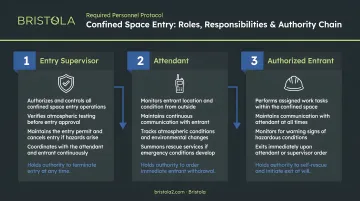
Three personnel roles are required during confined space cleaning operations:
- Authorized Entrant — knows the hazards, uses required PPE, and exits immediately when warned
- Attendant (topside) — remains outside, maintains continuous communication, monitors atmospheric readings in real time, and has the authority to order immediate evacuation without question
- Entry Supervisor — verifies all tests and controls before signing the permit, terminates entry if conditions change
Acceptable atmosphere thresholds per OSHA 29 CFR 1910.146:
- Oxygen: 19.5% to 23.5% by volume
- Flammable gases: below 10% of LEL
- H₂S: ceiling of 20 ppm (peak of 50 ppm for no more than 10 minutes)
- CO: 50 ppm 8-hour TWA
If any reading moves outside these thresholds, cleaning stops. Not pauses — stops, until the hazard is controlled and re-tested.
Fall protection is mandatory for all entrants: full-body harness with retrieval line attached at shoulder level or above, connected to a mechanical retrieval device staged outside the space. For vertical spaces deeper than five feet, a mechanical extraction device is required — not a manual line.
Atmospheric and Environmental Hazard Controls
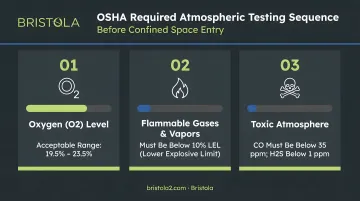
OSHA mandates a specific testing sequence before entry — and it matters:
- Oxygen first (combustible gas meters require adequate O₂ to read accurately)
- Flammable gases (percent of LEL)
- Toxic gases and vapors (H₂S, CO, and others relevant to prior contents)
Testing must occur at multiple vertical levels to account for gas density stratification — methane rises, CO₂ settles at floor level. Monitoring must continue without interruption throughout the cleaning operation.
A blower positioned incorrectly can concentrate hazardous gases directly in the work area rather than exhaust them — making placement decisions as consequential as the ventilation equipment itself. The blower must draw from the contaminated zone, with fresh air supplied from a clean source, accounting for internal geometry like baffles or partitions that can create dead zones.
Hazard severity by tank type:
- Biogas digesters and covered lagoons: methane, H₂S, CO₂
- Oil and fuel tanks: hydrocarbon vapor, benzene (OSHA PEL: 1 ppm 8-hour TWA)
- Wastewater vessels: CO, H₂S, biological pathogens
Cleaning chemicals must be matched to residue type and construction material. Introducing an incompatible agent into a space with reactive residue can create a new atmospheric hazard mid-operation.
OSHA and Regulatory Compliance for Confined Space Cleaning
Core Requirements of 29 CFR 1910.146
Facilities with permit-required confined spaces must have:
- A written confined space program documenting the employer's overall approach
- Entry permits completed, reviewed, and signed before work begins — not after
- Documented hazard controls and acceptable entry conditions
- Trained personnel in all three roles: authorized entrant, attendant, and entry supervisor
- A rescue plan with a designated team on standby before any entry begins
An entry permit must include:
- Space identity and purpose, plus authorized duration
- Names of all personnel in each role
- Identified hazards, control measures, and atmospheric test results with tester initials
- Required PPE, communication procedures, and rescue instructions
- Entry supervisor's signature
Rescue Planning: The Most Critical and Most Skipped Requirement
NIOSH Publication 86-110 documents that more than 60% of confined space fatalities occur among would-be rescuers — people who entered the space without proper preparation to save someone already in distress. That statistic makes rescue readiness the highest-stakes element of any confined space program — not a checkbox, but a life-safety system that must function under pressure.
OSHA 29 CFR 1910.146(k) requires:
- Rescue team members must practice permit space rescues at least once every 12 months using simulated conditions
- Rescue personnel must themselves be trained as authorized entrants
- Rescue equipment must be staged before entry begins — not retrieved when needed
Emergency response plans must also cover LOTO reversal procedures, atmospheric release protocols, communication with facility EMS or external responders, and documented post-incident review. A plan that exists only on paper — never tested, never rehearsed — provides no protection when conditions deteriorate.
Beyond OSHA's minimum requirements, NFPA 350 adds prescriptive guidance on gas tester competencies, ventilation specialist roles, and Prevention through Design principles. Facilities that align their programs with both standards tend to perform better during inspections and are better positioned to defend their procedures if a violation occurs.
OSHA Penalty Exposure
Non-compliance isn't just a safety risk. Current OSHA penalties (effective January 15, 2025) are significant:
| Violation Type | Maximum Penalty |
|---|---|
| Serious violation | $16,550 per violation |
| Willful or repeated violation | $165,514 per violation |
A single multi-citation inspection — covering an inadequate permit, a missing rescue plan, and insufficient atmospheric testing — can exceed $500,000 in proposed penalties.
Essential Equipment for Industrial Confined Space Cleaning
Safety Equipment (Non-Negotiable Minimums)
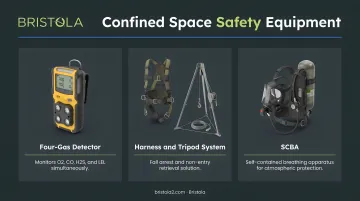
- Continuous four-gas detector: O₂, LEL, H₂S, CO — calibrated and tested before each use
- Full-body harness with retrieval line attached at the center of the back near shoulder level or above the head
- Tripod and mechanical winch for vertical spaces deeper than five feet
- Intrinsically safe lighting and communication devices rated for hazardous atmospheres
- SCBA or supplied-air respirators when atmospheric hazards cannot be fully controlled
- Chemical-resistant PPE matched to the specific contents of the space
Cleaning Equipment
Common methods used in industrial confined spaces:
- High-pressure water jetting for residue removal from walls and structural internals
- Vacuum extraction units for sludge and solids removal
- Robotic or automated cleaning nozzle systems for remote operation within the space
Equipment selection must account for tank construction material. High-pressure jetting on glass-lined or rubber-lined tanks can cause wall damage that compromises containment. Chemical cleaning agents must be verified compatible with both the tank material and the residue being removed.
Zero-Human-Entry Systems
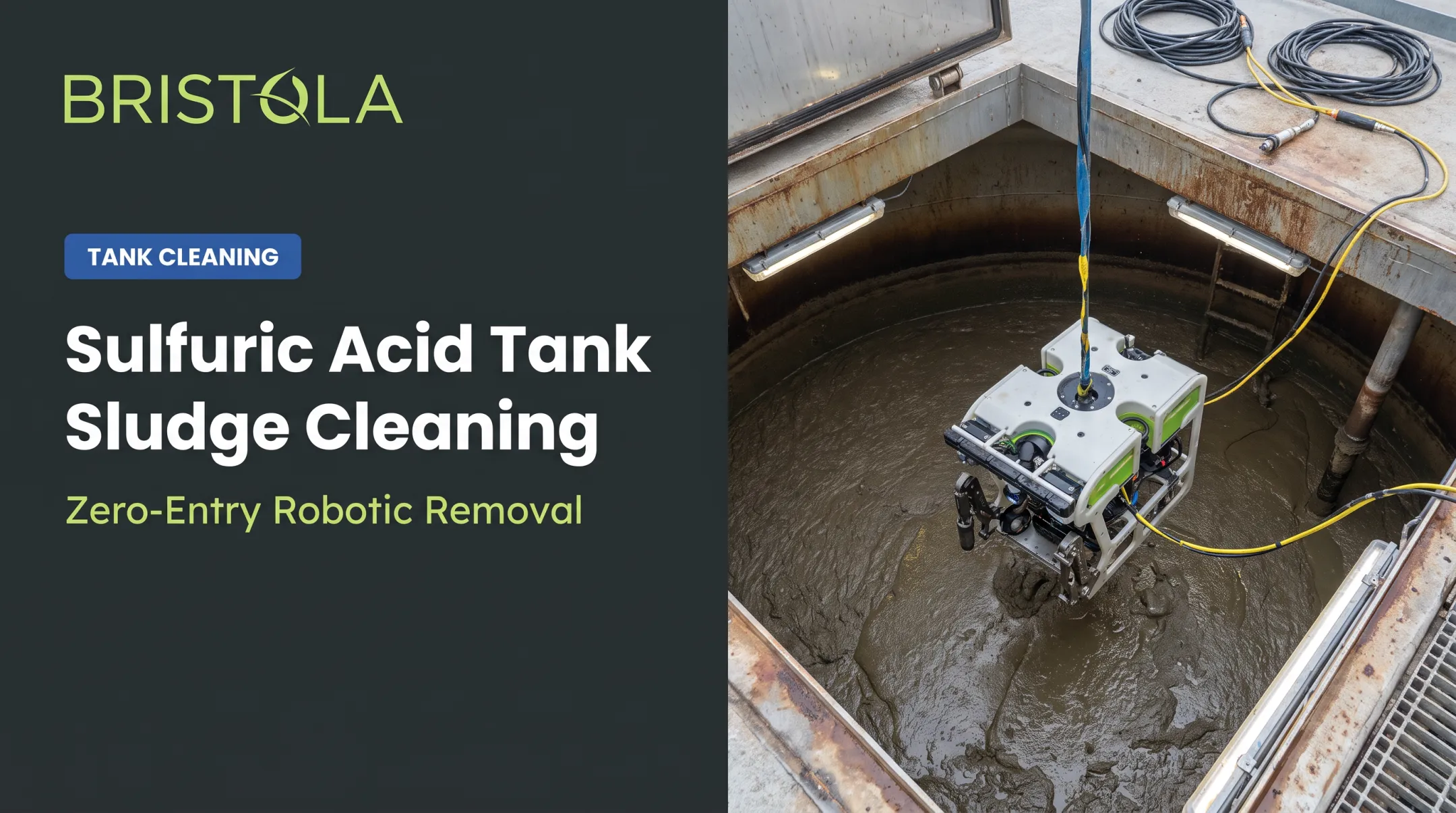
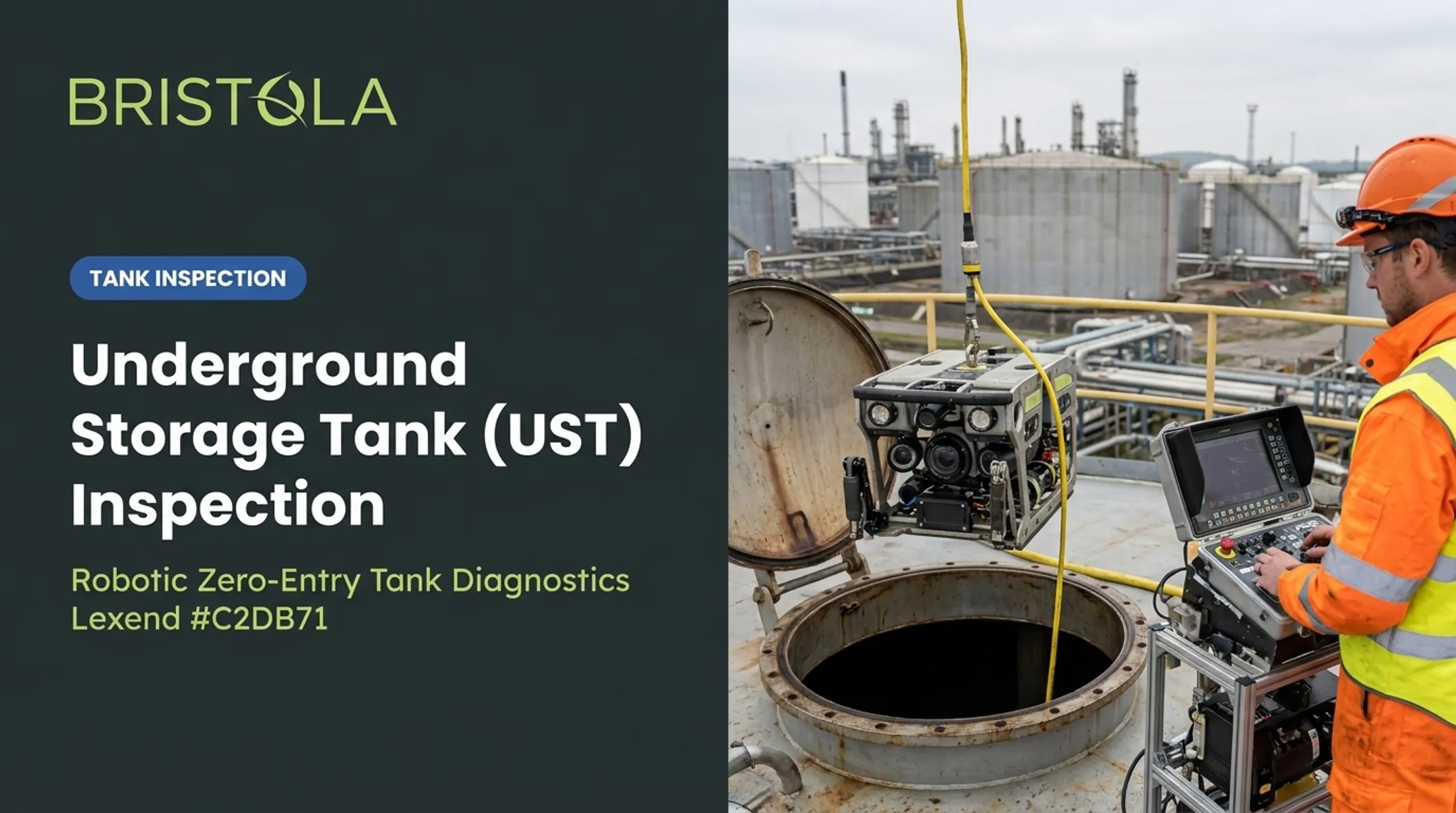
Robotic cleaning systems take the most effective hazard control approach available: removing workers from the hazard entirely. Bristola's remote-controlled submersible system deploys through a patented equalization chamber — an airlock-type portal that allows the ROV to enter tanks and covered lagoons through existing manholes (24 inches or larger). No draining required. No production halt.
Because the tank stays in active operation throughout the cleaning cycle, facilities avoid confined space entry hazards, rescue standby requirements, and production downtime simultaneously. Under OSHA's Hierarchy of Controls, elimination ranks above every other control measure. Zero-entry systems are the direct implementation of that principle.
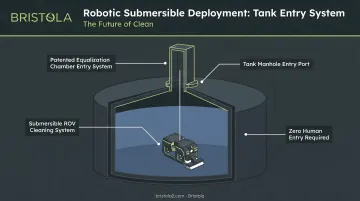
Bristola has documented that facilities switching from traditional cleaning methods to its system save approximately $80,000 per tank per year, accounting for avoided downtime, eliminated temporary storage costs, and reduced chemical treatment expenses.
Common Safety Mistakes in Confined Space Cleaning
Skipping or Rushing the Pre-Entry Atmospheric Test
Many incidents occur because workers assume a space is safe based on prior use or visual inspection. A tank that previously held water-based material can accumulate oxygen-deficient air from biological off-gassing. At 16% oxygen, there is no sensory warning. A worker will lose consciousness before recognizing anything is wrong — with no capacity for self-rescue.
The pre-entry atmospheric test is not a bureaucratic step. It is the only way to confirm whether the air in the space will sustain life.
Inadequate Rescue Readiness
Having a rescue plan on paper without a trained team physically staged, retrieval equipment set up, and communication established is a critical failure. A delayed rescue in a toxic atmosphere is almost always a fatality, not a close call. The 60%+ rescuer fatality rate exists precisely because well-intentioned responders enter without preparation and become victims themselves.
Rescue readiness means:
- A trained rescue team physically on site before entry begins
- Retrieval equipment staged at the entry point
- Communication confirmed and active
- Rescue personnel trained as authorized entrants themselves
Bypassing LOTO
In facilities with complex piping systems, verbal confirmation that a pump is off or a valve is closed is not acceptable. Physical isolation must be verified at every energy source.
An unexpected mixer startup, an unblinded line that opens, or a pressure release during cleaning operations creates an engulfment or mechanical strike hazard. There is no safe response available from inside the space. The permit must confirm physical verification of every isolation point — verbal assurances from operators are not sufficient.
Conclusion
Industrial confined space cleaning safety isn't a checklist to move through quickly before the real work starts — it is the work. Hazard assessment, permitting, atmospheric monitoring, ventilation, rescue readiness, and proper equipment function as a system. When any one element is skipped, the others don't compensate.
Facility managers and operations teams should also ask whether traditional human-entry cleaning still makes sense for their operations. Bristola's zero-human-entry robotic cleaning system, for example, cleans liquid storage tanks while they remain in active operation — no production halt, no rescue team on standby, no personnel in hazardous atmospheres. For many facilities, the safety case alone justifies the shift. The operational and financial case only strengthens it.
Safety protocol review should be an ongoing operational commitment, not a pre-job formality. Familiarity with a confined space does not reduce its hazards — and the facilities that treat every entry as a serious risk event are the ones that avoid the incidents that make headlines.
Frequently Asked Questions
What are the hazards of tank cleaning?
Tank cleaning involves four overlapping hazard categories: atmospheric (oxygen deficiency, toxic and flammable gases), physical (engulfment, falls, entrapment), chemical (hazardous residues reacting with cleaning agents or air), and psychological (disorientation and stress in tight, low-visibility spaces). These hazards compound each other in environments with limited entry and exit, making rapid deterioration of conditions the primary risk.
What are the OSHA and NFPA requirements for confined space cleaning and entry?
OSHA 29 CFR 1910.146 requires a written program, entry permits, atmospheric testing in sequence, trained personnel in three assigned roles, and a documented rescue plan. NFPA 350 supplements these with guidance on gas tester competency, ventilation specialist roles, and Prevention through Design.
What is the procedure for confined space cleaning and decontamination?
The sequence runs: hazard assessment → product removal → LOTO isolation → degassing and ventilation → atmospheric testing → cleaning with continuous monitoring → post-cleaning inspection → de-isolation. Each step must be documented before the next begins.
What are the common types, steps, and best practices for confined space cleaning processes?
Common methods include high-pressure water jetting, vacuum extraction, and robotic zero-entry systems. Core best practices: never skip pre-entry hazard assessment, maintain continuous four-gas monitoring throughout, stage a trained rescue team before entry begins, and match cleaning methods and chemicals to the tank material and residue type.
What chemicals are commonly used for tank cleaning?
Chemical selection depends on the tank's prior contents and construction material. Degreasers and alkaline cleaners handle fuel and hydrocarbon residues; chlorine-based sanitizing agents are standard for potable water storage tanks. All chemicals must be evaluated for compatibility with tank materials and for reactive hazard potential with residual contents before any chemical enters the tank.
How often should a water storage tank be cleaned?
Most industry guidelines and state programs recommend inspection and interior cleaning every three to five years. Tanks serving critical applications — municipal water supply, food processing — typically require annual inspection. Facility managers should verify applicable state requirements, as no single federal standard mandates a specific interval.