Introduction
Barge cargo tanks accumulate problems that compound over time. Cargo residue, sludge, and sediment build up inside holds, eating into usable capacity and creating contamination risks that can compromise entire loads. Left unaddressed, that buildup also accelerates corrosion and drives up operating costs.
Traditional cleaning methods make the problem worse. Sending workers into confined cargo tanks means navigating OSHA permit-to-work requirements, atmospheric testing, and real fatality risk. Taking the vessel out of service for a full clean-out means days or weeks of lost revenue.
ROV-based cleaning changes both calculations. Remote-controlled submersible robots handle interior tank cleaning from a safe surface position, without human entry and without halting operations.
This guide covers why regular ROV barge cleaning matters, how the technology works, the types of cleaning it performs, and the schedules and best practices operators should follow.
Key Takeaways
- Sediment buildup inside barges and storage tanks cuts operational capacity and efficiency — even partial accumulation forces unplanned maintenance and lost throughput
- Confined space entry kills an average of 40 seafarers per year; ROV cleaning eliminates that risk entirely
- ROVs equipped with patented entry systems can clean barge interiors and storage tanks while the vessel or facility remains in active service — no draining, no human entry required
- Bristola's patented equalization chamber entry technology eliminates the need to take tanks offline, protecting both production schedules and profit margins
- Cleaning frequency should be driven by sediment accumulation, cargo or feedstock type, and operational load — not fixed calendar intervals alone
Why Regular Barge Cleaning Matters
The Fuel and Capacity Cost of Fouling
Hull fouling is expensive in a way that compounds over time. According to IMO GloFouling research, even a 0.5 mm slime layer covering half a hull increases greenhouse gas emissions by 20–25%. A light barnacle layer pushes that to 55%. Heavy fouling can drive fuel consumption up by 80%.
Barges face a structurally worse problem than most vessels. Slow operating speeds and extended mooring periods reduce the hydrodynamic forces that would otherwise dislodge organisms — meaning fouling accumulates faster and heavier than on actively sailing ships.
Inside the vessel, the costs are different. Sludge and sediment reduce usable tank capacity, introduce cross-contamination risk between cargo loads, and create conditions that accelerate corrosion.
Corrosion, Safety, and Regulatory Pressure
AMPP estimates maritime corrosion costs the industry $50–80 billion annually. Sediment and biofouling are direct contributors — both trap moisture against steel surfaces and create conditions for microbiologically influenced corrosion under attachment points.
The human cost is documented. The UK P&I Club reports that at least 1,010 people died in enclosed spaces aboard ships between 2000 and 2024 (roughly 40 per year), with cargo oil tanks accounting for 18% of those fatalities.
OSHA 29 CFR 1915 Subpart B requires atmospheric testing, continuous ventilation, and rescue provisions before any confined space entry — a compliance burden that ROV cleaning sidesteps entirely.
Regulatory requirements now span international, national, and port-state levels:
- IMO Resolution MEPC.378(80) (2023) requires Biofouling Management Plans, Record Books, and Contingency Action Plans
- Australia enforces mandatory biofouling management for arriving vessels under the Biosecurity Act, with civil penalties and criminal prosecution for non-compliance
- New Zealand's updated CRMS biofouling requirements entered force in April 2025
- US Port State Control conducted 8,711 vessel safety exams in 2024, issuing 82 detentions — detained vessels cannot depart until deficiencies are corrected
Reactive vs. Preventive: The Cost Comparison
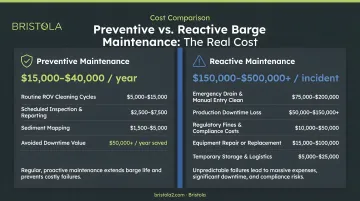
Scheduled cleaning costs less than reactive repair. ABS Consulting data shows predictive maintenance strategies deliver 20–30% cost reductions versus reactive approaches. Hull repair and recoating during a single dry-dock event runs approximately $200,000–$700,000, before accounting for transit costs, emergency scheduling premiums, and lost cargo revenue during downtime.
What Is ROV Barge Cleaning and How Does It Work
An ROV (Remotely Operated Vehicle) in the barge cleaning context is a remote-controlled submersible or surface-tethered robot equipped with cleaning tools — rotating brushes, high-pressure nozzles, scrapers, or vacuum systems. A technician operates the ROV from a safe surface position. No one enters the water. No one enters the tank.
Hull-Cleaning ROVs
Hull-cleaning ROVs attach to the submerged hull surface via magnetic attraction or buoyancy control, then traverse the hull under operator control. Cleaning mechanisms vary by system and fouling type:
- Brush disc systems — rotating brushes remove soft marine growth without abrading anti-fouling coatings
- High-pressure water jets — adjustable-pressure seawater jets handle harder growth without physical contact with the coating surface
- Combined systems — some ROVs use both, adjusting the approach based on fouling severity
The operator monitors progress through the ROV's live camera feed and adjusts pressure settings in real time to avoid coating damage.
For barges carrying flammable cargo, ATEX-certified ROV systems can clean tanker hulls during active cargo loading or unloading at berth — eliminating the traditional tradeoff between hull maintenance and cargo scheduling.
Interior Tank Cleaning ROVs
Interior cleaning ROVs enter cargo tanks, ballast tanks, and liquid storage compartments through specialized entry ports or hatches. Once inside, the ROV navigates internally to remove accumulated sludge, sediment, and residue using vacuum and jetting mechanisms — all controlled from outside.
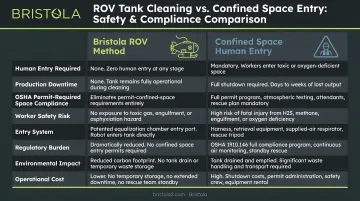
Interior tank environments are genuinely dangerous. Cargo tanks regularly contain toxic vapors, oxygen-deficient atmospheres, or explosive gas concentrations. Under OSHA and maritime confined space regulations, human entry at these levels is extremely high-risk, requiring extensive permit-to-work procedures even for brief inspections.
The ROV approach sidesteps those hazards entirely. Typical materials removed include:
- Accumulated sediment and sludge layers
- Residual cargo deposits
- Scale buildup on tank walls and floors
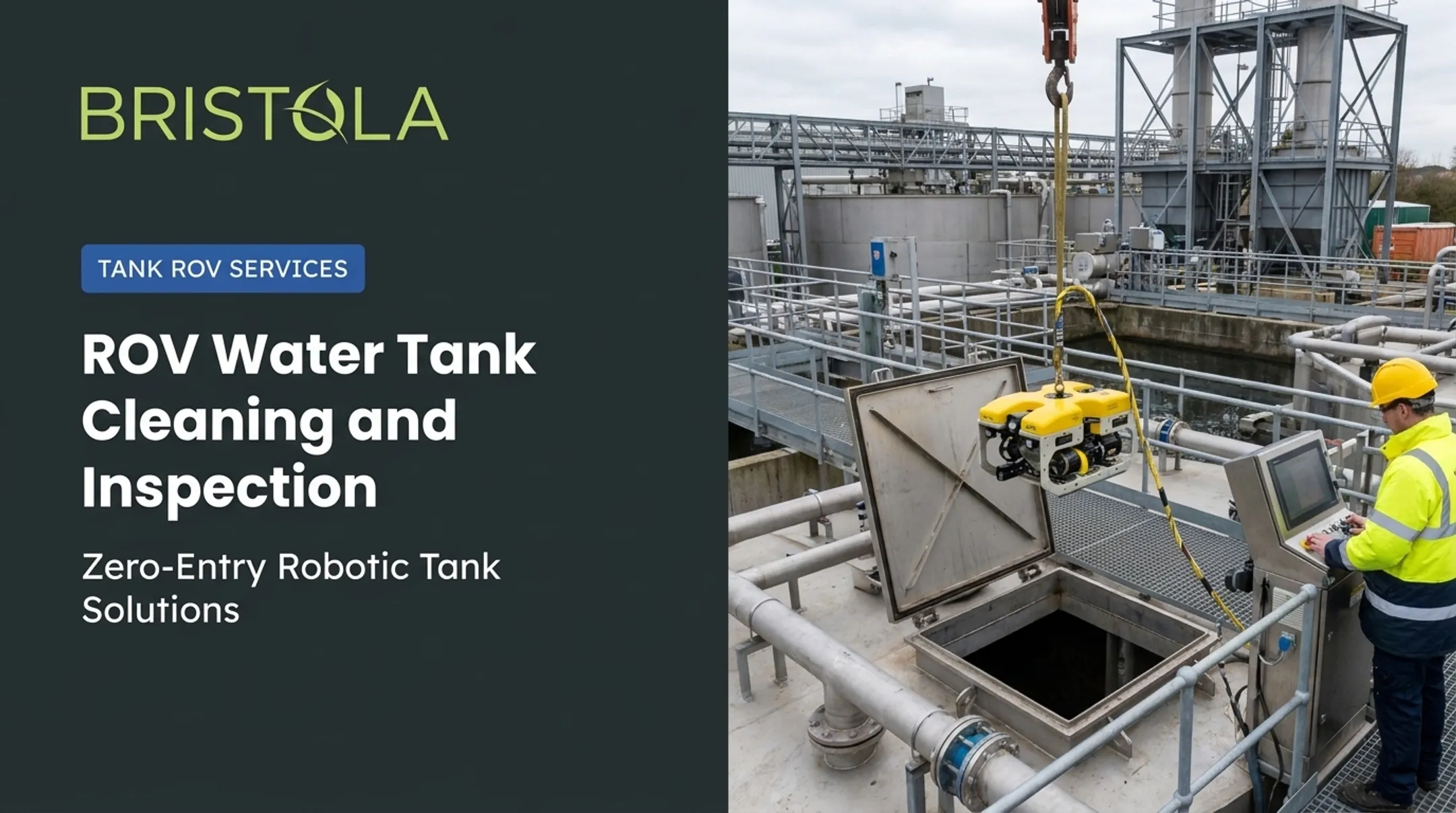
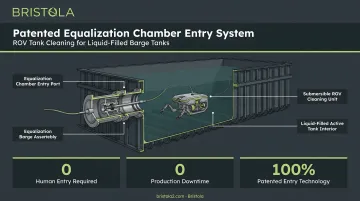
Bristola's patented equalization chamber entry system addresses this directly. It functions as an airlock-type mechanism — a unique entry portal placed on the tank's manhole, adaptable to any opening 24 inches in diameter or greater. This allows a remote-controlled submersible robot to enter a fully liquid-filled tank from the roof or cover while the tank stays in active operation. No drawdown is required. The system actually needs the tank to remain operational, since the liquid is necessary for sediment dilution during removal. No human entry, no dry-docking, no production halt.
Types of ROV Barge Cleaning
Hull and Exterior Cleaning
Hull cleaning targets the organisms and degradation that accumulate on underwater surfaces:
- Microfouling (slime/biofilm) — bacteria and microalgae that form even on freshly coated hulls within weeks
- Macroalgae — increases surface roughness and degrades coatings
- Barnacles and tubeworms — hard calcareous organisms that create significant drag; heavy barnacle coverage can increase total hydrodynamic drag by up to 60%
- Mussels and oysters — contribute to accelerated corrosion through microbiologically influenced corrosion at attachment points
Niche areas — sea chests, thrusters, rudder recesses — are particularly prone to infestation and can harbor invasive species even when the main hull looks clean. ROVs are the most reliable way to reach and clean these recesses without dry-docking.
Cleaning frequency and ROV selection depend on:
- Operating waters — tropical waters above 20°C produce continuous, year-round fouling with no dormant season; temperate waters show strong seasonality
- Vessel speed profile — slow-steaming and stationary barges accumulate fouling significantly faster than active vessels
- Anti-fouling coating type — hard coatings vs. self-polishing copolymers respond differently to cleaning approaches
Interior Tank and Compartment Cleaning
Interior ROV cleaning targets different problems depending on the compartment:
| Compartment Type | Primary Targets |
|---|---|
| Cargo holds | Residue from previous loads, cross-contamination risk |
| Ballast tanks | Sludge, sediment, biological buildup |
| Fuel/liquid storage | Sediment accumulation, coating degradation |
Tank atmospheres in these compartments can contain hydrogen sulfide, carbon monoxide, hydrocarbon vapors, or oxygen deficiency — all at concentrations that can incapacitate a person within seconds. OSHA requires oxygen content checks, flammability assessment, and toxicity testing before any entry, plus continuous monitoring and active ventilation throughout the job.
That compliance burden alone makes confined space entry costly and slow. ROV cleaning removes the need for human entry, which eliminates both the regulatory overhead and the exposure risk in a single step.
ROV Barge Cleaning Best Practices and Schedule
When Your Barge Needs Cleaning
Hull warning signs:
- Visible slime or growth at the waterline
- Measurable increase in fuel consumption at equivalent load and speed
- Reduced speed at the same engine output
Operators should establish performance benchmarks when hulls are clean (fuel consumption per nautical mile at standard load and speed) so deviations are easy to spot rather than guessed at.
Interior tank warning signs:
- Capacity readings inconsistent with actual fill levels
- Evidence of contamination or off-spec results in cargo samples
- Abnormal gas or odor readings from tank venting points
- Visible sludge through inspection ports during routine checks
Cleaning Best Practices
1. Always start with an inspection pass Before any cleaning, run a visual ROV survey of the hull or interior. This identifies fouling type, severity, and coating damage , determining tool selection, pressure settings, and whether coating repair is required.
2. Match method to surface and fouling type
- Soft marine growth: brush cleaning
- Hard calcareous organisms: higher-pressure jetting or mechanical scraping
- Intact anti-fouling coatings: avoid over-aggressive cleaning — stripping coatings drives up long-term maintenance costs
3. Manage wash water and waste properly IMO MEPC.1/Circ.918 (April 2025) sets the current standard: in-water hull cleaning without wash water capture is only appropriate for fouling rated below level 2. Any macrofouling requires capture, containment, and treatment. Interior tank sludge and residue must be disposed of per MARPOL Annex II/V requirements and local port discharge rules.
4. Log everything Use the ROV's camera footage and sensor data to produce maintenance records, document coating condition, and flag areas needing follow-up. This data supports condition-based scheduling and provides compliance evidence during port state control inspections.
Barge Cleaning Schedule — General Guidelines
| Interval | Activity |
|---|---|
| Per voyage / monthly | Visual check of waterline and hull condition; monitor fuel efficiency data |
| Every 3–6 months | ROV hull inspection in high-fouling environments (warm/tropical waters, slow or stationary operations); interior tank inspection for active cargo cycling |
| Annually | Full ROV hull cleaning and interior tank cleaning for most barge types; coating condition assessment |
| Every 2.5–5 years | Comprehensive structural inspection aligned with dry-docking cycle; coating repairs beyond ROV cleaning scope |
Scheduling notes:
- Barges in tropical or nutrient-rich waters should lean toward the shorter end of these intervals
- Stationary or slow-moving barges accumulate fouling faster than the schedule above assumes — adjust accordingly
- Zero-downtime interior ROV cleaning systems that operate while tanks remain in service can decouple interior cleaning from the dry-dock cycle entirely, enabling continuous cleaning rather than fixed-interval shutdowns
Conclusion
ROV barge cleaning works best as a maintenance discipline, not an emergency response. Regular cleaning protects vessel value, extends asset life, keeps operators on the right side of increasingly strict biofouling and safety regulations, and removes the genuine fatality risk that comes with confined space entry.
The economics reinforce this. Preventive ROV cleaning costs a fraction of reactive dry-docking — and with US dry-dock capacity down 27% over the past two decades per MARAD, reactive options are getting harder to access, not easier.
The case for proactive ROV maintenance comes down to three converging pressures:
- Cost: Preventive cleaning is a fraction of reactive dry-dock expenses
- Access: US dry-dock capacity has declined 27% over two decades, per MARAD — fewer fallback options exist
- Safety: Confined space entry carries real fatality risk that ROV systems eliminate entirely
Zero-human-entry systems that clean while tanks remain in service have made continuous barge maintenance operationally viable — no production stops, no crew entry into confined spaces. Fleet operators looking to modernize their approach can explore Bristola's zero-human-entry robotic cleaning system, which uses a patented equalization chamber entry technology to clean liquid storage facilities without downtime or human confined space entry.
Frequently Asked Questions
What is ROV cleaning?
ROV cleaning uses remotely operated submersible robots — controlled by a surface operator — to clean underwater hulls and internal tank surfaces. No personnel enter the water or confined spaces; all cleaning is performed via remote control with live camera monitoring.
How much does it cost to clean the inside of a barge tank?
Costs vary based on tank size, cargo type, sediment accumulation, and cleaning method. Traditional drain-and-clean approaches add significant expense through lost production time and temporary storage logistics. ROV-based systems like Bristola's eliminate those costs by cleaning while the tank stays in service — meaning no lost revenue and no idle vessel time.
How does ROV tank cleaning compare to confined space entry?
Confined space entry requires emptying the tank, obtaining permits, deploying safety personnel, and exposing workers to toxic gases and oxygen-deficient atmospheres. ROV cleaning eliminates all of that — the robot enters the tank through a sealed entry port, no workers go inside, and the tank can remain in service throughout the process.
How often should a barge be cleaned?
Hull cleaning is typically recommended every 3–12 months depending on operating waters and fouling rate; interior tank cleaning frequency depends on cargo type and accumulation rate. Bristola's system allows interior cleaning to run continuously rather than on fixed intervals tied to dry-dock scheduling, since the tank never needs to go offline.
Can ROVs clean the inside of barge tanks?
Yes. Submersible cleaning ROVs equipped with vacuum and jetting systems enter interior tank compartments through entry ports without human entry. Bristola's patented equalization chamber entry system makes this possible while the tank remains in active service — no draining, no confined space permits, no production interruption.