Introduction
Food and beverage manufacturing generates roughly 40 million tons of wasted food annually in the U.S. alone. That waste doesn't just create disposal headaches — it represents a compounding liability: landfill costs, emissions exposure, and foregone energy revenue sitting in every drum of dairy effluent, every batch of off-spec beverage, every tote of slaughterhouse byproduct.
Anaerobic digestion (AD) converts that organic burden into biogas and renewable natural gas (RNG). Well-designed systems routinely cut waste disposal costs while generating enough RNG revenue to fund the capital investment within five to ten years. The EPA's 2024 survey identified 313 AD facilities processing food waste in the U.S. — more than double the 154 counted in 2017.
Not all AD systems are built for food processing realities. High-fat dairy streams, variable solids from seasonal produce runs, and co-digestion complexity each demand different reactor configurations. Match the wrong system to your feedstock and you can spend years chasing biogas yields that never materialize. This guide walks through the leading AD system types, what each one handles best, and the variables that should drive your selection.
Key Takeaways
- 42.6% of U.S. food and beverage manufacturing waste is already managed through AD — the sector's largest single waste management pathway
- The best systems for 2026 are distinguished by feedstock compatibility, solids handling, and operational reliability — not just capital cost
- Matching reactor type (CSTR, UASB, EGSB, or plug-flow) to your specific feedstock profile is the single most important selection decision
- Revenue stacking (tipping fees + RNG credits + D3 RINs) drives ROI, but D3 prices softened to ~$2.40 in late 2025 — model conservative RIN values before committing capital
- Regular digester cleaning protects biogas yield — sediment accumulation reduces active volume and can cut gas output measurably over time
Anaerobic Digestion in Food Processing: An Overview
Anaerobic digestion is a biological process that breaks down organic matter in oxygen-free conditions to produce biogas — primarily methane — and a nutrient-rich digestate. Food processing is one of the most natural fits for this technology: meat, dairy, beverage, and produce operations generate high-strength organic waste streams with the consistent chemical oxygen demand (COD) and volatile solids content that digesters need to perform well.
The growth numbers reflect that fit. According to the American Biogas Council, 124 food-waste-only biogas projects now operate in the U.S., with approximately 200 more agriculture and wastewater facilities also accepting food processing waste. The sector attracted $3 billion in new investment in 2024 — a 40% increase — before moderating to $2 billion in 2025.
Adoption is being pushed from two directions:
- Regulatory pressure: 12 U.S. states have enacted food waste diversion mandates as of 2026, with California, New York, and Massachusetts leading enforcement
- Revenue opportunity: RNG production from food waste, combined with D3 RIN credits, tipping fee income, and state-level low-carbon fuel incentives, now gives mid-to-large processors a credible path to payback on standalone on-site digesters
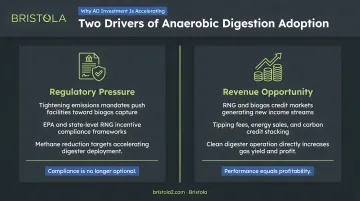
Together, compliance pressure and stacking revenue streams are compressing payback timelines in ways that were difficult to achieve even five years ago.
Best Anaerobic Digestion Systems for Food Processing in 2026
The systems below were evaluated on proven food processing deployments, technology maturity, feedstock flexibility, O&M support, and energy recovery track record. Financial stability factored in as well — a capable technology platform means little if the counterparty can't support a 15-year project.
Anaergia
Anaergia (Burlington, Ontario) offers an end-to-end organics-to-energy platform covering extraction, high-solids AD, and biogas upgrading to RNG. Their technology handles multi-feedstock streams — food waste, biosolids, and yard waste — with proprietary pre-processing equipment that separates contaminants before digestion.
Important caveat: Anaergia's Rialto Bioenergy Facility entered Chapter 11 restructuring in May 2023 after feedstock shortfalls tied to delayed California SB 1383 enforcement. Prospective clients should conduct thorough counterparty due diligence before entering long-term contracts.
| Attribute | Detail |
|---|---|
| System Type | High Solids AD (HSAD); two-stage configurations |
| Best Suited For | Mixed food waste, biosolids codigestion, high-solids municipal organics |
| Key Differentiator | Turnkey delivery from organics extraction through RNG upgrading; proprietary pre-processing for contaminated feedstocks |
Weltec Biopower
Weltec (Vechta, Germany) has deployed 400+ plants across 27 countries using modular stainless-steel CSTR digesters. Their ProMoS Bio digital management system provides remote monitoring and performance data — a real operational edge for processors without dedicated biogas engineering staff.
North American presence dates to 2005, with a U.S. subsidiary (AMBICO) founded in 2007. A EUR 100 million investment fund established in 2021 supports ongoing plant acquisition and expansion, with new commissions recently in Japan and Taiwan.
| Attribute | Detail |
|---|---|
| System Type | Complete mix CSTR; modular stainless-steel design |
| Best Suited For | Breweries, distilleries, dairy, industrial organic waste; mid-scale plants |
| Key Differentiator | Modular expandability; ProMoS Bio remote monitoring; strong reference portfolio in food/bev |
Biothane (Veolia Water Technologies)
Biothane, operating under Veolia Water Technologies, is the strongest candidate for food processing wastewater applications. With 40+ years of granular sludge bed experience and 700+ global installations — including 100+ brewery-specific plants — they bring a depth of food industry references no competitor matches.
Their core technologies are high-rate reactors: the UASB (Upflow Anaerobic Sludge Blanket) and EGSB (Expanded Granular Sludge Bed). Both require significantly smaller footprints than conventional CSTR systems and handle high volumetric loading rates efficiently — important given that breweries alone generate 2–6 hectoliters of wastewater per hectoliter of beer produced.
| Attribute | Detail |
|---|---|
| System Type | Biothane Advanced UASB; Biobed Advanced EGSB; Biobulk for solid organics |
| Best Suited For | High-COD liquid effluents: breweries, soft drinks, dairy, potato processing |
| Key Differentiator | Highest reference count in food processing wastewater; compact footprint; Veolia Group financial backing |
EnviTec Biogas
With 700 biogas projects across 18 countries and 577+ MWel of installed capacity, EnviTec Biogas (Lohne, Germany; U.S. offices in Oregon, New York, and South Dakota) has one of the more credible track records in the sector. Their EnviWaste system targets food-specific organic streams: slaughterhouse waste, fats and glycerine, brewery malt spent grains, and manufacturing byproducts.
The EnviThan gas upgrading system enables RNG production directly from plant output. EnviTec also operates its own fleet of plants — a strategic choice that keeps their operational expertise current and grounded in live operational data.
| Attribute | Detail |
|---|---|
| System Type | Heated CSTR; two-stage configurations; EnviWaste food waste system |
| Best Suited For | Food waste, slaughterhouse byproducts, brewery residues, fats and glycerine |
| Key Differentiator | Full-service O&M packages; EnviThan RNG upgrading; $391M revenue base confirms financial stability |
Vanguard Renewables
Vanguard Renewables (Wellesley, MA) operates a build-own-operate (BOO) approach that eliminates upfront capital requirements for food processors entirely.
Under the Farm Powered model, food manufacturers and retailers pay tipping fees to deliver organic waste — Vanguard handles everything else, from logistics to RNG production. In April 2026, Vanguard completed three new RNG facilities, expanding its food-waste-based RNG portfolio.
| Attribute | Detail |
|---|---|
| System Type | Farm Powered BOO; codigestion of dairy manure and food processing waste |
| Best Suited For | Mid-size processors without capital for own system; multi-source food waste generators |
| Key Differentiator | Zero capex for food processor; tipping fee structure offsets disposal costs; RNG revenue stays with operator |
Note: With D3 RINs softening to ~$2.40 and Jefferies forecasting a long-term price of $2.20, BOO operators face margin compression — evaluate tipping fee structures carefully.
Key Factors to Consider When Choosing an AD System for Food Processing
Feedstock Characterization Comes First
Food processing waste streams vary more than most buyers realize before their first feasibility study. High-fat slaughterhouse effluent behaves completely differently from high-sugar beverage waste or mixed solid organics from produce processing. Selecting a system designed for the wrong feedstock profile is the single most common mistake in AD procurement.
A pre-engineering feedstock assessment — covering COD, volatile solids content, pH, nutrient ratios, and seasonal variability — must happen before system selection, not after.
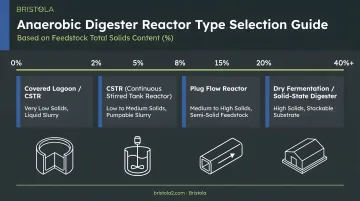
Solids Content Determines Reactor Type
The wet/dry threshold matters enormously for equipment selection:
- Below 15% total solids (TS): use wet digestion systems — UASB, EGSB, or CSTR with liquid mixing
- Above 15% TS: high-solids or dry digestion systems are required
- Wrong match leads to pumping failures, inadequate mixing, reduced biogas yield, and accelerated equipment wear
High-rate systems like UASB and EGSB suit liquid-dominant wastewater streams. CSTR and plug-flow digesters handle mixed solid organics better.
Temperature Regime Trade-offs
| Parameter | Mesophilic (95–100°F) | Thermophilic (122–131°F) |
|---|---|---|
| Process stability | Higher | Lower (more sensitive) |
| Energy input | Lower | Higher |
| Pathogen reduction | Partial | More complete |
| Biogas yield | Moderate | Typically higher |
Processors handling slaughterhouse or rendering waste may face regulatory requirements favoring thermophilic operation for pathogen kill. Confirm local requirements before locking in temperature regime.
Biogas End-Use Strategy
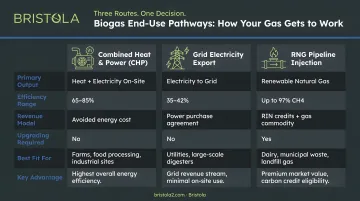
Temperature regime also shapes which biogas end-use options are viable. Decide on end-use before selecting a system — the economics and equipment differ substantially:
- On-site heat and power (CHP): lowest infrastructure cost; offsets energy bills directly
- Grid electricity sales: requires an interconnection agreement and is subject to utility pricing
- RNG for pipeline injection or transportation: highest revenue potential, but demands upgrading equipment, gas quality certification, and often LCFS/RFS registration
RNG from food waste has a levelized cost range of $8.60–$51.20/MMBtu depending on scale and configuration — project economics require careful modeling at current D3 RIN price levels.
Scalability and Integration Costs
Infrastructure costs routinely surprise buyers:
- Pre-processing equipment (de-packaging, screening, grinding)
- Effluent polishing and discharge compliance
- Digestate handling, storage, and land application permits
- Building permits and utility connections
Modular systems (Weltec, EnviTec) offer lower long-term risk as production volumes change. Build the expansion pathway into your evaluation criteria from day one.
Keeping Your AD System Running at Peak Performance
Selecting the right AD system is only half the equation. How you maintain it over a 15–20 year operating life determines whether the project delivers on its financial promise.
The Sediment Problem
As solids accumulate on the digester floor, active digestion volume shrinks. Mixing efficiency drops. Biogas yield follows. In one documented case involving a 1.2 million gallon EnviTec digester that hadn't been cleaned in four years, daily biogas production had dropped by 20% and volatile solids reduction had fallen below 25%. The facility also lost the ability to maintain mesophilic temperatures during winter months.
That's not an outlier — that's what uncleaned digesters do.
The Traditional Cleaning Problem
Conventional cleaning requires emptying the tank, halting production, and sending workers into a confined space. The financial hit is substantial: one case study analysis estimates $200,000 in lost revenue per cleaning cycle under traditional methods. For high-throughput food processing AD systems where feedstock arrives continuously, extended shutdowns aren't just costly — they can compromise the biological process itself.
Confined space entry also carries serious safety liability. Founder Jared Burma started Bristola in 2019 after a near-fatal experience inside a tank — a close call that shaped everything about how the company approaches tank cleaning.
Bristola's Zero-Downtime Solution
Bristola's patented Equalization Chamber Entry System allows a remote-controlled submersible ROV to enter an active, pressurized digester through any manhole 24 inches or greater — without draining the tank, halting production, or requiring human confined space entry.
The system works because liquid must remain present for sediment dilution and transport through the flexible hose to the customer's chosen processing point. Cleaning and production happen simultaneously.
Food processors including JBS and ADM have relied on Bristola's robotic cleaning system to protect biogas output and eliminate confined space risk at their AD facilities.
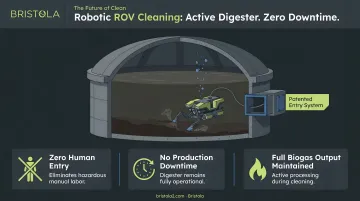
The system retrofits to existing digesters. An initial manual cleanout prepares the tank, then the entry portal is installed on the manhole — all future services run without ever draining the tank again.
Bristola also provides sonar-based sediment mapping with GPS precision. The service produces 3D renderings covering:
- Sludge depth and sediment volume across the digester floor
- Settlement variation between zones
- Objective scheduling baselines that replace guesswork with data
How We Chose the Best Systems
Evaluation Criteria
Systems were assessed on:
- Verified deployments at food processing facilities, not just agricultural or municipal sites
- Confirmed commercial availability in 2026 with demonstrated technology maturity
- Feedstock flexibility validated across common food processing waste streams
- Financial stability of the technology provider and their long-term viability
- O&M support infrastructure with credible long-term service capacity
- Documented biogas yields and RNG production references from comparable facilities
Common Procurement Mistakes
Food processors who regret their AD investments typically made one of these errors:
- Chose lowest capital cost without modeling total cost of ownership over 10–15 years
- Failed to budget for digestate disposal — hauling costs that can run $20–$30/ton
- Selected a system without validating it against their specific feedstock, not a generic "food waste" profile
- Overlooked the maintenance burden, then watched biogas yields decline without understanding why
A lifecycle cost model built before vendor selection — covering capital, O&M, digestate disposal, and projected biogas revenue — is the single most effective way to avoid all four.
Conclusion
The best anaerobic digestion system for a food processing facility in 2026 isn't a universal answer. Biothane's high-rate reactors suit liquid-heavy effluent streams. EnviTec's EnviWaste system handles slaughterhouse byproducts and solid food waste. Weltec offers modular scalability for mid-size operations, while Vanguard eliminates capex for processors who'd rather pay tipping fees than own infrastructure.
Across all of them, one pattern holds: performance degrades without maintenance, and traditional maintenance has meant production downtime and confined space risk. That's the problem Bristola was built to solve.
Whether you're evaluating a new AD system or working to restore performance from an existing one, Bristola's zero-downtime robotic cleaning system protects biogas output, eliminates confined space risk, and keeps food processing AD facilities running without interruption to production. Reach out to the Bristola team to discuss your facility's needs.
Frequently Asked Questions
How much does an anaerobic digestion system cost for a food processing facility?
Capital costs vary widely based on system capacity, feedstock type, and biogas end-use infrastructure. Smaller on-site units can start below $1 million, while standalone food waste digesters with RNG upgrading can reach $20–$30 million or more. Project-specific feasibility studies are essential before any budget commitment.
What are the 4 stages of anaerobic digestion?
The four biological stages are hydrolysis, acidogenesis, acetogenesis, and methanogenesis. Each stage depends on the previous one — a pH imbalance during acidogenesis, for example, can inhibit methanogenesis and sharply reduce biogas yield and system stability.
What are the main types of anaerobic digesters for food processing facilities?
The most common types are CSTR, UASB, EGSB, plug flow, and two-stage systems. High-rate systems like UASB and EGSB suit liquid food processing effluents; CSTR systems handle mixed solid organic waste more effectively.
Are anaerobic digestion systems for food processing facilities profitable?
Profitability depends heavily on biogas end-use strategy (RNG commands the highest value), tipping fee revenue, local utility rates, and incentives like D3 RINs and state LCFS credits. Payback periods typically range from 5–12 years, with well-managed systems hitting 5–8 years under favorable conditions.
What feedstocks from food processing are best suited for anaerobic digestion?
Fats, oils and greases (FOG), beverage processing waste, dairy effluent, slaughterhouse byproducts, and high-sugar fruit and vegetable processing waste are among the highest-yielding feedstocks. High organic content — measured as COD or volatile solids — directly correlates with biogas output per ton processed.
How often do anaerobic digesters in food processing facilities need to be cleaned?
Cleaning frequency depends on feedstock solids content and system design. In high-throughput food processing systems, sediment buildup can reduce active digestion volume and biogas yield within months. Bristola's robotic cleaning system lets facilities clean without production downtime or confined space entry.